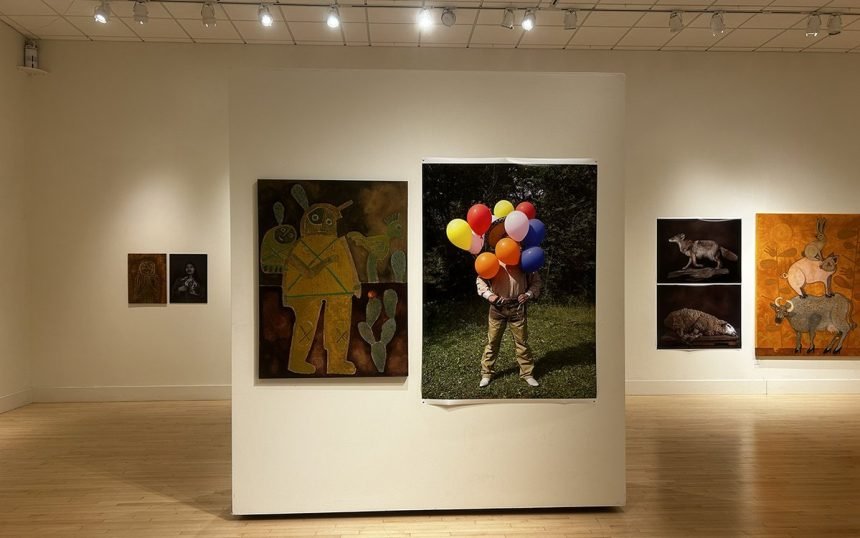
Photographer Xavier Tavera and painter Luis Fitch both grew up with a love for lucha libre, a Mexican wrestling style. Their dual exhibition, La Lucha Sigue / The Struggle Continues, on display in the Inez Greenberg Gallery at the Bloomington Center for the Arts through August 30, showcases a different kind of fight, one to honor Latino people and cultures.
“Latinidad is not a monolith,” Tavera said. “But within that, making difference, but also knowing what unites us, is very important.”
Both Mexican immigrants—Tavera from Mexico City and Fitch from Tijuana—the two artists use different mediums and hold different stories within their art. While Fitch’s paintings draw upon familial and personal memories, often borrowing materials from both sides of the U.S.-Mexico border, Tavera’s photographs document the lives of immigrants from the border to Minnesota and the realities of the border itself.
Tavera and Fitch have known each other for 27 years and have worked on multiple projects together, “but never in a symbiotic way,” according to Tavera. When organized side-by-side, their paintings and photographs uplift details and themes that might be harder to see when their works are displayed individually. By telling different stories next to each other, the duality creates a new story.
Upon entering the exhibition, viewers are met with photographs taken at the border, paired with paintings that echo themes of border crossings, confinement, and lineage. From there, the exhibition moves to paintings and photographs that center “immigrants, individuals, friends of ours, people that we know, places that we go to eat, a local clown who’s Latino with his family, and so on,” as Fitch put it.
The exhibition concludes with another type of border crossing: a photograph of a Latino astronaut paired with a galactic painting titled Universo.
These photographs and paintings weren’t created with the other in mind, though. Instead, the conversation between each piece formed after Fitch was contacted to organize the dual exhibition and began looking through Tavera’s photography, which spans more than 35 years.
“I think if we would have planned it, we would have never done it,” Fitch said.
By the time Fitch was ready to send a slideshow of paired works and ask Tavera to participate in the dual exhibition, he had already amassed a collection of more photographs and paintings than the gallery could house.
For Tavera and Fitch, part of the struggle that La Lucha Sigue displays involves showing that Latino people deserve to be recognized in art and galleries in the first place.
“A lot of [Latinos are] scared of institutions like a museum,” Fitch said. “They’ve never been there, or there’s nothing for them there, or the language is an issue, or they don’t see themselves represented in the museum. In this exhibit, what we were trying to do is change that. By us promoting the exhibit like a wrestling match, and us being dressed as wrestlers, a lot of our community thought that there was going to be a wrestling match for real.”
True to their promise, Fitch and Tavera first showed up to the exhibition’s opening night in July dressed in plain clothes before reappearing dressed as luchadores. While there was no wrestling match, attendees could take photos with the artists-luchadores in the exhibition.
“The struggle of documenting, being able to take a break from what we do to paint and whatnot—that’s a struggle by itself,” Fitch continued. “And then being able, as Latinos, to have a show like this is a struggle for us too. We don’t have galleries that represent us. It’s very hard for us to get into museums.”
That problem of representation has been compounded by the aggressive immigration enforcement that restricted access to art galleries, as well as libraries, grocery stores, and other necessities for many undocumented and immigrant communities during Operation Metro Surge. Tavera recalled how his 45-minute commute to teach at Carleton College in Northfield changed in January, when he started bringing his passport and whistle with him.
“One day I got the notice like, Don’t come, ICE is in the parking lot,” Tavera said. “What does that mean to me? What does that mean to my students? That some of them are undocumented, some of them are international students, still fearing going to Minneapolis at all because something might happen, some of them are refugees. And all of a sudden, the community gets bigger. It’s not just the Latino community.”
“That’s what made this movement in Minneapolis what it is, and it has a ripple effect around the country,” Tavera continued. “Because it’s saying, ‘Okay, let’s care for each other.’”
Fitch feels similarly. “Our community went through a lot of shit, and this is part of it,” Fitch said. “We want to put a face to the immigrants of our culture: that we’re not scary people.”
Fitch and Tavera both hope that the exhibition encourages personal connections for non-Latinos as well. That’s one of the reasons that none of the pieces have a displayed title or explanation, though the cost and title for each piece can be found at the gallery’s entrance.
Tavera sees this decision as encouraging viewers to “come up with your own stories. From my story to Luis’s story to the combination of the two stories, add your own story.”
“That’s the story that people are going to live with,” Tavera continued.