Photo by Ethan Miller/Getty Images
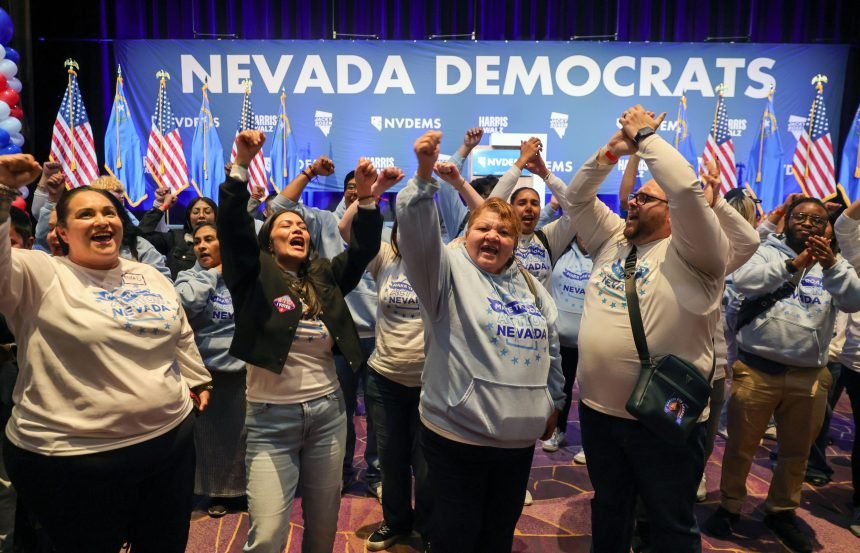
The Democratic National Committee locked in its 2028 presidential primary calendar on Saturday, and for the first time, two states with sizable Latino populations will help shape the party’s nominee before most of the country casts a single vote. Meeting in Austin, Texas, DNC members gave final approval to a six-state early lineup that keeps Nevada in the second slot and adds New Mexico to the early calendar for the first time, according to CNN.
The New Order, State by State
South Carolina holds onto the leadoff spot it has occupied since 2024, voting January 22, 2028. Nevada follows on February 1, then New Hampshire on February 8, New Mexico on February 15, Michigan on February 22, and Virginia closes out the group on February 29, per the finalized schedule reported by ABC News. Iowa, which anchored the caucus season for decades, didn’t make the early cut at all — a decision party officials still tie back to the vote-counting breakdown that marred the 2020 Iowa caucuses.
The decision didn’t go unchallenged. Iowa Democratic Party Chair Rita Hart argued the state should keep a spot among the earliest contests, warning that skipping it risks alienating rural and Midwestern voters the party needs. Members ultimately approved the calendar on a voice vote that drew sustained applause from the room, according to CNN’s account of the meeting.
Why Nevada and New Mexico Carry So Much Weight
The placement of Nevada and New Mexico near the front of the calendar wasn’t incidental. Roughly 31% of Nevada residents and 49% of New Mexico residents identify as Latino or Hispanic, based on current census-based estimates. Party strategists have linked the move directly to the party’s slipping Latino support in the last presidential race. According to Pew Research Center’s analysis of the 2024 election, Joe Biden carried Hispanic voters by 25 points in 2020, while Kamala Harris’s margin among the same group shrank to just 3 points four years later — a decline Democrats are now trying to reverse well before the next campaign gets underway.
DNC Chair Ken Martin has called the new calendar the most diverse the party has ever adopted, framing it as a test of which 2028 hopefuls can build support across the party’s full coalition rather than lean on a narrow, early base. “These states reflect the diversity of America,” Martin wrote on social media after the vote, according to Al Jazeera.
New Mexico’s Border-State Case
For New Mexico — rural, heavily Spanish-speaking, and sharing a border with Mexico — an early primary slot is uncharted territory. Democratic Rep. Teresa Leger Fernandez argued the state reflects the coalition the party needs on a national scale. “New Mexico looks a lot like the America Democrats need to win,” she told CNN ahead of the final vote. She added that when presidential hopefuls show up to court Latino voters there directly, Latino communities nationwide will read it as a sign they’re finally being taken seriously in the nominating process — not treated as an afterthought once the general election arrives.
The Latino Advocacy Behind the Shift
The outcome caps a sustained lobbying effort by Latino political organizations, one that intensified in the weeks immediately before the vote rather than fading into the background. Just seven weeks before the DNC’s final decision, CHC BOLD PAC — the campaign arm of the Congressional Hispanic Caucus, chaired by Rep. Linda Sánchez — formally urged the party’s Rules and Bylaws Committee to make Nevada the nation’s first presidential primary for 2028, citing the state’s rapidly growing Latino electorate, according to the organization’s own press release.
That push built on groundwork laid earlier by Latino Victory, whose president, Katharine Pichardo, had warned DNC members that clinging to the traditional order or favoring less diverse states would leave the party’s eventual nominee weaker in the general election. “Nevada is a diverse battleground that will produce a battle-tested nominee,” Pichardo wrote in a letter to influential DNC members, according to CBS News.
Political Stakes Heading Into 2028
Nevada and Michigan double as general-election battlegrounds Donald Trump carried in 2024, meaning any candidate who wants to win the early states will effectively be tested against the broader electorate Democrats need to win back — not just against loyal primary voters. The reshuffle also revives old friction: New Hampshire, which ran the first-in-the-nation primary for a century, now votes third, even though state law still requires the state’s top election official to schedule its primary at least seven days ahead of any other state’s, a wrinkle noted by PBS NewsHour.
The vote also lands amid an unresolved argument inside the party over ideology, not just geography. Former South Carolina DNC member Boyd Brown suggested Southern primary voters lean more moderate than Democrats elsewhere. Democratic strategist Nina Smith pushed back on that framing, noting that South Carolina’s Black electorate has twice passed over more progressive candidates in favor of Hillary Clinton and Joe Biden. “Southern Black voters are more progressive than they’re given credit for,” Smith said, according to AP wire reporting carried by NBC New York. That same tension is likely to resurface in Michigan, where progressive Senate nominee Abdul El-Sayed’s narrow primary win this month suggests the state’s early slot could become another proxy fight between the party’s left and center.
With the calendar locked in, expect Latino outreach in Nevada and New Mexico to ramp up well before voting opens in 2028, and prospective candidates to start building Spanish-language and border-state operations earlier than in past cycles. For Latino communities in South Florida, Houston, Chicago, and beyond watching how national Democrats court the diaspora vote, the calendar shift signals that party leaders now see Latino voters as central to picking a nominee — not simply a bloc to be courted after the primaries are already decided.
© {{Year}} Latin Times. All rights reserved. Do not reproduce without permission.