Whiz! Bang! Pow!
It’s not ’60s-era Batman, it’s a large metallic-green beetle. And it’s heading straight for your face.
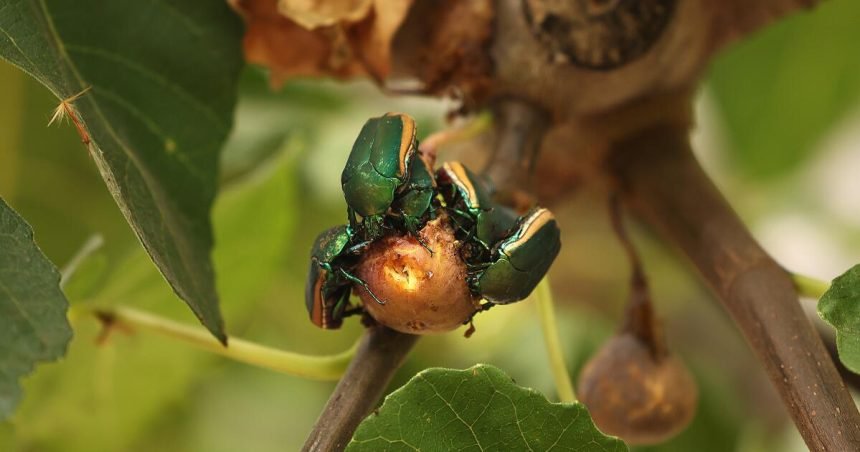
Parts of Los Angeles are abuzz with hordes of figeater beetles, also known as green fruit beetles or Cotinis mutabilis. About an inch long, they’re hard to miss — and are known for careening into unsuspecting bystanders.
That’s not typical behavior for insects, according to Megan Barkdull, assistant curator of entomology at the Natural History Museum of Los Angeles County.
“I think a lot of the reason why they’re so clumsy is because they’re so large and they’re flying with these relatively small wings, so it’s pretty hard for them to kind of control that flight trajectory and avoid bumping into you,” Barkdull said.
There’s a common misconception that the beetles are blind. But their eyes function just fine, she added.
-
Share via
August is peak season for the bugs in L.A., she said, citing data from iNaturalist, a citizen science app. Sightings begin around June and ramp up in July before slowly tapering down through the fall.
Part of the scarab family, the beetle has an apt name: they munch on soft-skinned fruits such as figs and grapes.
They appear to be thriving, and not just in the City of Angels. In recent years, they’ve expanded their range. In 2009, they were first spotted in Utah. Three years later, they were found in Colorado. Southern California is firmly within their native range, but Barkdull believes their population size here has likely increased.
What’s behind the beetlemania? Barkdull pointed to a combination of factors driven by us: humans. We have created compost piles, where beetle larvae often feed. We irrigate our lawns and other greenery, which is a boon to the beetles because they need moist landscapes. We plant fruit trees, which provide the insects with sustenance. Climate change is also believed to be making more areas hospitable for them.
Though the beetles snack on fruits we might also desire, they’re generally not considered pests, said Karey Windbiel-Rojas, an associate director with the University of California’s statewide integrated pest management program.
That’s because they generally chow down on decaying fruit. Their larvae, called grubs, often feast on the organic matter in compost.
“They do have a role in the ecosystem,” Windbiel-Rojas said. “They help break down decaying matter.”
(Fun facts: the grubs can grow to the size of a pinky finger. They’re so hefty and their legs are so small that they flip over and crawl on their backs.)
People often mistake figeater beetles for Japanese beetles, which are a major pest, Windbiel-Rojas said. Also members of the scarab family, they consume the leaves of crops and ornamental plants. There aren’t many of those critters in the Golden State and, when they’re found, officials seek to eradicate them.
If a figeater beetle ends up in your house, Windbiel-Rojas recommends gently putting it back outside. Smashing it would be an icky mess and pesticides are not the way to go, she said.
She has some recent experience. On a trip to UC Irvine for orientation with her son, one flew into her long, curly hair. It was tricky, but she extricated it.
Then, during lunch indoors, one made a beeline for her salad. The entomologist caught it with her hand.
“I showed these girls who were like, ‘What is that? Oh my god! Oh my god!’ And I said, ‘It’s just a little beetle. They don’t bite. They’re not really pests.’ And I said, ‘You want to see?’ And they mostly didn’t.”
She let it out and earned an ovation.