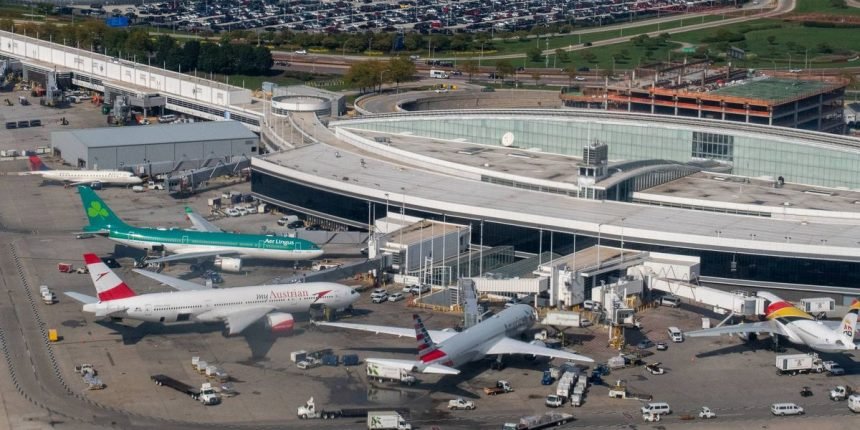
It feels like the search for a faster way to get from downtown to O’Hare International Airport started moments after the Wright Flyer took off from Kitty Hawk. Chicago is fortunate to have direct rail service between the central business district and our airports (just ask commuters in New York and Los Angeles), and the Blue Line ride between the Loop and the big airport is often faster than a cab or rideshare trip, for as little as $2.25 (it’s $5 when leaving from O’Hare).
But that ride, which at its best is about 40-45 minutes, can easily be stretched out by slow zone delays, and can feel much longer if the rider has to endure dirty seats and challenging odors (the least objectionable of which is weed). The CTA has worked diligently to improve the rider experience, but that hasn’t stopped others from looking for a different path.
Years ago, the developers who built the Loop shopping and condo complex known as Block 37 roughed out a space beneath the building intended to be used one day as a station for potential future high-speed rail service to O’Hare. In 2018, then-Mayor Rahm Emanuel announced a proposal from Elon Musk’s The Boring Company to use that station as the base for a high-speed shuttle service using electric “skates” (based on Tesla’s Model Y crossover vehicle) to whisk passengers to and from O’Hare in less than 20 minutes for about $25.
But a year later, Emanuel was out of office, and questions arose over The Boring Company’s ability to complete the $1 billion dollar project (indeed, the company’s only completed underground project comprises about two miles of tunnels around the Las Vegas Strip), so the “Chicago Express Loop” hit a dead end.
Now, however, shifts in freight rail traffic have opened up a potential lane for a new express service to O’Hare. The interests behind the proposed “O’Hare Flyer” say they plan to run electric trains on largely under-used and unused tracks between the airport and a depot just west of the Old Post Office, promising station-to-station service in 15 minutes.
“Chicago has had projects that have not succeeded in the past. We’re not going to be one of them,” O’Hare Flyer CEO David Luncy confidently told my colleague Carolina Garibay this week, saying the $2.2 billion service relies on 100% private funding, and could be in service within five years. “We really are hoping that we are solving a problem for the city.”
The O’Hare Flyer website includes a computer-rendered video showing travelers boarding carpeted, well-appointed trains from modern stations and arriving at what will one day be O’Hare’s Global Terminal. It’s an experience very similar to privately-run airport shuttle trains in cities such as London, where a ride from Stansted Airport to the central city costs the equivalent of $30.
What the O’Hare Flyer website doesn’t include is any mention of what a ticket will cost. The people behind the proposal have said it’ll be cheaper than a rideshare trip, which can cost about $50. There certainly are people who would gladly pay that kind of money for a 15-minute ride to the airport (or vice versa) … and because it’s not publicly-run, the owners may not need to subsidize ridership.
But many factors need to line up before the first train ships out, including regulatory approval and a sign-off from city leaders. And while Chicago Mayor Brandon Johnson says “there’s a lot more investigation to do around this proposal,” he seems generally inclined to support it, mostly because of what it says about the city under his administration.
“This is, I believe, a healthy response to the Chicago that I’m building,” the mayor told reporters this week. “I believe it sends a strong signal.”
Whether that signal is loud enough for the necessary parties to get on board remains to be seen.