Every year in its restaurant issue, Food & Wine magazine chooses not only its highly publicized list of the Best New Chefs in America but also a Restaurant of the Year — a singular distinction awarded to one spot that delivers exceptional food, a strong point of view, and a dining experience that says something about the times we’re living in. This year’s selection will be a name familiar to Chicago diners and also, perhaps, a bit of a surprise: John’s Food & Wine, the neighborhood bistro in Lincoln Park. (You can read their article here.)
In explaining the magazine’s selection of John’s from a list of about 10 serious contenders, executive editor Karen Shimizu told me in an email that it stood out for “Its tightly curated romp of a chef-led menu, curiosity-sparking wine list, and warm and welcoming atmosphere — on each visit I felt like the restaurant was in the flow state, and pulled diners right into it, too.” Shimizu left a message for co-owner Adam McFarland with a ruse about a Mother’s Day recipe, then broke the news when he called back. “Now that was a cool moment,” he says.
McFarland and his business and cheffing partner Tom Rogers opened John’s (named for both their fathers) nearly three years ago in the former Nookies Too space. Their stolid American menu reads as familiar but fresh and completely devoid of clichés and trends. Lobster salad and french fries with leek aïoli emerged as instant classics. Moreover, the portions are generous, the flavors sneakily complex, and the early reviews of the food were overwhelmingly positive.
The service model at John’s, however, didn’t sit well with many diners, some even comparing it to McDonald’s. There were no dedicated servers; instead, the restaurant had a support staff who could deliver food and bartend. Guests were (and still are) asked to read the posted menu at the host stand, make their selections, and lay down a credit card for the eventual bill that would arrive with a 20% autogratuity affixed. Commenters on online forums were outraged, one writing on Tripadvisor, “I’ll accept that for white linen table service but not on pay in advance counter service.” (Adding another wrinkle, John’s didn’t accept reservations, though that policy has since changed.) Professional reviewers also balked, calling the service chaotic and nerve-wracking. I had less of an issue, writing in my three-star review: “On a busy night, you may have to wait in the front with a glass of wine, but when your table is set, you can order, take your place, and be stuffing your face within minutes. Even if the service hits snags — and it will — you’ll focus on this restaurant’s strength, which is its food.”

Despite the criticism, McFarland and Rogers stuck to their guns because the model allowed them to pay their staff a living wage with salary and the gratuity distributed on a point system that rewards employees for time spent and the quality of their work. According to them, staffers earn between $70,000 and $90,000. (I wrote about their system for Plate magazine in 2024 and they were transparent, showing me both sales and payroll.)
This approach also impressed Food & Wine. Editor in chief Hunter Lewis noted in an email to me that McFarland and Rogers are “rethinking what a successful restaurant can look like for its employees. Adam and Tom have built a neighborhood restaurant that feels deeply personal, and their business model gives us hope and a roadmap for others in the restaurant industry who are looking for a more sustainable way to grow their businesses.”
This model, which does give short shrift to the traditional front of the house, has allowed the owners to keep the kitchen as the main priority, according to McFarland. “We’re able to focus on cooking and bringing in the best talent,” he says. Indeed, their kitchen has drawn some of the most promising cooks in the city. Notable alums of their kitchen include Cellar Door Provisions chef de cuisine Alex Cochran and Oriole executive sous chef Evelyn Aloupas. But whoever joins the team has to understand that Rogers and McFarland write the menu and have a specific notion of what a John’s dish should be. “We like to have three flavors going on and one creating tension,” says McFarland. So a brûléed sweet potato may find a soulmate in its red eye aïoli, both then set into high relief thanks to a flurry of shaved, super-sharp clothbound cheddar.
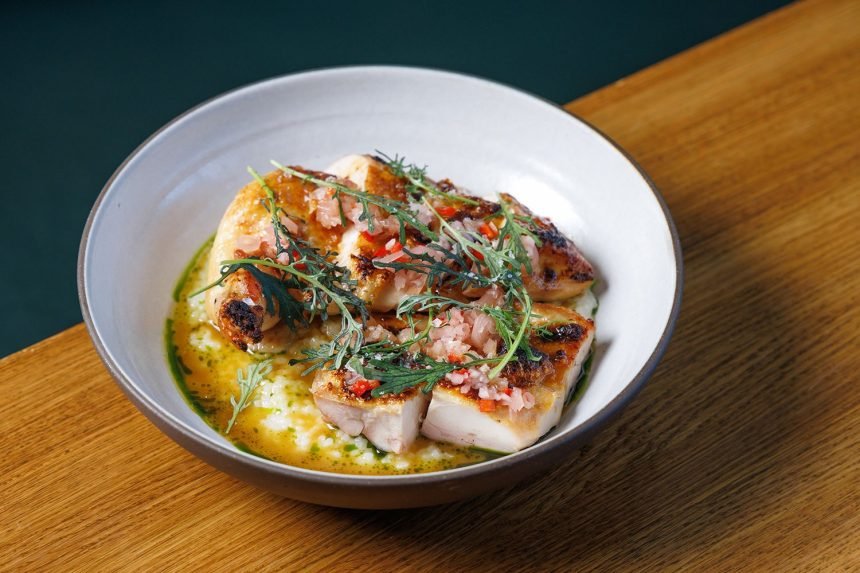
John’s has always passed my ultimate test, which is that I can remember dishes I ate there with clarity weeks or even months later. The last salad I ate there? Etched in memory for the way it revealed a shocking and surpassingly delicious swoop of black garlic yogurt on the bottom of the plate once I ate my way down. “We take a lot of pride in layering flavors,” McFarland says. And technique, adds Rogers: “We really care about the crispy skin on a pan-roasted chicken.”
The menu changes with the seasons and over time, but gradually. If you loved a dish at John’s three months ago, it may still be there. The hours of operation, however, are all over the board. It is open for lunch, then not (it is currently open for lunch on Saturdays). It has a happy hour, then not. “We’re trying to be responsible to our team,” Rogers says. “Business in Chicago in winter is different than in summer. We shrink some of the hours and services to shift with the seasons.”
The pair did try to instigate a $185 tasting menu, but quickly realized they couldn’t pull off the wine service needed for such a meal. The restaurant, with its terrific beverage program, has always had more of a wine bar vibe. It’s about pouring glasses and popping bottles. They offer a nightly “chef’s pour” — a generous $25 slug of the kind of wine you’ll rarely find by the glass. Last time I ordered one it was a fantastic red Burgundy.
Now they have an $89 four-course menu on offer for people who want to taste a variety of dishes without passing around share plates. They’re getting to know their customers and trying to predict what they’ll want next. “We’re still trying to figure out the best version of John’s,” McFarland says.
May they never stop.
John Kessler is a freelance dining critic for Chicago magazine.