By Luis Montoya
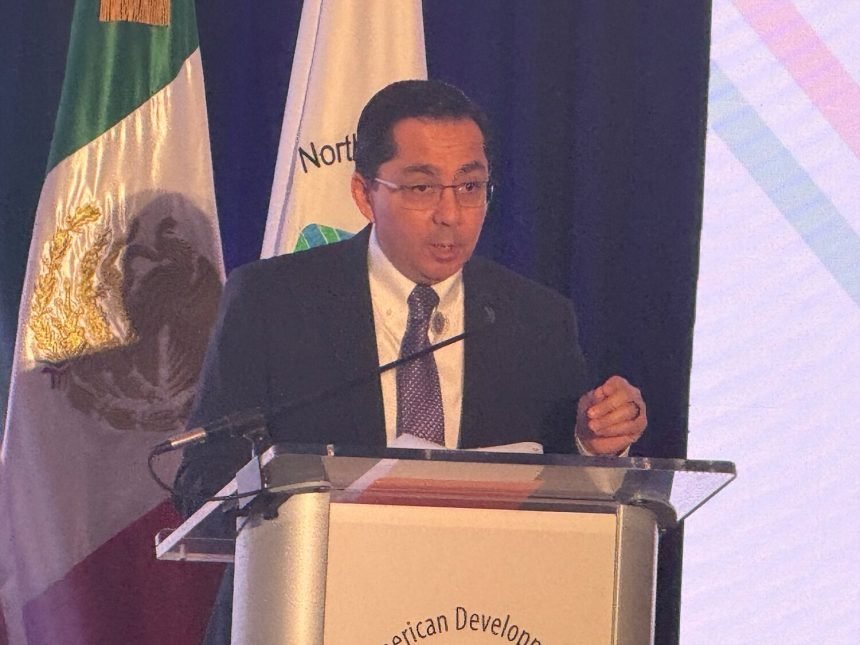
SAN ANTONIO, Texas — Emphasizing that Texas sits at the very heart of the U.S.-Mexico economic engine, Roberto A. Coronado, senior vice president and senior economist at the Federal Reserve Bank of Dallas, delivered a keynote address outlining the deep integration, recent challenges, and future trajectory of binational trade.
Speaking on Aug. 28 at the 2026 NADBank Summit in San Antonio, Coronado’s presentation, titled “Texas-Mexico Economy Dynamism & Interconnectedness,” detailed how cross-border supply chains are evolving amid trade policy shifts, artificial intelligence expansion, and industrial transitions along the Rio Grande.
Texas as the Economic Anchor
Coronado pointed out that Texas accounts for more than 64 percent of the total U.S.-Mexico border region, making the Lone Star State the nation’s premier exporting hub.
“Texas sits at the center of the U.S.-Mexico economic relationship,” Coronado said, noting that Mexico remains the state’s top trading partner. In 2025, roughly 28 percent of Texas exports—valued at $125 billion—went to Mexico. Furthermore, three-fourths of all land trade along the entire U.S.-Mexico border crosses through Texas ports of entry, anchored primarily by Laredo and El Paso.
Energy trade remains a critical pillar of this exchange. Mexico currently sources 75 percent of its natural gas from the U.S., much of it originating in Texas, with demand expected to grow steadily. Overall U.S.-Mexico goods trade reached $872 billion last year, expanding six-fold in real terms since the inception of NAFTA.
Editor’s Note: Here is a video recording of Roberto Coronado’s remarks at the 2026 NADBank Summit:
Paso del Norte: Advanced Manufacturing & AI Frontiers
Drawing on his background as a border native, Coronado highlighted the Paso del Norte region—encompassing El Paso, Texas; Las Cruces, N.M.; and Ciudad Juárez, Chihuahua—as a live microcosm of North American integration. Accounting for 23 percent of total U.S.-Mexico land trade worth $178 billion last year, the region is currently undergoing a structural transformation.
While Juárez saw a loss of 57,000 maquiladora jobs from mid-2023 through mid-2025—primarily concentrated in traditional automotive and transportation manufacturing—the regional economy is pivoting toward high-value, advanced manufacturing, including automation, medical devices, and hardware for artificial intelligence.
“Mexico is a critical partner in the artificial intelligence build-out here in the U.S., accounting for one-fourth of products related to artificial intelligence,” Coronado explained, adding that Juárez is increasingly attracting firms building data center servers under USMCA frameworks.
Trade Policy and Inflation Mitigation
Highlighting recent research from Dallas Fed economists Enrique Martínez-Garcia and Ron Mau, Coronado detailed how the U.S.-Mexico-Canada Agreement (USMCA) functioned as a key buffer against rising global tariffs in 2025.
As external tariffs rose, regional compliance spiked dramatically. By July 2025, approximately 80 percent of imports from Mexico entered the U.S. duty-free under USMCA, up from roughly 50 percent previously.
This utilization reduced realized average tariffs by about 1 percentage point by late 2025, dampening consumer price pressures:
- Overall PCE Price Level: Saved approximately 9 basis points.
- Goods Sector: Reduced price impacts by 21 basis points.
- Durable Goods: Reduced price impacts by 30 basis points, reflecting the high imported content (30%) in durable manufacturing.
Looking Ahead to USMCA 2.0
With the initial six-year joint review of USMCA commencing on July 1, 2026, Coronado cautioned that trade uncertainty remains a primary concern for business leaders, potentially delaying investment and expansion decisions while negotiations continue.
“We are at an inflection point,” Coronado concluded, quoting Alexandre Tombini of the Bank for International Settlements: “The rules of the game are being rewritten; the new equilibrium is not yet defined.”
Despite headwinds and ongoing policy reviews, Coronado underscored that decades of shared history, logistics infrastructure, and human capital make the Texas-Mexico economic partnership resilient enough to navigate the changing global landscape.