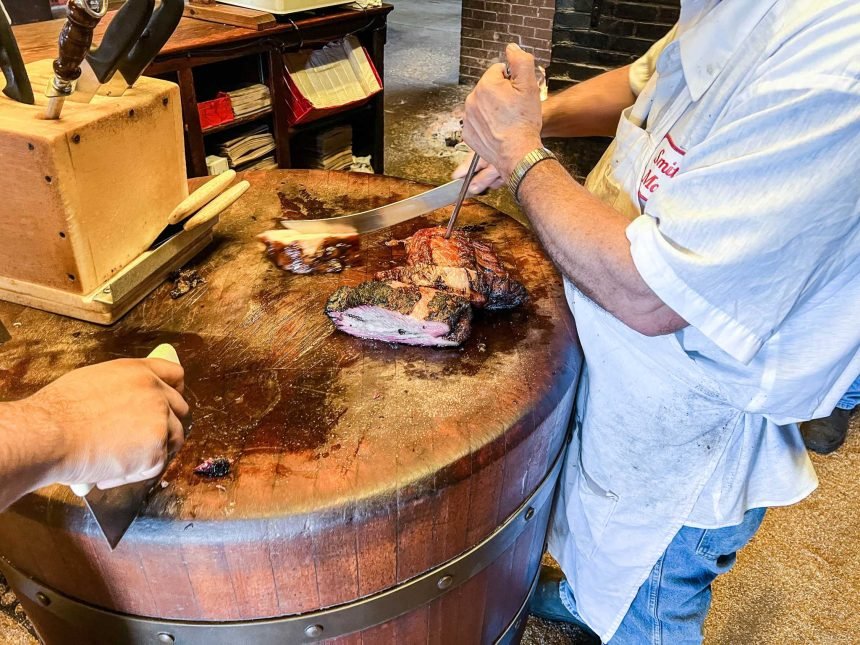
Cutting block at Smitty’s Market, Lockhart
The process of cutting meat — raw or cooked — dates to the earliest humans.
More recently, concerns about safety and hygiene helped shape one of the most ubiquitous tools in residential and commercial kitchens: the chopping block.
Also known as butcher blocks or cutting boards, chopping blocks are surprisingly sophisticated tools that have evolved over the past century. That evolution is intertwined with the history of Texas barbecue.
Article continues below this ad
At meat-market-style joints in Central Texas, including Smitty’s Market, Kreuz Market, the original Black’s Barbecue and City Market in Luling, meat is cut in front of customers on a large wooden block.
Why wood? The main reason, of course, is that it is much more forgiving to a knife’s blade than stainless steel or other hard surfaces.
At some meat-market-style joints, the block’s surface has a noticeable sway or dip, worn into the wood by decades of chopping and slicing. If you have an eye for engineering, you’ll notice a few other things about these blocks.
For one, they are never made from a single, continuous slab of wood. Instead, they are usually assembled from thin strips or squares of wood bound or laminated together.
Article continues below this ad
The reason goes back to an improvement made to the original chopping blocks of the American meat industry. Those blocks were little more than cylindrical sections of wood — usually sycamore — cut from a log. The flat cross-section served as the cutting surface.
The problem was that the wood cracked as it dried, pulling apart along the grain. Besides creating a poor cutting surface, the cracks made the block difficult to clean thoroughly. Bits of raw meat could become lodged in them.
Beginning in the early 1900s, a flurry of patents sought to solve the problem. The new designs used strips of hardwood turned on their sides — creating an end-grain or edge-grain surface — and laminated together to create a flat surface that resisted cracking and could be wiped clean.
End-grain construction also helped prevent splintering. When wood is cut along its length, following the grain, it can splinter. Chopping blocks instead present the cross-sections of the wood fibers to the knife, creating a durable surface that is less likely to splinter.
Some of these new designs used maple, prized for its durability and relatively nonporous qualities. To this day, “maple block” is another name for a chopping block.
Article continues below this ad
Another characteristic of the chopping blocks at historic Central Texas barbecue joints is their round shape.
Consider the chopping block at Smitty’s Market in Lockhart. It is about 4 feet in diameter and made of slabs of wood assembled to present an edge-grain cutting surface. Metal hoops compress the wood around the perimeter.
That design makes engineering sense. The hoops act like hose clamps: They can be tightened as needed to keep the laminated pieces compressed and the surface free of cracks.
Chopping blocks play a practical role in serving sliced and chopped meat to barbecue fans, but their deeper value is tradition. New barbecue joints can’t recreate the dips and sways worn into blocks by decades of use.
At places such as Smitty’s in Lockhart, those blocks provide a direct connection to Texas’ barbecue past.
Article continues below this ad
208 S. Commerce St., Lockhart; 512-398-9344