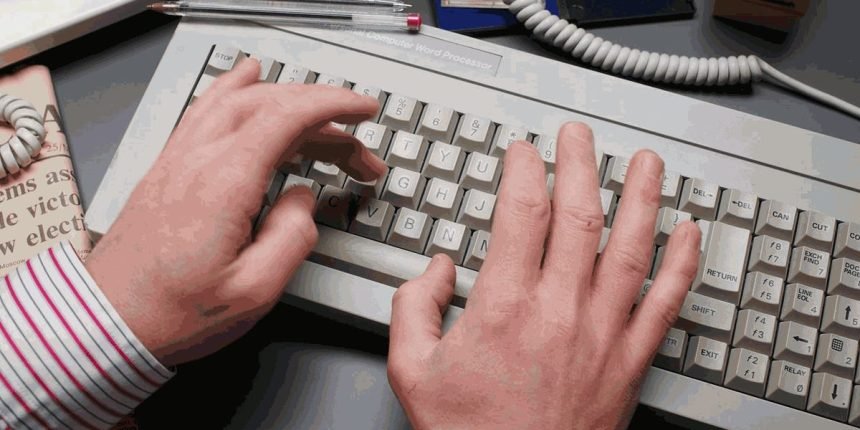
When Julia Andrusiak was in college, she noticed one of her professors repeatedly pausing his lecture. Eventually, she realized that she was the disruption: Her slow, two-finger typing was so loud that he couldn’t concentrate.
“It was the first moment I realized that I may not be the best at this,” Andrusiak said.
So she began drilling: First, she typed out books. That made her faster, but she was still staring at her keyboard. Then, she advanced to touch typing — typing without looking at the keyboard. She’s still working on her speed and accuracy. Now 26, Andrusiak has an AI-focused job that involves helping people use the technology and sometimes necessitates writing strong prompts. She still can’t type fast, so when she has a longer prompt, she dictates it — and feels self-conscious about what looks like talking to herself in an open office.
In 2024, The Wall Street Journal reported that digital natives were baffling “teachers and parents with their lack of typing skills.” Now, for some younger workers and students, typing is making a comeback.
While AI might seem to harken a turn away from typing — who needs note-taking when you have an agent? — AI is only as good as the prompt it’s given. Rambling voice prompts can be insufficiently clear and precise. The rise of AI has some Gen Zers looking for any efficiency edge they can carve out.
“With the ever increasingly fast world, we need to type quicker. But I feel like people are really relying on AI,” Andrusiak, who happily uses AI as an aid for writing and research, said. “One of my friends said, ‘Well, you don’t really have to type the whole page. You can just give it short sentences. It’s not really that tiring.’ But then I feel like it’s outsourcing too much of cognitive power to a technology.”
Courtesy of Julia Andrusiak
Typing as meditation and efficiency generator
Andrey Gerasimov, a 23-year-old computer science graduate, never took typing classes. But he first needed the skill for his video game chats and decided to beef it up, eventually reaching 170 words per minute.
As an AI user, he believes that faster typing makes for more efficient prompting.
“You’re going to be a lot more comfortable actually giving your full thoughts and ideas if you know that, hey, doing this is only going to take a minute,” Gerasimov said.
He’s not the only one trying to up his speed and technique. In his decade teaching typing to 15 to 30-year-olds, Andreas Francazi, a 36-year-old IT teacher in Vienna, noticed that his students’ typing skills have deteriorated — but they’re setting out to change that.
His newer crop of students didn’t grow up around physical computers, and their familiarity with keyboards is much lower than previous typists. He’s seen younger students come in typing rapidly with just two fingers, so he’s teaching them the basics. Francazi said that students of all ages become entranced by a three-minute typing test, falling into a rapt silence.
“The practice can be quite meditative,” Francazi said. “You just sit there, you have the text in front of you, and you type character by character, and it kind of calms you a bit.”
While Francazi’s screen-first students have mastered the art of two-finger typing, their future schooling and careers might necessitate the manual keyboarding skills he’s teaching.
Nick Sjolinder, the founder of BYOK — a purposefully distraction-free, digital typewriter device that connects to keyboards — said that around 10% of the device’s orders are coming from educators, including elementary schools, middle schools, high schools, homeschools, and universities. A recent batch order came from a high school creative writing teacher, he said, with the intention of cutting down on AI and distractions for students.
Tarun Krishnamurthy, an 18-year-old sophomore at San Diego State University, said his college professors speak quickly and tend to power through their slideshows. Krishnamurthi, who began intentionally practicing typing in middle school for fun, has an edge in keeping up.
“I’m fortunate at least I can keep up with some of the professors, but I know some other students might have difficulty with that because they need to look at their keyboard instead of looking at the professor’s slideshow,” he said.
And beyond fast classroom notetaking, Krishnamurthi sees his keyboard skills as a potential professional edge: In an ever-optimized and efficiency-focused world, “typing could be a big bottleneck.” Slow typing could worsen workers’ outputs, he said; his touch typing might give him an edge in an AI-ified world.