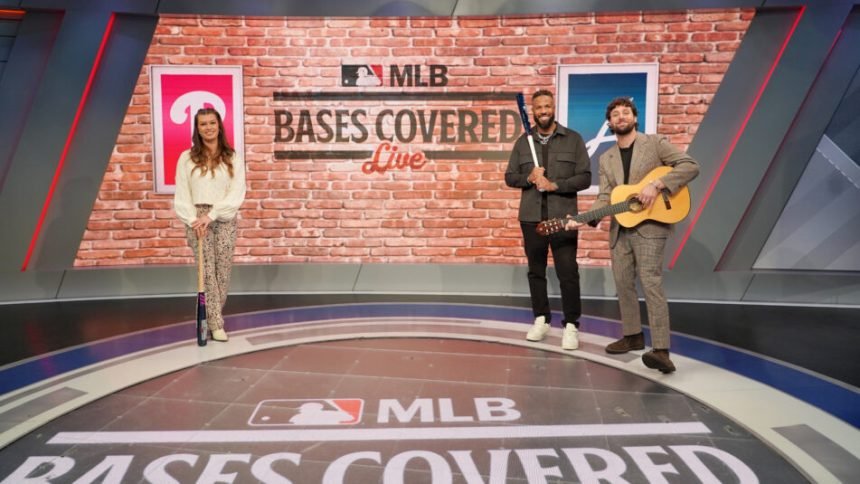
The broadcaster’s capability as an internal production house continues with studio programming for U.S. viewers
The MLB Postseason comes with an attraction that can be felt around the globe. This is spurred in part by viewership of fans in India and the UK, thanks to world-feed–style productions by MLB Network. After a regular season of constant coverage and a handful of games in the Wild Card Round, the broadcaster will execute more international broadcasts during the Division Series on MLB Bases Covered Live on the BBC via a traditional control room and the MLB Postseason on JioStar via a cloud-based production through BitFire.
“During the last half of the season,” says Michael Herbert, VP, studio operations, MLB Network, “we’ve produced different productions of the same game on both networks every Sunday, but now that we’re in the postseason, the workflow has become a little different. From production and studio operations to our full engineering team, these productions are a true collaboration across the company.”
Bridging the Broadcast: Secaucus-Based Team Accepts the Challenge
The team based at MLB Network’s headquarters in Secaucus, NJ, was more than up to the task of producing the postseason broadcasts. Spearheaded by MLB Network VP, Live Events and Production, Chris Pfeiffer, the final two months of the regular season set the foundation for what is now being implemented in the playoffs to link these international viewers with the National Pastime. In the regular season, the cloud-based production known as MLB Bases Covered Live was the basis of both shows, with JioStar receiving a dirty feed with graphics of the production being used on the BBC.
“Now it kind of switches,” says Pfeiffer. “[JioStar] will be taking a feed and implementing their own graphics and content. We’ll also be using the same group of talent that we used last year from the Wild Card to the World Series.”
This crop of talent includes two separate teams for the international broadcasters. On JioStar, play-by-play announcer Jacob Wilkins — a versatile voice who previously worked for the Binghamton Rumble Ponies and other outlets — is calling games remotely from New Jersey with additional commentary by analysts Manish Batavia and Aayush Sharma in India. For the BBC, play-by-play announcer Melanie Newman and analysts Xavier Scruggs and Felix White (a prominent voice in the UK professional-baseball community) are calling games from Secaucus. Back-to-back postseasons of remote productions has created a well-oiled machine both behind and in front of the camera, and the two talent teams have established a good rapport to create an impressive broadcast.
“They’ve developed a really good chemistry,” adds Pfeiffer. “It has been fun to watch.”
In the Cloud: BitFire’s Cloud Infrastructure Enables the Endeavor
The nuts and bolts of the productions will leverage BitFire’s cloud-based infrastructure, which MLB Network has relied on for not only this style of shows but other events throughout the year. From offsite video feeds during the MLB Draft to overseas broadcasts during the World Baseball Classic, a full cloud-driven control room in Secaucus is allowing the team to pull off the productions.
Logistically, most days comprise multiple productions running simultaneously, which calls for numerous crews taking different shifts during long hours of baseball action. Customization and flexibility were paramount to making these crews feel comfortable in a virtual environment.
“The software-defined production environment of the cloud is perfect for this type of show,” explains Steve Mellace, lead technical director, MLB Network, who is building the production templates for both shows. “It’s all about scaling what we’re already doing to a wider audience, reusing that same content, and adding customization for wherever we’re sending it to. It’s mostly about training the next operator in the same way as the current operator and cloning that setup into the next production.
“We do have to be more organized,” he continues, “since we’re working in a virtual cloud environment. We have to be aware of what our expectations are and be ready to go before we go on-air.”
Organization is necessary in all facets of the show. For example, replay needs fluctuate from regular-season games to the beginning of the postseason to the biggest games of the year in the World Series. This has pushed Mellace and his team to construct virtual-production libraries that allow repeatability but also provide time to build on top of pre-existing workflows depending on a show’s demands. For the postseason alone, the 2026 edition of the playoffs isn’t the first time MLB Network has handled such productions. Many of the first iterations experienced bumps in the road since it was still very early in the process, but, since then, the team has gained its footing and is hitting its stride.
“We’ve been working on this for about three years now,” notes Dawnlynn Kulenich, manager, studio technical operations, MLB Network,who keeps an eye on the cloud production during live broadcasts. “What we’re most excited about this year is that we’re no longer at proof-of-concept to see if the cloud productions work. We want to expand the capabilities and tailor [the show] to specific audiences and languages around the world to make the game more accessible for fans.”
Kulenich is supported by Manager, Studio Technical Operations, Tony Giner. On the commentary side, especially for the broadcasts on JioStar, linking Wilkins to his counterparts in India is a challenge. Latency is the prime challenge, but, through the help of MLB Network Production Engineering Manager Joe Alvaro, this phase of the operation has become more seamless.
“Jacob was concerned that his call was a hair behind,” says Alvaro, “so we had to find a way to work with BitFire on a solution. They were able to give him an advanced cut of the game as well as a line cut so that he could still read the graphics.”
Close Contact: Constant Communication With FOX Sports, TNT Sports
Many viewers can’t comprehend the delicate dance that goes into this production model. National broadcasters — in this case, FOX Sports on the National League side of the bracket, TNT Sports on the American League side — are capturing video feeds from the ballpark. During the regular season, games were handled by local regional sports networks or MLB Local Media for games on MLB Showcase, MLB.TV, NBCUniversal’s linear and digital platforms, and Netflix.

The feeds are beamed to Secaucus for a clean cut of the show before being distributed to the respective headquarters of JioStar and the BBC. The complex yet coordinated approach relies on back-and-forth dialogue with the production and operations teams onsite and the crew in Secaucus. Any technological bugs are squashed with the help of MLB Network Director, Remote Tech Operations, Steve Dolce; Director, Remote Camera Operations, Dan Stillwell; and Remote Tech Manager Kelly Bournes,and the pieces are assembled operationally by Kulenich and her team.
“We’re doing daily faxes and reaching out to the trucks the week prior to let them know what we’ll be doing and what we’re looking for,” Kulenich says. “We send them a production memo that breaks down camera shots and generic replays and wipes and receive an audio feed so we can hear their director in the truck. We do our best to run through everything with the team onsite to make sure that we have all the elements we need and that they’re making it back to our control room. The last thing we want to do is interrupt a truck’s workflow, and we’re trying to work closely with them so that we’re not hindering their production.”
Like MLB Network’s experimenting and eventual experience, technology as a whole has evolved since cloud-based productions took hold during the COVID-19 pandemic. Six years later, workflows have matured, and the sports-video–production industry has further embraced these methods, which have ultimately created more-engaging broadcasts.
“Having seen where we started with the original version of this, where we were writing code on the fly,” says Alvaro, “working in the cloud feels the same to our operators as a traditional production.”
These shows, like many at the network, couldn’t be done without the support of executives on both production and operations. Among this large group are MLB Network President Bill Morningstar and SVP, Remote Events, Tom Guidice. Additional assistance comes from VP, Engineering and IT, Jacob Soto and VP, Broadcast Operations and Network Origination, Karen Ganjamie. From the MLB office, support is also provided by EVP, Media and Business Development, Kenny Gersh; SVP, Business Development and Global Media, Dom Balsamo; VP, Programming, Streaming and Partnerships, Mike Siano; and VP, Global Media Sales, Chris Milkovich.
“We have to give a massive credit to everyone at Major League Baseball that allow us to run with this,” adds Herbert. “It all starts with the video feeds that we’re getting from the trucks at each of the games. Without that, we’d have nothing to work with.”
In Secaucus, the facility bustles throughout the year, but the month of October might be the peak of activity. Studio programming kicks into overdrive during the push to the playoffs, and this will only accelerate with a full slate of pre/postgame coverage for U.S. viewers throughout the postseason. Multiple control rooms will be dedicated to producing the world-feed productions.
In addition, the building will also produce studio programming for the first week of the NHL season on NHL Network. Available space can be at a premium during times like this, but MLB Network Director, Studio Operations and Scheduling, Jillian Connelly and her team are the air-traffic controllers ensuring that the shows are broadcast on time.
“She does a fantastic job managing not only the physical resources of studios and control rooms but also all the people that work inside these spaces,” says Herbert. “She’s constantly discussing any issues that arise with our operations team and going through the plan with senior leadership.”
Cultural Impact: Baseball Fans Invest in the Game in India
Catering a broadcast to another country is a difficult task, but, along with Pfeiffer, Senior Segment Producer, Live Events, Patrick Armstrong was asked to find a way to connect the game of baseball to a fanbase still learning the sport. In India, strides have been made since the first attempt four years ago, and the team has continued to build on its approach, scaling the show from an elementary level to one that offers more nuance.
“We started off at a very basic level,” notes Armstrong, “but what we’re doing now is a culmination of everything we’ve done until this point. We have gotten progressively more intense over the years with our production value, and it has been exciting for me because I’ve had an opportunity to present the game of baseball to fans in India.”
This meant explaining rules the typical U.S. fan might already understand or breaking down a pitcher’s arsenal of pitches. That rudimentary-level knowledge can be parlayed into discussing situational hitting, how a pitcher attacks a hitter, or how a hitter works a count throughout the course of an at-bat.

To help with this process, Armstrong and his team at the front bench compared baseball to one of India’s most popular sports: “We showed as much correlation with the game of cricket as possible; there are a lot of differences, but there’s also a lot of similarities. Our announcers make our jobs a whole lot easier because they’re prepared to present a game with 120 years of history to an audience that has been newly introduced to Major League Baseball.”
MLB Network is fully involved with broadcasts in different languages, but, for this audience in India, coming to baseball with a fresh pair of eyes, there are many chances for rich and untapped storytelling. In the face of various challenges like a 9½-hour time difference or cultural and language barriers, the effort has been worthwhile in the research done by the team — compiling newspaper articles on each team, MLB Network’s research team and the commentary trio of Wilkins, Batavia, andSharma add localized flavor to the broadcasts via human-interest stories — and the lifelong connections for kids who could be watching their first game.
“I always think about the little 8-year-old boy or girl in India who might be interested in baseball,” says Armstrong. “Through this show, we’re showcasing superstars for these kids to see for the first time.”
From Tuesday, Sept. 29 and Game 1 of each Wild Card Series through Tuesday, Oct. 20, these viewers will see a total of 21 games.
Commercial Free: BBC On-Air Talent Adds Color
In the UK, the BBC will cover a postseason edition of MLB Bases Covered Live. For this batch of games, BCL has offered four games in the past week, with doubleheaders on Wednesday, Sept. 30 and Saturday, Oct. 3. Both days featured separate production crews as well as different studio sets. For Wednesday’s Wild Card Round, Newman, Scruggs, and White were in Secaucus’s Studio 3; for tomorrow’s Division Series, the trio will be in Studio 21. From a production perspective, the on-air team can showcase its own set of skills in leaving an impression on the viewers.
“Melanie, Xavier, and Felix all bring something different to the table,” says Pfeiffer. “Melanie brings play-by-play credibility and makes sure the game is documented. Xavier brings a player’s insight without talking down to the audience because he’s always there to help the viewer understand a play a bit better. Felix brings a casual fan’s point of view with his excitement as well as a social following for additional engagement.”
One of the more interesting wrinkles to the postseason shows on the BBC is that they come without commercial breaks. To fill the time between innings and pitching changes, the crew will supplement the live action with ancillary content that keeps the fan tapped into the broadcast.
Says Pfeiffer, “These could be pieces about the week that Melanie and Xavier spent in London with Felix, an ‘X Marks the Spot’ about a certain moment that happened in the game, or a Fact or Fiction segment about a certain player. All of this together makes a pretty unique show where it’s a live game but also a podcast.”
Senior Segment Producer, Live Events, Jason Russo; Director Dan Gentile; Associate Director Mike Kaas;and Tape Producer Gianni Lobikis are critical to every BCL production. Supervising Producer Andrew Batti oversees editing for broadcasts on both JioStar and the BBC.
Growing the Game: International Broadcasts Spread MLB’s Appeal
During another banner year for MLB Network, the production and operations crews have stayed busy in many areas, but the ultimate goal is to spread the joy and passion of the professional game. This commitment is evident on the broadcast side, but, elsewhere, the broadcaster and its edit team — led by MLB Network SVP, Production, Marc Caiafa and VP, Production and Content Strategy, Will Cope — have been involved with an abundance of creative content as well. This included collaborating with MLB Marketing on brand campaigns and MLB social on the league’s 25 Top 10 lists as part of the league’s 250 for 250 content series, partnering with NBCUniversal Studios and the Walt Disney Co. on creative spots with star MLB players promoting this summer’s blockbuster movies, and supporting Minor League and Amateur baseball initiatives with the production of GameChanger’s The Prospect and NBC’s Road to the Show series. Back on the broadcasting front, the partnership with JioStar and the BBC promises further investment and attachment to the game that can last a lifetime.
“Every market is different,” says Balsamo, “but there’s something invaluable and important about working with two non-traditional baseball territories alongside rightsholders that resonate with viewers in their respective countries. It’s extremely powerful to also have two networks that are engaged with the broadcasts and want to find ways to customize this content for their fans.”
Viewership has been strong all season long, but, as the postseason kicks into high gear, both Major League Baseball and MLB Network are expecting even greater viewership for these broadcasts as teams fight to lift the World Series trophy.
“The postseason is our biggest stage and where we want to trumpet the game not only here in the U.S. but throughout the world,” adds Balsamo. “The 2025 World Series is a shining example with our largest international viewership, so this time of the year is what we build toward. There’s value in amplifying our reach and doing it in a way where it’s directed to a local population of fans.”