



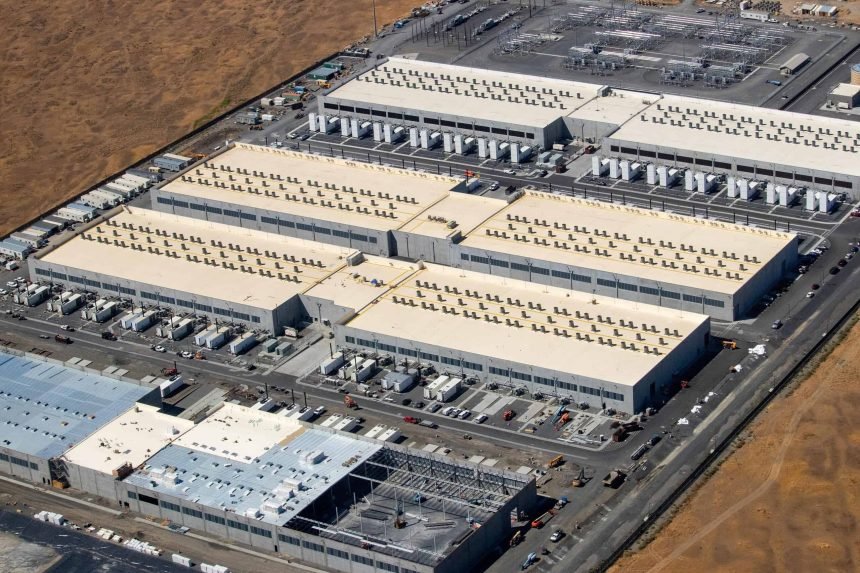
The cloud has a dirty little secret. It’s not actually in the cloud.
It’s in enormous warehouses filled with thousands of humming computers. It uses powered electrical substations and water-hungry cooling systems. And increasingly, all this is becoming a fixture of the American landscape.
But apparently, it’s doing so in a rather biased way.
A sweeping new study of more than 5,000 U.S. data centers has uncovered that majority-Black or Hispanic neighborhoods are more than two times more likely to host a data center compared to otherwise similar majority-white neighborhoods in the same state.
And for majority-Asian neighborhoods, it’s even higher: 4.2 times the odds.
People really don’t like data centers

You might think data centers are a new thing. They’re absolutely not.
Data centers have been around for decades, keeping websites running, storing images and videos, and processing financial transactions.
But artificial intelligence has supercharged demand for computing infrastructure. Training and operating advanced AI models require enormous quantities of electricity, processing power, and cooling. That’s why tech companies are pouring hundreds of billions of dollars into new data centers.
For all the promised investment, however, data centers have become remarkably unpopular.
Residents across the United States are increasingly fighting projects over concerns about higher electricity bills, water consumption, industrial noise, air pollution, and the loss of farmland. And the backlash cuts across political lines.
In a June 2026 Reuters/Ipsos poll, just 14% of Americans said they would support an AI data center being built in their community. A month later, opponents organized 142 protests across 42 states.
But some communities might be more affected than others.
Until now, however, there has been little systematic research examining how data center locations relate to race across the United States.
To investigate, researchers at George Washington University Law School and American University mapped 5,291 facilities against more than 81,000 U.S. census tracts, which they used as approximations of neighborhoods.
They then examined the demographics of the neighborhoods where those facilities were located or proposed.
The pattern was hard to miss
In neighborhoods with data centers, people of color made up approximately 44% of residents, compared with 38% in comparable neighborhoods without them.
That 6% difference might not seem like much, but is quite significant. Yet the data was even more striking when it came to the odds of hosting a facility in neighborhoods with different racial majorities.
Majority-Black neighborhoods had roughly 2.2 times the odds of hosting a data center compared with otherwise similar majority-white neighborhoods in the same state.
For majority-Latino neighborhoods, the figure was 2.6 times. Remarkably, Majority-Asian neighborhoods showed an even larger disparity, at 4.2 times the odds.
“We argue that data center development follows historical patterns of race-based infrastructure development, leading to disproportionately negative impacts on communities of color,” the researchers write in a report.
The racial disparities persisted when the team accounted for income, education, population density, property values, and proximity to major electrical infrastructure. In other words, this isn’t about rich versus poor neighborhoods, or rural versus urban.
Which begs an important question: is this the ghost of America’s past disparities?

The industrial past comes back
There’s a reason data centers tend to cluster in certain places. They need enormous amounts of electricity, reliable grid connections, suitable land, and access to telecommunications infrastructure.
But this type of place comes with its own bias.
For much of the 20th century, American governments and financial institutions systematically disadvantaged Black communities through practices such as redlining, which restricted access to mortgages and investment.
Meanwhile, highways, factories, power plants, and other industrial infrastructure were frequently concentrated in communities with less political and economic power.
The result was an unequal landscape. Some neighborhoods inherited industrial corridors, major power infrastructure, and land-use patterns that continue to influence what gets built there today.
But the racial disparity remained even after the researchers accounted for proximity to transmission infrastructure. In other words, the power grid matters, but it isn’t the whole story.
Decades later, those decisions continue to shape where people live and how land is used. Now, apparently, data centers are the latest stage in this history.
Who’s fighting back against data centers?

There’s another extraordinary finding buried in the report.
As data centers spread across America, communities are increasingly fighting back. Residents have organized petitions, challenged zoning decisions, and protested projects over concerns about pollution, noise, and rising utility costs.
This documented opposition also isn’t evenly distributed.
Communities where opposition was recorded were, on average, 79% white. Communities without documented opposition were only 53% white.
That doesn’t necessarily mean white people dislike data centers more, or that residents of color support them.
Organizing a campaign requires time, money, access to information, and political connections. And some protests attract significantly more media attention than others. The data can’t distinguish these possibilities.
The future is built on an unequal map
The study has important limitations. Most importantly, it’s observational, so it can only establish a correlation, not a causation.
But the broader finding is difficult to ignore.
For all the talk about AI revolutionizing society, the physical infrastructure supporting it is taking shape within a society that remains deeply unequal.
The researchers argue that this is precisely why data center development needs closer scrutiny. Among their recommendations are racial impact assessments, stronger zoning rules, greater transparency, and more meaningful opportunities for communities to participate in decisions about proposed facilities.
AI may be new, but the forces shaping its seem oddly familiar. Without deliberate safeguards, the infrastructure of tomorrow risks reproducing the inequalities of yesterday.
And as billions of dollars flow into AI infrastructure, the question isn’t simply where the next data center will be built.
It’s who will live beside it, who will profit from it, and who will get a say.
You can read the report in its entirety here.