



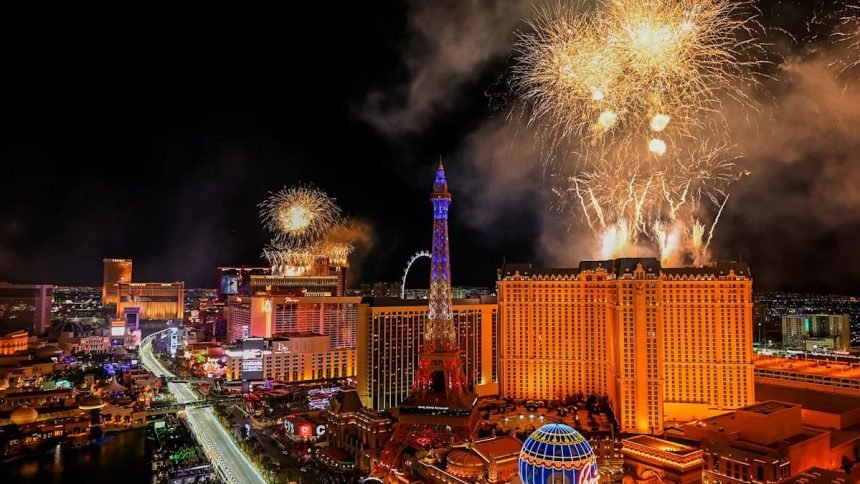
On Thursday, in the Colosseum Theatre at Caesars Palace just off Las Vegas‘s iconic strip, the second F1 Business Summit was held. With more than 25 featured speakers across eight sessions and thousands in attendance from dozens of top-brass companies, it is where the bigwig executives coalesce with motorsport’s premier class. And, if recent proclamations are anything to go by, boy, is Sin City the place where deals get announced.
A day earlier, F1 announced a high-profile official partnership with popular fitness wearable Whoop, with the next step in broadcasting being the airing of drivers’ heart rates, subject to approval. Naturally, Max Verstappen has already voiced his disapproval. Then, F1 announced an elevation in their partnership with Lego – including an actual Lego race before Saturday’s Grand Prix – and multinational bank Standard Chartered.
Advertisement
But it wasn’t until Friday, UK time, when the biggest of the lot arrived in our mailboxes. After 24 years away from the sport, Nike will return to Formula 1, replacing Puma as the sport’s official apparel and uniform supplier. F1 chief Stefano Domenicali described it as “two of the world’s most iconic brands” uniting, in a period where “Formula 1 is experiencing unprecedented global growth”.
F1 has announced a new deal with Whoop (PA)

F1 has also disclosed a new partnership with Nike (F1)
On the commercial front, then, all is very much well. F1 now has more than 35 championship-level partners – 10 of whom are global, top-tier link-ups – and all 11 teams are thriving too. McLaren alone, for instance, have over 55 sponsorship agreements. The valuation of every team is exponentially rising to levels unforeseen when Liberty Media first took over the sport a decade ago. And inevitably, there is no better place to showboat and strut than the bright lights of Vegas.
Advertisement
Yet, given what has been a largely forgettable season on-track, that is just as well. Ahead of this weekend’s 21st round, both championships are wrapped up: Mercedes clinched their first constructors’ title in five years at the last race in Brazil, while 20-year-old Kimi Antonelli became the sport’s youngest-ever champion a race earlier in Mexico.
The whole year, however, has been overshadowed by justified complaints about the new era of engine and chassis regulations, which have been slated from just about every corner. From the first qualifying session in March in Australia, concerns were awash in the paddock. Slowing down at the end of straights to go quicker – such were the requirements to recharge the battery – is clearly not what F1 should be about. And provisional plans are now already in place to reintroduce V8 engines from 2030.
It is a clear admission: they got it wrong.
And the last week or so has seen another controversy rear its ugly head. A seasoned British journalist from the Daily Mail has had his accreditation revoked for the final three races of the year after calling Charles Leclerc a “sneaky little bastard” in an article, following the Monegasque’s clash with Ferrari teammate Lewis Hamilton in Mexico City.
Advertisement
The Mail have since insisted they will not cover any Formula 1 for the rest of the season, calling the removal of accreditation “an unprecedented and outrageous attack on the freedom of the press”. The journalist in question, Jonathan McEvoy, also blamed Ferrari team principal Fred Vasseur for the situation, calling him a “tubby little nobody”.
Now, The Independent is not defending those comments, nor the name-calling and, more so than anything else, a swear word directed at a professional athlete. Doubling down on such quotes, too, is a dubious course of action. However, eight months on from another veteran journalist being banned from the paddock – after writing blogs critical of the FIA, who insist it was because he didn’t meet strict requirements on website page views – it is a deeply uncomfortable look that the sport’s governing body (which organises media accreditation, separate from the commercial rights holder) is essentially barring reporters from doing their job on-site.

A British journalist has been banned from the paddock for the rest of the season after a piece about Charles Leclerc (PA)

Audiences have been falling for Drive to Survive on Netflix (Getty)
And, in a different avenue of the sport’s wide-ranging media junket, F1’s greatest asset is actually showing slow signs of regression. The sport launched into the mainstream via its Netflix docuseries Drive to Survive, but since season four in 2022, viewing figures have been steadily declining. A peak of 4.1 million views four years ago has now turned into a low of three million for this year’s season.
Advertisement
The lack of invigorating on-track storylines this year won’t help ahead of season nine next year and, in the US, this year’s broadcast rights shift from ESPN to Apple has seen audiences fall. According to a USA Today report in July, six of the nine races to that point saw viewership declines of 13 per cent or greater compared to 2025. Miami and Monaco, strikingly, saw drops of 68 per cent and 66 per cent respectively. And that’s before you consider the natural fall with the four end-of-season dud rounds, with no drivers’ title on the line.
Is the bubble bursting a tad, then? Next year’s action will likely result in a 10th season of Drive to Survive in 2028. Is it time to mix things up again? With so many commercial partners, is the sport biting off more than it can chew? Worldwide fan figures – around 830 million, roughly 10 per cent of the world’s population – and race attendance records suggest not. Yet other metrics indicate a regeneration of some sort is needed, particularly in light of three more years of these much-maligned regulations.
One thing is for sure: it will all be discussed and debated in the conference rooms and high ceilings of Sin City. How much such talks can actually cater for the lack of narrative on track, however, remains to be seen.