



WHAT TO KNOW
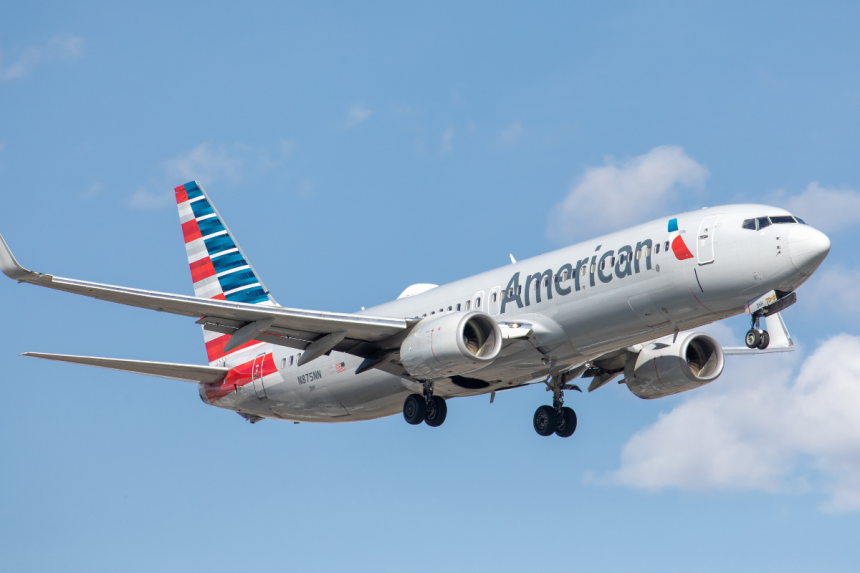
An American Airlines Boeing 737 made an emergency landing at Chicago O’Hare on Friday afternoon after a suspected fire in the cabin. Flight attendants suspected a fire in the trash can in the rear galley.
In this article
- Airport operations were briefly halted after the aircraft returned to Chicago O’Hare.
- Airport Rescue and Fire (ARF) vehicles met the aircraft on arrival.
- The aircraft was able to taxi to the gate without further incident.
An American Airlines flight that had just departed from Chicago O’Hare on Friday afternoon made an emergency return to the airport after flight attendants suspected a fire in the trash can in the rear galley of the Boeing 737-800, with smoke entering the cabin.
Flight Details
Operator
American Airlines
Aircraft type
Boeing 737-800
Route
Chicago O’Hare (ORD) – Dallas Fort Worth (DFW)
Passengers onboard
180 passengers and crew
American Airlines flight AA-618 departed O’Hare at around 12:19 pm on October 16 for what should have been a routine two-hour flight to Dallas-Fort Worth. But just minutes after takeoff, and with the aircraft still in its initial descent, the pilots declared a “Mayday” emergency.
As air traffic control was given the pilots’ new instructions for their climb out of O’Hare, one of the pilots reported: “Mayday, Mayday, Mayday… American 618, fire in the cabin.”
The pilots requested an immediate return to O’Hare, and air traffic control scrambled to facilitate the plane’s return, while also organising Airport Rescue and Fire (ARF) vehicles to meet the aircraft on arrival.
Once on the ground, the pilots decided it was safe to taxi back to the gate with the fire trucks following close behind. In radio communication between the pilots and ground controllers, the pilots explained that the flight attendants saw smoke coming out of a trash can in the rear galley of the plane.
On board the aircraft were 180 passengers and crew, with no reported injuries. American Airlines did not, however, respond to a request for comment.
The cause of the smoke was not immediately clear. The affected plane was taken out of service for the remainder of Friday, although American Airlines managed to find a replacement aircraft to get the passengers to Dallas – albeit with a delay of around four hours.
Initial reports suggested that the smoke and potential fire were in the rear bathroom trash can, which would have suggested that someone had been smoking a cigarette in the bathroom and tried to dispose of it in the waste.
While rare, it’s most definitely not unheard of, and it’s exactly this scenario why every lavatory trash can on a commercial jet has a heat-activated fire extinguisher built in to quickly tackle a blaze caused by a discarded cigarette butt.
The fact that the smoke was seen coming from the trash can in the rear galley, however, is a lot stranger, suggesting that something electrical may have overheated in the rear galley.
A concealed fire or smoke seeping into the cabin from an unknown source is one of the biggest threats that pilots and flight attendants could find themselves dealing with. When the source of the smoke can’t be ascertained, it has to be assumed that there is a concealed fire that is quickly taking hold.
The priority is to get the aircraft on the ground as quickly as possible, and be prepared to commence an emergency evacuation via the inflatable slides if necessary.
A delay in this type of situation has, in the past, resulted in tragic consequences.
Nearly 44 years ago, Saudia Airlines suffered one of the worst aviation disasters in modern history when all 301 passengers and crew died after a fire erupted in their Lockheed L-1011 TriStar shortly after takeoff from Riyadh.
The exact reason why everyone onboard Saudia Flight 163 perished has never been fully established, but a leading theory is that the crew succumbed to toxic smoke and carbon monoxide poisoning before they could start an evacuation.
It’s believed that the inferno was caused by butane gas tanks in the cargo hold catching fire, quickly spreading and breaking through the cabin floor. Flight attendants valiantly tried to suppress the flames with fire extinguishers, but their efforts were to no avail.
The inexperienced Captain and First Officer appear to have initially delayed diverting the aircraft back to Riyadh, and when it eventually landed, the aircraft rolled down the runway for two minutes and forty seconds as fire trucks chased down the plane.
When the aircraft eventually came to a stop, the fire trucks couldn’t get close because the engines had been left running. By this point, the fire had started to burn through the roof of the plane, and only at the request of the fire services did the pilots power down the engines.
After this, however, there was no further communication from the cockpit and none of the emergency doors were ever opened. The fire engulfed the plane, and everyone on board perished.
Want to see more stories like this? Add PYOK as a preferred source on Google, and we’ll show up more often in your searches and Google News.
Related
Subscribe to our newsletter
No spam, just a weekly roundup of the best aviation news that you don’t want to miss