



Gil Asakawa for Westword
Not long ago, it would have seemed unimaginable to find part of an aisle at King Soopers dedicated to Asian products.
Back in the day, if you wanted to buy some miso, nori seaweed, spicy gochujang sauce or even goods like bamboo shoots and ramen noodles, Denver would have felt like a food desert. Unless you know where to look.
In-the-know shoppers have long turned to family-owned supermarkets like Pacific Mercantile, a downtown Denver institution since 1946 (making it the oldest Asian market in the area), or Great Wall Chinese Market (originally known as Pacific Ocean Marketplace from 1989 until it was acquired in 2022), and, of course, H Mart, the international Korean chain with locations in Aurora (since 2004) and Westminster (2013).
Many other long-established smaller mom-and-pop markets serve Asian communities throughout the area, including Little Saigon Market and Saigon Supermarket along the South Federal Vietnamese corridor, or M Mart on the Koreatown strip in Aurora.
But recently, a flock of new corporate behemoth Asian markets has come to town in the last year, delighting many Asian shoppers while also raising concerns among the mom-and-pop grocers who have been here for years.
New stores threaten old businesses
Jolie Noguchi, the third-generation head of Pacific Mercantile in downtown Denver’s Sakura Square, has weathered the arrival of H Mart and Great Wall to the metro. But today, she’s concerned about the arrival of Hashi Market, a New York-based Japanese-themed chain that describes itself as a blend of supermarket, mini department store and catering service.
Hashi Market was brought to Noguchi’s attention by her daughter, Alyssa, who will be the fourth-generation owner of Pacific Mercantile, and is already making plans for the store’s evolution.

“When Alyssa told me about Hashi, she was showing me a video,” Noguchi says. “And she says, ‘Oh, my God, Mom! I think this one could hurt us.’”
The “coming soon” chain is planned for 12200 E. Mississippi Ave. in Aurora, directly across from one of Great Wall’s stores. Based in the United States with Chinese management, Hashi Market will have a kitchen to make fresh bentos and serve sushi. The company has ties to Japanese suppliers; “hashi” is the Japanese word for chopsticks, but it also means “bridge.”
Pacific Mercantile has a long history and a loyal following of both downtown and suburban Japanese and Japanese-Americans to rely on thanks to the Noguchis’ commitment to showcasing local Japanese-American food and crafts. But Alyssa is still planning fresh ideas to help fend off competitors, like hosting pop-up events and adding a kitchen for fresh bentos in the store — an idea she’s been sitting on during Sakura Square’s eventual revitalization.
And there are many competitors, both direct and indirect.
An oversaturated market?
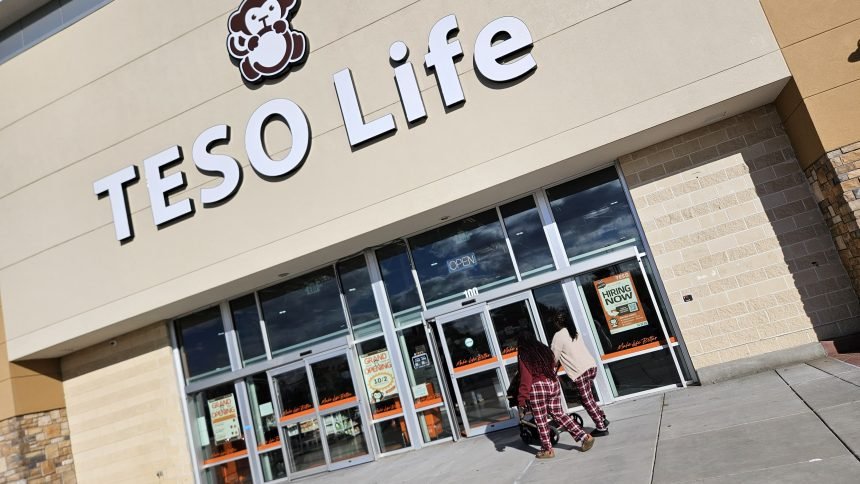
Recently opened shops with Asian influences include Teso Life in Aurora, two locations of the 85-Degree C Bakery Café (one in Aurora and another in Centennial), and several Colorado locations of Daiso, the popular Japanese “100-yen shops” where prices start at $2.25. There’s also Dajoa Premium Market in Aurora, a smaller gourmet Korean grocery store that opened in Dec. 2025. All offer Asian snacks and packaged foods.
Noguchi is happy to see more acceptance of Asian culture in Denver, but from a business perspective, it certainly represents economic pressure.
“We feel like it’s crazy,” she says. “It’s like just popping up, all of a sudden. Is there a market for this many in Denver? I say no.”
But across town in Aurora, Havana Business Improvement District executive director Chance Horiuchi embraces the new arrivals while acknowledging the increasing competition they bring.

“You can’t compete with a Teso Life,” Horiuchi says. “Small stores don’t have the same buying power. So, yes, that part is concerning, because I know that cuts the competition. I am concerned about the really small mom-and-pop shops that have been around for 40-plus years.”
Aurora has been a magnet for these companies, both large and small. Daiso, Teso Life, H Mart, Great Wall and many others are concentrated not just along the Havana strip, but throughout the city.
“It’s our diverse global corridor. It’s known as a global city,” Horiuchi explains. “The demographics of the area meet the needs. … Every intersection of Havana can get anywhere from 40,000 to 60,000 cars.”
And those demographics include plenty of Asians of many persuasions. Beyond the borders of Aurora, Horiuchi notes, the popularity of Asian culture and food makes it harder for smaller businesses to compete.
“It’s not just Daiso or Teso Life anymore. It’s almost everyone,” she says. “Target carries (Asian goods). Five Below carries a lot of stuff. … King Soopers now has a pretty good Asian department. … It’s almost everyone.”
More stores to come
Even 7-Eleven, the ubiquitous convenience store chain owned by a Japanese company, is adding to the trend. American 7-Elevens now sell the popular “Japanese style” egg salad sandwiches, a viral hit throughout “konbini” stores across the Pacific. The chain’s parent company — Seven & I Holdings, which took over the American company that ran 7-Eleven in 2005 — is consolidating its influence in the U.S. by focusing on more fresh-made foods (no more wrinkly hot dogs rotating for hours on the counters) and a modern inventory system to make sure stores sell products that people actually want in each location.
And if that’s not enough, a One Plus One Chinese grocery store is slated to open near DIA at 18200 E. 64th Avenue. The property will include both hot pot and pho restaurants, and is expected to be completed in 2028.
So the trend of Asian markets coming to town will continue for a while yet.