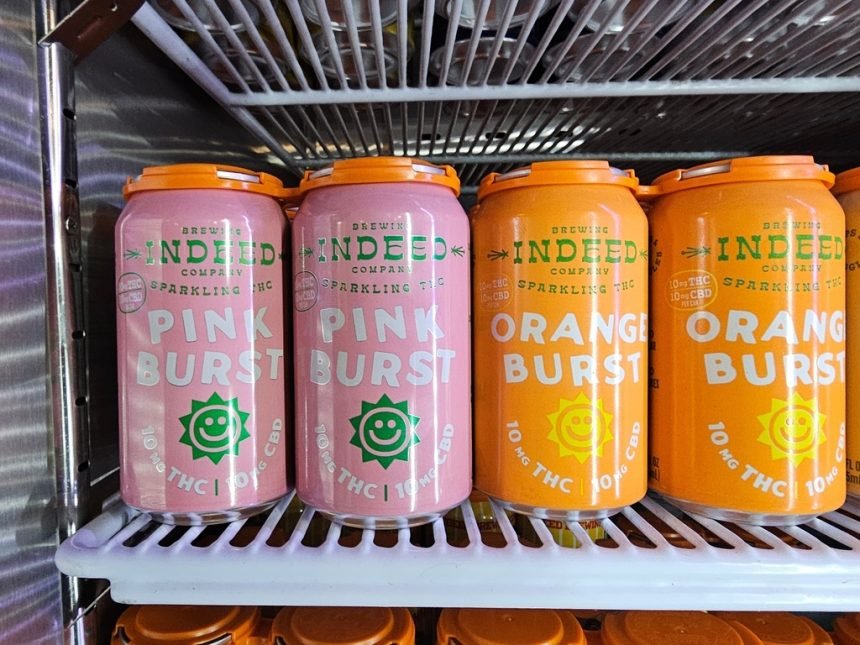

Starting Jan. 1, Alabama retailers who have been selling or want to sell consumable hemp products, including canned beverages, have to comply with a new state law regulating the products.
They’ll do that with the understanding that 11 months later, they may not be able to sell most of those products under an even newer federal law.
“They have to run their own calculus about the likelihood that the federal law will stay the same and take effect (next November,)” said Whitt Steineker, a partner at the Bradley law firm and founder and co-chair of its cannabis industry team.
The federal legislation that reopened the government earlier this month also included a ban on the sale of consumable hemp-derived products with more than 0.4 milligrams of tetrahydrocannabinol, or THC. That’s the same psychoactive element found in marijuana, but at significantly lower levels. Conversion processes can increase those levels.
The sale of the hemp-derived products, including gummies, drinks and vape liquids, has become a major industry since the 2018 Farm Bill legalized it.
To rein in the sale of products in Alabama, including their over-the-counter availability to teens, the Legislature and Gov. Kay Ivey approved House Bill 445 earlier this year. It imposed a THC cap of 10 milligrams per serving for edibles and beverages, bans any smokable hemp products, prohibits use for those under age 21 and limits THC product availability to specialty shops or dedicated areas of grocery stores of at least 14,000 square feet. It also imposes a 10% tax on the sale of all THC products, establishes a licensing requirement for retailers and impose severe civil and criminal penalties for retailer violations.
The Alabama Alcoholic Beverages Control Board, tasked with overseeing the implementation of the new state law, is currently finalizing the rules and licensure process to take effect next year.
It will be succeeded by the federal ban on any consumable products with THC levels above 0.4 milligrams.
Ellie Taylor, executive director of the Alabama Grocers Association, said that more than 100 grocery stores in the association are currently selling hemp products and are gearing up to do so under House Bill 445, starting Jan. 1, assuming they obtain the necessary licenses.
“We had some of our retailers that were very hesitant to get into the hemp business until there were regulations around it and it’s treated like an intoxicating item like beverages are,” Taylor said. “So, for those retailers, I’m not sure if they’ll just hold back and just wait and see what happens federally because they weren’t selling it anyway, or they’ll move forward. But I do feel like the 100-plus stores that are currently selling it and will be allowed to sell the liquid will continue to do that until they’re told federally that they can’t, if that happens.”
Hemp-product sales in Alabama currently are over $15 million, Taylor said. Beyond grocers, there are producers and distributors in Alabama.
Unless it is amended or continued, the federal law takes effect on Nov. 13, 2026. Steineker and Taylor expect a major push to get it modified between now and then.
Rep. Andy Whitt, R-Harvest, sponsored House Bill 445. He praised the federal law that, had it come a year or two earlier, would have saved him and his legislative colleagues a lot of time and work. He argued earlier this year to end “pop-up pot shops” and keep harmful products out of kids’ hands.
“We took the lead on this, but I’m certainly glad Congress followed up with a tougher bill,” he said.
Whitt said that while there may be efforts to undo the federal law and lessen restrictions, finding something passable just in Alabama took tremendous negotiations.
“I know the fight I had in Alabama, I can only imagine on a national level what that would look like,” he said.
Hemp production
Since 2019, the Alabama Department of Agriculture has been licensing industrial hemp growers and processors. Currently, 38 growers and 26 processors are licensed. Nothing is expected to change in its program under the federal ban, the department told Alabama Daily News.
Alabama Farmers Federation’s Blake Thaxton said the organization hasn’t heard from members who might be affected.
“Our longstanding position has been that if hemp is going to be produced, we want Alabama farmers to have the opportunity to produce it,” Thaxton, director of Alfa’s Greenhouse, Nursery and Sod Division, said. “The impact of the Continuing Resolution shouldn’t change that, but if anything emerges that would hinder Alabama farmers’ ability to produce hemp, we will engage as needed.”
Steineker said there are growers in Alabama raising hemp for consumable purposes, while others grow what will become products like textiles and paper.
“The people who are growing the CBD-style plant are going to be immediately impacted (by the federal ban) and they’ve got to make a huge decision, probably by the spring, if they think there is going to be a change to federal law or they need to start planting soybeans or some other alternative.”