This article is one of a series on Catholic higher education. You can view all the stories here.
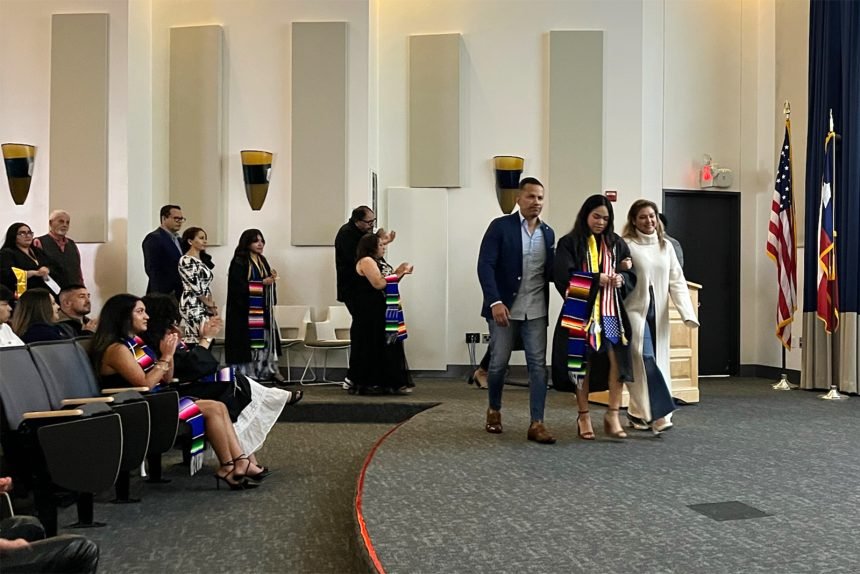
AUSTIN, Texas (RNS) — Despite the graduates’ best efforts to remain composed, the tears were flowing freely in the small auditorium at St. Edward’s University, which was hung with the lacy colors of papel picado and the faint scent of carne asada wafting in from outside.
In a graduation ceremony last December for six Latino students, many either undocumented or among the first to attend college in their families, Jackeline Guajardo, one of the graduates, told the group, “Remember that your success is not just yours, but a collective triumph for those who have supported you and those who will follow in your footsteps.”
Days later, they would walk with their classmates at St. Edward’s commencement, but on this day, each graduate crossed the stage arm-in-arm with their parents before having serape-style stoles placed around their shoulders. Guajardo, who grew up with English as her second language, teared up as she said, “I’ve always felt stupid and unprepared every single time I stepped foot into a classroom.”
Family, community and the college, which offered additional support systems, “made us feel smart, confident and capable.”
Only 1 in 5 U.S. Hispanic Catholic adults have a college degree. They are less than half as likely as white Catholics to have a bachelor’s degree. Even as the U.S. church becomes increasingly Latino, however, U.S. Hispanic students make up less than 20% of undergraduate students at Catholic colleges, according to 2024 data from the Department of Education. That lags far behind the estimated 6 in 10 U.S. Catholics under the age of 18 who are Hispanic, and even behind the more than 1 in 3 U.S. adult Catholics who are Hispanic.
Experts say that lag has a tangible impact on the church and diminishes Latino representation among priests, religious sisters, Catholic school teachers and administrators, as well as among influential Catholics in secular society.
“ When Latinos, by and large, have been absent from these systems of education that have benefited so many millions of Catholics in this country,” said Hosffman Ospino, professor of Hispanic ministry and religious education at Boston College, “ many of them are missing out on the spaces that would allow them to consider these ecclesial vocations.”
Historically, Latino high school graduation rates were significantly lower than the national average, with only 58% percent of Hispanic young adults having graduated high school in 1996 — about 30 points behind the total young adult figure. But as that gap has narrowed — by 2021, 89% of Hispanic young adults were high school graduates — Latinos remain underrepresented in Catholic higher education.
Experts point to a variety of reasons. Much of Catholic higher education is concentrated in the Northeast, away from areas with the highest concentrations of Latinos. There’s a perception that Catholic higher education is too expensive, especially if schools don’t effectively communicate about financial options that change the sticker price.
There are also few Latinos in the Catholic education pipeline. While the majority of Catholic college students attended Catholic grade schools, Latinos are underrepresented in Catholic K-12 education, at 17% of enrollment. If Catholic universities aren’t creating community partnerships beyond Catholic K-12 schools, “ you’re not going to be serving Hispanic students at the higher ed level,” said Deborah Santiago, CEO of Excelencia in Education, an organization dedicated to improving Latinos’ higher education achievement.
This July 18, 2012, file photo shows a student stapling colored paper to the wall of a classroom after summer school at Our Lady of Lourdes in Los Angeles. (AP Photo/Grant Hindsley)
But more importantly, Latino leaders say, Catholic colleges must create an overall culture of Latino belonging at every level of the institution.
Esteban del Río, director of the Frances G. Harpst Center for Catholic Thought & Culture at the University of San Diego, said: “ If you really want to join with the people you hope to be part of your community, you have to reflect and discern: What about our assumptions has been exclusionary? What about our normal operations may be producing the experience of marginalization?”
The question is not, said del Río, “ How do we replace those that are in the center with these ideas that are in the peripheries?” but instead, “ How do we enlarge the center?”
At the University of San Diego, del Río said, community-engaged learning has been particularly successful in strengthening relationships with Latino communities. As opposed to other models, in which the college and its students engage in one-off service events in a community, community-engaged learning involves investing in ongoing accompaniment and seeing the wisdom and resources in that community.
That focus is a common thread for many leaders in Latino inclusion in Catholic higher education.
At Dominican University, in the Chicago area, where nearly 7 in 10 students are Hispanic, Jaqueline Neri Arias, assistant vice president for Hispanic-serving and culturally sustaining initiatives, said that the university’s Family Academy has been a way to include Hispanic students by making families part of the educational process.

Students Viviana Soria, left, and Evelyn Acosta Celestino study at Dominican University, Sept. 25, 2025, in the Chicago area. (RNS photo/Aleja Hertzler-McCain)
In monthly Family Academy sessions given in English and Spanish, any Dominican family can meet other families and learn about how to support their students. By attending five sessions, families can enroll their student in a summer class at no cost.
But every facet of the university is involved in meeting the needs of Hispanic students, Neri Arias said, from culturally responsive programming and ministry to support for students with challenges due to immigration status, first-generation status or finances. That support might look like running a food pantry or treating all U.S. resident students in the financial aid process as domestic regardless of their citizenship status.
Dominican, like other Catholic universities serving Hispanic students, has been hit hard by the Trump administration’s cuts to higher education, including funding specifically for Hispanic-Serving Institutions.
Donna Carroll, a former president of Dominican who now heads the Association of Catholic Colleges and Universities, said she had heard anecdotally that many Catholic institutions have lost federal funding for Hispanic-Serving Institutions, “causing institutions to scramble financially, and in cases, make difficult budget decisions.”
With a third of Catholic colleges classified as HSIs or emerging HSIs, the cuts will impact all students, not just Hispanic students, she said.
@religionnews Across three Catholic universities in New York, students share their stories and how faith shapes their campus life. Watch the full video at religionnews.com Produced by Fiona Murphy #religionnews #catholicuniversity #catholicism ♬ original sound – RNS
While the funding cuts are a serious challenge, Neri Arias said, for Catholic universities in financial jeopardy because of low enrollment, Latino inclusion can be a fiscally responsible priority. “Our culturally sustaining initiatives are crucial to the survival of Dominican,” she said.
St. Edward’s is the only Catholic institution to have earned the Seal of Excelencia, awarded by Excelencia in Education to institutions that compile data to demonstrate a robust infrastructure to recruit and retain Latino students.
Some of those strategies include having faculty reach out to prospective students and making sure information sessions for their families are held in English and Spanish. “ We wanted to make sure that when parents left, they left knowing that the information that was given to them was in their native language because it’s a scary moment for them, having their sons and daughters leaving,” said Sonia Briseño, director of the College Assistance Migrant Program, adding that many have never set foot on a college campus.
When admitted students arrive at St. Edward’s, they are paired with a success coach and a career coach. Other supports follow, such as peer cohorts for mentoring, programming for first-generation students, a mental health center, emergency laptop assistance for students who cannot afford them and experiential learning opportunities, such as internships and research.

Families and students attend a December 2024 Las Posadas celebration at St. Edward’s University in Austin, Texas. (RNS photo/Aleja Hertzler-McCain)
“ That’s meeting the students where they are. And if they’re behind, it’s pulling them up. If they’re ahead, it’s also taking those students and encouraging them to do other things,” said Brian Smith, a political science professor and vice provost for academic policies/student success.
Lazaro Calvillo, a philosophy major who hopes to become a lawyer, told Religion News Service that academics aren’t the only challenge. In addition to an internship, “I work in a movie theater, so that, plus balancing school has made it relatively difficult.”
A major program that primarily serves Latino students is the College Assistance Migrant Program or CAMP, in which the federal government has historically funded first-year expenses for the children of migrant farmworkers. St. Edward’s has covered tuition for the next three years.
Briseño, the director of CAMP and an alumna of the program, credits it with allowing her to go to college. So does Christina Vasquez, a nursing student. “I’m so thankful for them because without them I wouldn’t be here,” she said.
But CAMP has come on the Trump administration’s chopping block. Gwendolyn Schuler, a St. Edward’s spokesperson, declined to answer how federal funding cuts would impact the university. But Richard Bautch, executive director of the university’s Holy Cross Institute, which promotes the university’s founding charism, said that cuts to CAMP present a challenge to the university’s mission of bringing hope, through God’s providence, to places without resources.
The funding cuts eclipse hope, Bautch said, but “we need to work so that we can move to a new place where hope is again strong and prominent.”