When Amtrak’s new Borealis train from St. Paul to Chicago debuted in May, early ridership data were so strong it set off waves of attention. Borealis became the transportation fashion statement of the summer for a cadre of very online people. Mainstream media took notice. KARE-11 sent two of its most prominent anchors on a Borealis journey which produced a nearly seven-minute news segment and 11 minutes of additional online footage, extraordinary for a rather bare bones train that serves an existing Amtrak route.
But the hype is real, or the hype made it real. Amtrak’s fiscal year ended Sept. 30 and four-plus months of ridership data says Borealis justified the decade-long quest to improve service in the corridor. Its empirical success is difficult to quantify because Amtrak (a government corporation) does not share market segment ridership with the public.
What Amtrak did say is that 88,000 people rode Borealis in those four months, and many trains were sold out. Even accounting for the fact that roughly a third of riders only travel between Chicago and Milwaukee, it’s still a healthy 58,000 or so beyond the Cream City. The other train Amtrak operates in the corridor, the Chicago-Seattle/Portland Empire Builder, also added 40,000 new riders in the fiscal year, but we don’t know where on the route those riders traveled.
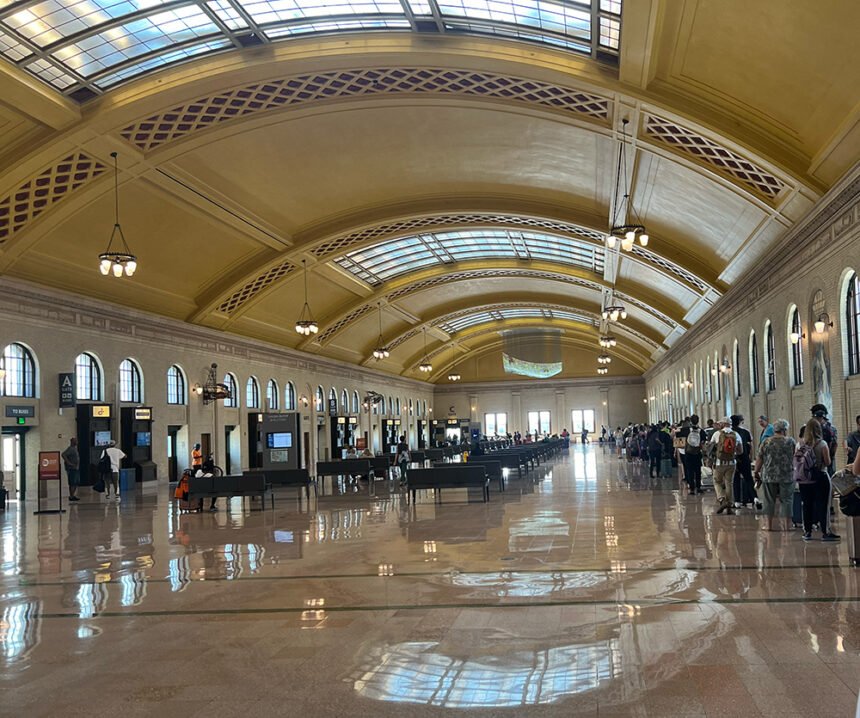
Amtrak also shared that the number of passengers using St. Paul Union Depot jumped from 77,597 in FY23 to 130,328 in FY24. Again, we don’t know how many of them traveled MSP-Chicago, but it’s safe to say a majority. Amtrak spokesman Marc Magliari did tell TCB that “the data shows most of the increase at St. Paul is Borealis,” and added that the train’s success has raised Amtrak’s profile in the Twin Cities and probably benefitted Empire Builder as well. It also validated the idea of MSP-Chicago as a growth market for rail, which some have questioned, due to its 420-mile length (300 or less is considered optimal for urban corridor passenger rail).
It matters because Borealis is funded by the states of Minnesota and Wisconsin, and the train was created to grow ridership in the corridor, not simply transfer it from a federally subsidized train to a state-subsidized one.
During the train’s early days, a misimpression got propagated that Borealis was profitable. (Accounting is subjective, but by and large Amtrak trains are not profitable.) Despite Borealis’ success, it does not cover its cost of operations, according to Amtrak. But neither was it expected to, and profitability is not a criterion for additional service in the corridor. The stakeholders are primarily focused on use. It’s a truism in transportation that improvements in frequency often have an exponential impact on ridership because schedule options are a singular driver of demand.
But what does the future hold? With an airline or bus company, such a successful start would be followed quickly by more service. With Amtrak (and its state sponsors), it’s not so easy.
The Biden infrastructure legislation provides a process (Corridor ID) for states to identify and fund rail services. Amtrak operates the trains, but everything else about them is the responsibility of the states in which they operate. The process is cumbersome and requires the consensus of numerous stakeholders— in this case Wisconsin, Minnesota, Illinois, and Amtrak itself, along with CPKC Railroad and Chicago commuter rail agency Metra, which each own part of the route on which Borealis operates.
“It took nine years to get these stakeholders to agree on the first Borealis,” explains Ian Weisser, an analyst at the Wisconsin Association of Railroad Passengers, an advocacy organization. “That agreement is for exactly the size of train they have now. Even adding an extra car requires negotiation.” Wisconsin has started that process for a second Borealis train (Weisser says MnDOT’s passenger rail office lacks sufficient staff to lead the process) but it has not advanced beyond the first phase.
Amtrak allocates four coaches and a café car with business class seating to Borealis (from its pool of cars allocated to Chicago-based state-sponsored operations). Stakeholders would like to add capacity to the train in peak months.
Unfortunately, Amtrak is facing a shortage of equipment which is not likely to abate until 2026 at the earliest, says Magliari. New Midwest railcars currently being delivered to Amtrak were not funded by Minnesota, so Borealis cannot use them. “Siemens [railcar] has a five-year order backlog,” adds Weisser. Another option is hand-me-down trains that become surplus as new Amtrak equipment arrives in 2026. Weisser says the Borealis states would need to pay Amtrak to use those cars.
Extending Borealis to St. Cloud, a popular talking point, could be accomplished with the existing trainset on the current schedule, but suggested extensions to Fargo would likely require an additional set of equipment and change in schedule. Even the status quo requires maintaining a political consensus in Minnesota and Wisconsin over funding. Wisconsin for years stood in the way of new service under anti-rail Gov. Scott Walker.
Some change is nonetheless in the offing. Weisser says that state-funded improvements to rail infrastructure in downtown Milwaukee will allow the addition of an eighth Hiawatha roundtrip to Chicago. Wisconsin wants that train to operate in Borealis’ time slot, so the state only needs two sets of railcars for the Hiawathas, rather than the current three. He is expecting this to force a rescheduling of Borealis, but the timing needs to be negotiated with CPKC and Metra. Thus even Borealis’ 11 a.m. departures are not written in stone.