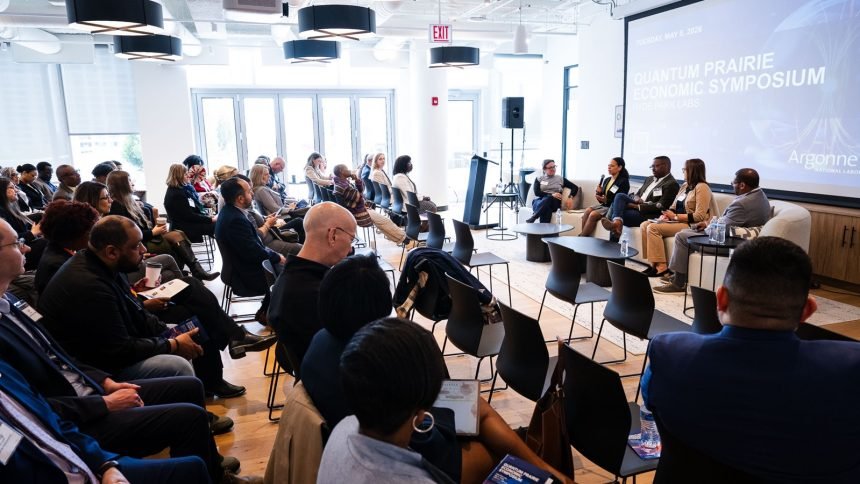
The U.S. Department of Energy’s Argonne National Laboratory convened leaders from business, government, academia and nonprofit organizations in May for the inaugural Quantum Prairie Economic Symposium, bringing together nearly 100 participants to examine how advances in quantum science could drive regional economic growth, workforce development and technological innovation. Held at Hyde Park Labs in Chicago, the symposium highlighted the laboratory’s leadership in quantum research and its commitment to helping build the partnerships needed to translate scientific discovery into economic opportunity.
The morning set an ambitious tone, underscoring the laboratory’s long-standing role in advancing quantum research and its growing efforts to connect scientific leadership with regional economic development.
The half-day symposium opened with remarks from Argonne Laboratory Director Paul Kearns, who noted that Argonne leads Q-NEXT, a National Quantum Information Science Research Center, and that in 2023, the lab launched both the Argonne Quantum Foundry and the Argonne Quantum Institute.
Kearns grounded the day’s conversation by highlighting the laboratory’s deep roots, noting, for example, an Argonne scientist was the first to propose a theoretical framework for a quantum computer, and even today, Argonne continues to drive innovation in quantum information technologies.
“We are advancing powerful computing and precision sensing technologies while developing the building blocks of this field, including high-performing qubits. We are also beginning to see how quantum could influence areas such as finance, communication and logistics, while enabling new capabilities that are still emerging,” Kearns said. “It is exciting that Illinois is at the center of this transformation. Our state has a long history of scientific and technological leadership, and quantum is a natural extension of that.”
A region on the edge of a quantum leap
The keynote address was delivered by Kate Timmerman, CEO of the Chicago Quantum Exchange (CQE), a Midwest-based consortium of universities, national labs and nearly 70 industry, nonprofit and international partners.
Timmerman painted a compelling picture of what the quantum future looks like for the Midwest. A 2024 analysis by Boston Consulting Group for the Chicago Quantum Exchange projects as much as $80 billion in economic impact and as many as 191,000 quantum technology jobs in the Illinois, Wisconsin and Indiana region by 2035. More than 70% of those positions are projected to be open to workers without graduate degrees.
“I hope participants walked away with a sharper sense of what quantum technologies can mean for the Quantum Prairie over the next decade in terms of jobs, regional economic growth and innovation across a wide range of businesses and institutions,” Timmerman said. “That means we can all play a role in preparing for and shaping this future. This is an exciting, all-hands-on-deck moment for our region.”
Panels: business, talent and the road ahead
The morning featured two panel discussions that tackled the quantum economy from both sides of the equation — business opportunity and workforce development.
The first panel, “The Business of Quantum,” examined the transition of quantum technologies from the laboratory to the marketplace. Panelists stressed the importance of initiating efforts to establish the support systems and frameworks necessary for quantum science to continue to thrive in our region.
Representatives from the Illinois Quantum and Microelectronics Park (IQMP), Chicago-based quantum startup memQ, World Business Chicago and the Illinois Chamber of Commerce discussed business-to-business opportunities emerging from the growing quantum industry and the role of business development in accelerating commercialization.
Harley Johnson is the chief executive officer of IQMP, a 128-acre campus being built along the shores of Lake Michigan on Chicago’s South Side. IQMP is a first-of-its-kind project for quantum technology and microelectronics innovation and scale-up. Designed to be a global destination for quantum, the park will bring together a dynamic ecosystem of companies, researchers, manufacturers, suppliers, end users and other partners working to develop and commercialize technologies with the potential to solve the world’s most complex problems. Johnson offered an encouraging message to those who may feel the quantum world is out of reach.
“People also need to be reassured they don’t have to be a quantum physicist to benefit from or participate in this ecosystem, but they can form the partnerships,” he said. “They can realize some of the benefits of those jobs and opportunities for their kids and grandkids, and I hope that they would come away from this appreciating that this is a unique time and place to do that.”
During the panel, Johnson mentioned that the people who will eventually fill many of these initial quantum roles are currently in middle school.
The second panel, “Quantum Leaps in Human Capital,” turned the spotlight on workforce development. Moderated by Emily Easton, director of education and workforce development for CQE, the discussion brought together voices from the University of Chicago’s Pritzker School of Molecular Engineering, City Colleges of Chicago, Black Tech Jobs and PsiQuantum to discuss how institutions across the region are collaborating to create accessible pathways into the quantum workforce.
According to Boston Consulting Group, the expansion is expected to happen fast, with the number of quantum jobs predicted to grow more than 200% from 2027 to 2030, and then more than 550% between 2030 and 2035, making workforce preparation not just timely, but urgent. Panelists stressed proficiency in mathematics and engineering will be essential for success in these roles.
Discovery sessions: going deeper
Attendees also participated in interactive discovery sessions — small-group discussions designed to go deeper on specific topics within the quantum landscape. Sessions covered quantum business development, state investment, startup opportunities, building talent pipelines and quantum ethics.
“Argonne National Laboratory and its Office of Community Engagement recognize that the advancement of quantum science and technology must be rooted in broad collaboration,” said Robyn Wheeler Grange, director of Argonne’s Office of Community Engagement. “Our commitment is to help support the building of a quantum economy that advances science and delivers positive regional impact, supports economic growth and creates pathways for meaningful participation throughout Illinois and beyond.”
The conversations and connections sparked at the Quantum Prairie Economic Symposium underscored the region’s readiness to lead in the quantum era through scientific breakthroughs and by building a robust ecosystem where innovation, education and economic opportunity go hand in hand.
With momentum building and a shared vision for the future, the Quantum Prairie is poised to become a national model for how communities can come together to shape the next frontier of technology and prosperity.
Courtney Gousman is a five-time Emmy Award-winning communicator with an extensive background as a broadcast journalist. Courtney leads communications for Argonne’s Office of Community Engagement. In this role, she also manages the lab’s public lecture series, OutLoud.
Argonne National Laboratory seeks solutions to pressing national problems in science and technology by conducting leading-edge basic and applied research in virtually every scientific discipline. Argonne is managed by UChicago Argonne, LLC for the U.S. Department of Energy’s Office of Science.
The U.S. Department of Energy’s Office of Science is the single largest supporter of basic research in the physical sciences in the United States and is working to address some of the most pressing challenges of our time. For more information, visit https://energy.gov/science.