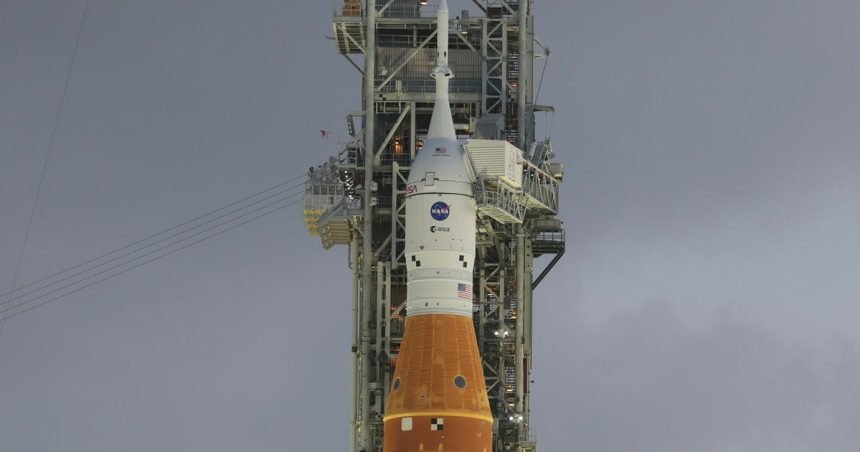
The countdown is on for Artemis II and its crew’s historic liftoff Wednesday evening. The mission will mark NASA’s first piloted flight to the moon in 53 years.
Attached to the Orion spacecraft the four astronauts will take around the moon, is a key piece of technology developed over decades in Lexington, Massachusetts.
MIT Lincoln Laboratory
Researchers and developers at MIT Lincoln Laboratory designed and built optical communication systems, which use lasers instead of traditional radio frequencies to transmit information.
“With laser communications, we’re able to deliver a lot more data with a lot less power and with much smaller terminals,” explained Jade Wang, Assistant Group Leader of Optical and Quantum Communications at MIT Lincoln Laboratory.
MIT Lincoln Laboratory
The technology marks a major leap from the RF systems used during the Apollo missions decades ago. Researchers say those older systems created limits on how much and how reliably data could be sent back to Earth during flight.
“The in-flight instrumentation is a huge bottleneck [on newer spacecrafts], and without laser communications, all of that data that’s critical to the safety and the health of the astronauts wouldn’t be as readily available,” said Steve Gillmer, Assistant Group Leader of Structural and Thermo-Fluids Engineering at MIT Lincoln Laboratory.
4K video in space
The new system is expected to provide a faster, more seamless flow of critical data, including 4K video upload and download as well as other capabilities. In a sense those grainy videos of the moon from the 60s and 70s will truly be a thing of the past.
“The way I eventually described it to my friends was I was working to make communications in space more like, bring the internet so astronauts could view cat videos for instance, and to have the experience in space that they currently enjoy at home,” said Wang.
Beyond Artemis II, researchers say technology will play a vital role in the future of deep space exploration. NASA plans to have a moon-landing flight in 2028.
“Artemis is just the first step. Ultimately, we are hoping to send people to Mars for exploration there, and this same of technology is required to kind of provide the amount of data and services that we need for that kind of exploration,” Wang added.
MIT Lincoln Laboratory is owned and operated by Massachusetts Institute of Technology but serves as the largest federally funded R&D tasked with developing advanced technology for the DoW, U.S. government agencies and non-DoW organizations such as NASA, the FAA, and NOAA.