“It’s not a consensus issue for the industry to raise the cap,” said David O’Brien, president of the 65-member Massachusetts Cannabis Business Association. “Some smaller companies fear it, because they think it’ll give more power to larger companies. Others want it.”
That divide is one reason the cap appears unlikely to change right now, as the young industry goes through a shakeout. Plummeting prices have forced many cannabis operators into dire straits, and most newer weed companies are struggling to stay afloat. Adding to their challenges are soaring expenses, sky-high tax rates, and regulatory hurdles. More than 30 companies have gone out of business in Massachusetts since 2021.
A bill that includes a measure to raise the limit on retail licenses from three to six has not made any headway on Beacon Hill and seems unlikely to pass before the session ends in July. But a half-dozen business owners who spoke to the Globe still view the ultimate outcome on the cap as a key factor that will influence which cannabis companies survive, and which will not.
Take Rooted In, for example. Brian Keith and Rokeya Chowdury opened the Newbury Street dispensary in 2022 with piecemeal investments from around 50 Boston-area residents. Money was always in short supply for Rooted In, Keith said. But if the cap were raised, there would be little to stop a larger rival with deeper pockets from opening nearby, which he worries would devastate his business.
“It would open up Pandora’s box,” Keith said. “We don’t have a lot of capital to pad the business or expand. But another big company, they can then open three stores, then four or five. They could be right next to us. They can lower prices and drive us out of business, because they have more money for marketing.”
But other dispensary owners say the cap hurts their business prospects.
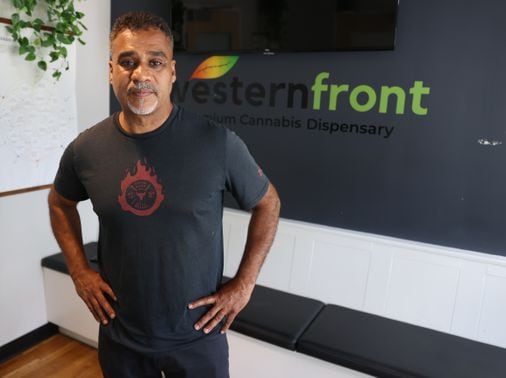
Dennis Benzan, president of Western Front, manages three dispensaries in Cambridge and Chelsea that are struggling to pay down debt, rent, and the cost of construction and licenses. He has explored selling to another cannabis company that could rebrand or invest in the storefronts. But with the three-store cap in place, Benzan said, his options are few.
Some large businesses interested in acquiring operators such as Western Front are already unable to expand in Massachusetts. At least five multi-operators have hit the three-license limit on retail locations, according to data from the Cannabis Control Commission, the state’s cannabis regulator. And Benzan said he has had little luck convincing an out-of-state operator to buy him out and enter Massachusetts, or to even invest.
“We’re asking for the freedom and flexibility in a free market economy to do what is necessary to raise capital,” Benzan said. “Without capital, you basically die on the vine.”
Complicating matters is the fact that cannabis companies cannot use the US bankruptcy system to restructure their debts because marijuana is still illegal at the federal level. If they cannot pay their bills, either the owner has to come up with additional funds or sell to another operator.
That has not been possible in Massachusetts yet, said Gyasi Sellers, owner of the cannabis delivery company Treevit.
“In Massachusetts, we haven’t seen that storybook entrepreneur who started with passion, watched it take off, and then had someone write them a huge check. That’s the real success story,” he said. “It’s not a participation trophy for taking out loans to open a cannabis business. It’s that you had the dream, and it went somewhere.”
One thing nearly everyone agrees on: The cannabis market is too burdensome for most entrepreneurs to navigate. Launching a weed company can be so expensive that over 200 priority applicants — minority business owners who received “social equity” or “economic empowerment” designation by the state that comes with technical assistance and other resources — have received licenses but not yet opened stores, according to the CCC.
But expanding the cap would do little to change that, said Drudys Ledbetter. As co-owner of upcoming Zéb Boutique in Mattapan, she believes regulators should focus on distributing money in the state-run Social Equity Trust fund, which so far has doled out less than $3 million.
Another option would be paring back regulations to start a cannabis business, which would level the playing field more than alterations to the license limits. It could keep the potential for profit in everyone’s hands, Ledbetter said, rather than simply allowing the big players to roll up the business.
“Why are they the savior?” she asked. “Why aren’t we strategizing other solutions?”
A few alternative models are being explored, too. Danielle Drummond, vice president of social equity at Ascend Wellness, pointed to New Jersey, which recently increased the number of companies that investors could have their hands in, as well as the percentage of the business they could own.
That sort of tweak could inject money into the market — benefiting big and small companies that could function together in a “symbiotic relationship,” as both competitors and, sometimes, suppliers, Drummond said.
“You want the bigger companies to be healthy, just as the bigger companies should want the [social equity] licensees to be healthy, because those are the folks you share shelf space with and who buy from you wholesale,” Drummond said.

In such a highly fragmented market, supporters of lifting the cap say worries about a monopoly are exaggerated. Even if every multi-state operator currently doing business in Massachusetts ran six dispensaries, they would control less than 10 percent of the retail market, which includes around 300 stores.
“We would not be supportive of all of a sudden owning half of the market,” said Robert Sciarrone, east regional leader at Curaleaf, which operates in 23 states, including Massachusetts. “Ultimately, we want to create successful businesses, not just a successful model for Curaleaf.”
Now the cap debate is one focus of a new cannabis trade group of small business owners, called the Massachusetts Cannabis Equity Council. Launched in mid-June, the 17-member coalition opposes changes to the license limits. But the council is as much about pushing other pending reforms, such as updating who can sell medical marijuana, as it is about the cap, said Kevin Gilnack, a founding member.
“The license cap is an existential threat,” Gilnack said. “But any time it’s getting attention, it’s taking oxygen away from addressing all these other incremental pieces that could have outsized impact for equity businesses.”
Diti Kohli can be reached at diti.kohli@globe.com. Follow her @ditikohli_.