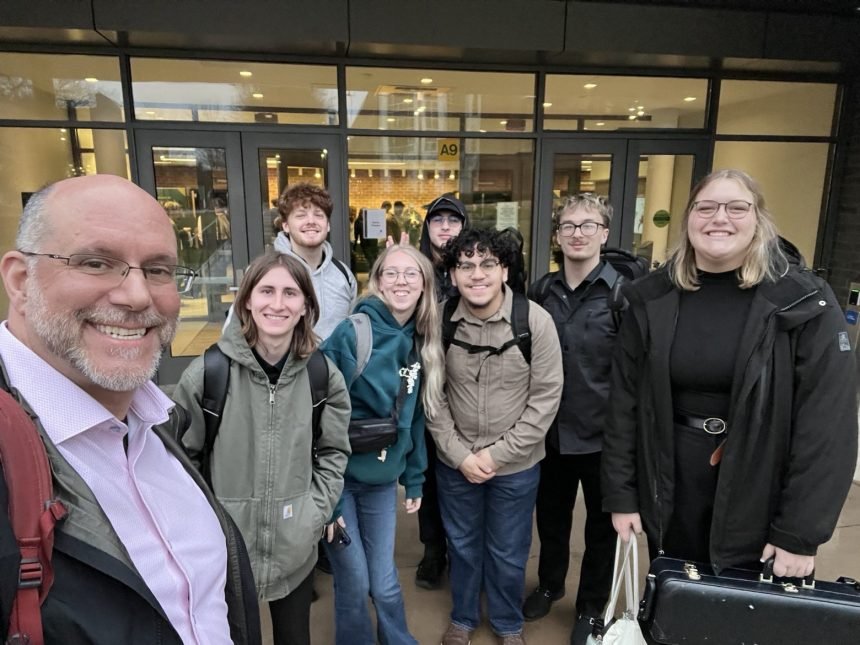
After years of shaping music students in the classrooms, music professor Matthew Sintchak is taking a step back next year to begin a sabbatical. What makes this sabbatical stand out is the relevant topic it touches on: artificial intelligence, specifically how it can be utilized in music practices and performances.
“I have always been interested in the intersection of music and technology,” Sintchak said. “Early on, that interest led to exploring how computers and live musicians could interact in real time through performance.”
The project starts out with an exploration of how AI can be used to benefit instructors and students. Eventually, Sintchak hopes that this research will lead to the creation of software.
This software would provide instant feedback to students of all levels while acting as a practice assistant. Building on this, the focus then shifts to practical development. Sintchak wants to create a platform for students and technology to interact spontaneously during performances. He calls this an “AI interactive performance system.”
Not only would the software be able to diagnose areas to improve during practice, but it also provides tools and adaptive exercises that can be integrated into applications. The tool would serve as an introduction to the technology emerging nowadays for students.
Sintchak’s intent with creating AI isn’t to replace the role of the teacher or performer, but to serve as a tool within the learning process.
“I definitely think that music – art in the larger sense– needs to be created as part of the human condition and cannot be replicated in the same way with AI,” Sintchak said.
Sintchak’s peers and students have shown strong interest in the project and are eager to see how his work develops during the sabbatical.
“It has the potential to transform not only [Sintchak’s] work with his saxophone students, but it could be transformative for music pedagogy in general,” Christian Ellenwood said.
While Sintchak is away, his students will have the opportunity to learn from other teachers. This not only gives them a new perspective to gain feedback from, but it will broaden the students’ experience, preparing them for their future career paths.
“I think it gives us another opportunity to see music through another perspective. To see how differently a professor teaches,” saxophone student Adriel Correa said. “I think that’s valuable as musicians view everything from different angles.”
As Sintchak prepares to leave for his sabbatical, he’s excited to go in-depth on the relationship between AI and students’ practices. By studying potential applications of AI in music pedagogy as well as performance, Sintchak hopes to better understand where AI can interact with musicians, reshaping how students practice and perform. Eventually leading to a tool that doesn’t replace, but supports musicians.