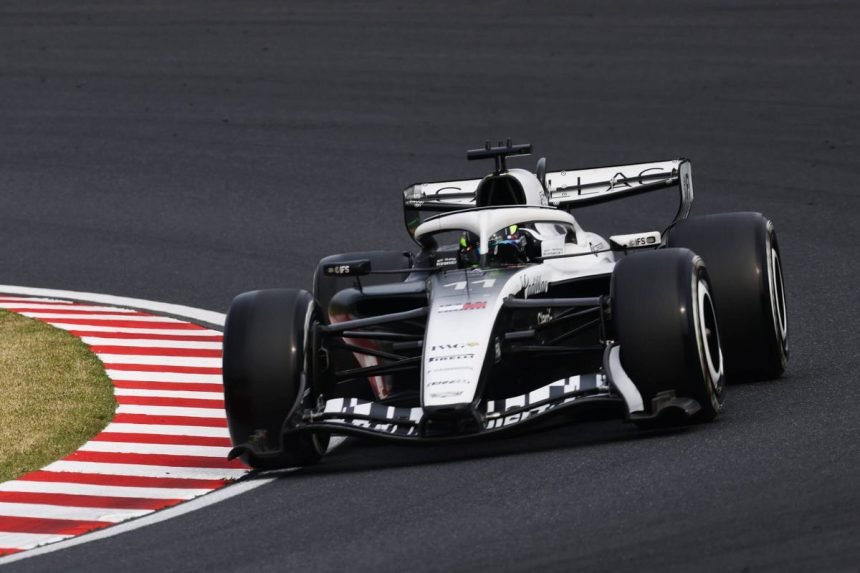
SILVERSTONE, UK — From the top of a bright blue cherry-picker raised far above the ground, a photographer called out instructions through a megaphone to the crowd below.
Around 500 members of Cadillac’s Formula 1 team stood in a car park in front of a black truck — the ones used to transport its cars and equipment to races. Those to the right shuffled inwards for a tighter shot before the photographer, content with what he saw, snapped away for a fresh item in Cadillac’s short F1 history.
This was the first opportunity for the sport’s newest outfit to take an official team photo. The 2026 season’s first three races in Australia, China and Japan had been too hectic, with total focus being on getting this start-up on the grid and running.
But it was also a chance to take stock of how much the operation had grown — so much so that Graeme Lowdon, Cadillac’s F1 team principal, wasn’t quite sure what the employee count had reached.
“The number is increasing so quickly that I don’t actually have the accurate answer for this week,” Lowdon tells The Athletic in an interview. “But it’ll be circa 600 now working on the project both here in the U.S.”
As the team’s American headquarters in Indianapolis nears completion, anticipated for late this year, a similar headcount ramp-up on the other side of the Atlantic will follow.
For a team that only knew last March that it would be racing this year, Cadillac has grown rapidly.
Since The Athletic’s last visit to its UK headquarters, spread across seven different buildings at Silverstone, its operations have matured significantly. Gone are the open benches; in their place are dedicated areas, new production machines, and, for the cars, two race bays. In the main manufacturing and car-build spaces, mechanics and engineers flit around, working on the two race car chassis before they’re packed away and sent to Miami for the now-imminent race weekend there.
To account for the rapid growth, the team even set up a temporary set of design offices across the road from the main buildings. Featuring workspace for almost 300 people, it is known informally as ‘the Battleship,’ a name coined by chief designer John McQuilliam. A pirate flag is thought to be somewhere in the office. After the season’s summer break in July and August, many existing sites will move into the main technical building.
As daunting as it may be to start from zero, doing so has allowed Cadillac to get its facilities and infrastructure in place from the very start.
“It’s got all the latest machines,” Nick Chester, the technical director, tells The Athletic during a tour of the facility. “We’ve been able to buy exactly what we wanted.”
A Cadillac F1 employee works at the team’s Silverstone factory (via Cadillac F1)
Unlike fellow U.S. team Haas, which is a smaller operation that relies on technical support from Ferrari, Cadillac produces its own parts, including its engine and gearbox. Ferrari currently supplies these, but a future General Motors-backed F1 engine project is in development. Going it alone like this arguably gives Cadillac a higher competitive ceiling, even if it means a steeper learning curve at the outset.
“All of that’s been done in parallel to building cars and going racing and setting everything up as well,” Lowdon says of the team’s growth. “I tell everyone in the team every so often that what they’ve achieved is truly exceptional. It doesn’t happen very often, if ever.”
Lowdon pointed out that teams such as Ferrari, which has started 1,124 grands prix to Cadillac’s three, have a certain amount of “corporate muscle memory” that only comes with time. Operations such as pit stops or car servicing around curfew times require a natural adaptation period, despite the workforce’s prior F1 experience. Even Haas has more than 200 races to its name now.
But F1 waits for no team, a reality that became clear to Cadillac in those first three races as the excitement and hype over its long-awaited debut gave way to the competitive reality. Sergio Pérez and Valtteri Bottas are yet to qualify within 3.3 seconds of the pole lap, left duking it out with the beleaguered Aston Martins for the final positions on the grid. In F1, that’s an enormous margin.
Just once has a Cadillac car finished on the lead lap – Pérez in Japan – although the team did get both cars to the finish for the first time in China and then again at Suzuka. Unlike Aston, reliability has largely been there from the start.
Pérez and Bottas have combined for 16 grand prix victories in their careers and have both been part of multiple constructors’ championship-winning teams, with Red Bull and Mercedes, respectively. Their experience was a key reason Cadillac wanted them at the start of this journey, and they knew this would be a case of building the team from the ground up.
Expectations were always managed — Lowdon said last July teams on the grid for a decade-plus would be “apoplectic” if Cadillac came straight out of the box and beat them — but the focus had to swing toward chasing performance.
As Dan Towriss, the team’s CEO, put it after Australia: “The honeymoon’s over, and so elbows are out.”
Now Cadillac’s goal was to claw its way toward the points-paying positions.

Bottas was encouraged by the team’s performance in Japan (Mark Thompson/Getty Images)
“Another double finish is really, really good,” Bottas said after that most recent race in Japan a month ago. “Now we just need to wait for the upgrades.”
Miami this weekend will be a major yardstick in Cadillac’s season. Not only will it be the team’s first home grand prix, complete with its own fan grandstand and a live screening event in the Florida city, but it will also herald the first major upgrade package for the MAC-26 car.
Chester says the unexpected five-week gap in the calendar since Suzuka, created by the cancellation of April’s Bahrain and Saudi Arabia races due to the Gulf conflict, benefited Cadillac by allowing it to knuckle down and focus on readying the upgrade package. He adds that it also gave time to conduct extra tests on the chassis in the factory — such as a K&C (Kinematics and Compliance) session, used to analyze the suspension — that would normally have waited until the summer to better understand the car.
The downside to Lowdon was a halt to the momentum the team had built operationally through the first three races, as well as two fewer races’ worth of data and learnings.
“It’s clear just from looking at our pace gains — race pace I’m talking about here — from Melbourne to Shanghai and to Suzuka, that there was really quite dramatic improvement,” Lowdon says. “A lot of that is operationally extracting more from the package, so we’ve lost that momentum.
“But we have done a number of things to try and keep that treading water, if you like, ahead of some simulations and acting out certain things, so that Miami doesn’t feel like Melbourne, part two.”
But development has been the primary focus in this period, leading to a sizable set of new parts for Miami that should boost performance.
These had been in the pipeline since January, when Cadillac’s car got its first extended run-out in the private Barcelona test.

Cadillac will bring upgrades to the Miami GP this weekend (via Cadillac F1)
“For the moment, in Miami, we’ve got a new floor, new floorboards, a new front wing, new rear brake ducts, new rear suspension tracks,” Chester explains. “So it’s a big package.”
He does acknowledge that most teams on the grid will have “a big step” with their upgrades for Miami, making it a relative game to see how much ground Cadillac can make up: “We’re obviously hoping we’ve brought a bigger upgrade package than other people. I’d like to see our gap to the midfield come down a bit.”
Chester anticipates the team’s next major package will arrive for the Austrian Grand Prix at the end of June.
Cadillac’s starting position this year didn’t come as a great surprise to him. “We wanted to turn up and look sensible, not be a mile off the back of the grid,” Chester says. “And we weren’t. We were not that far away from the midfield. It was respectable, and now we just have to inch our way to the midfield with a bit of progress. It would have been unrealistic to think, bang, new team, straight in the middle of the midfield.”
Miami will bring a lot of attention to Cadillac.
It has pushed hard to forge an identity as F1’s all-American team, and many of its major U.S. partners and sponsors will be at Hard Rock Stadium, the home of the NFL’s Dolphins which the circuit passes on three sides, to see how it fares – and whether these upgrades can mark the start of a competitive upswing.
“It’s just going to be interesting to see what the other teams are bringing,” Chester says. “We know what we’re bringing. After that, it’s just a race-by-race focus on making us quicker all the way through. But there’s a nice momentum there.”