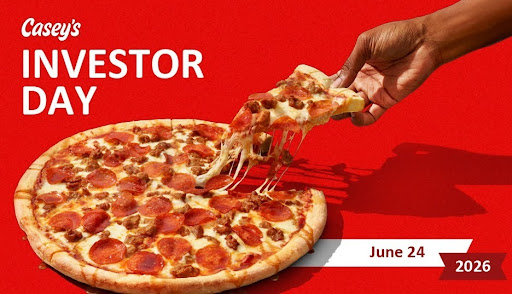
Casey’s General Stores Inc. is launching a new three-year strategy that includes adding at least 400 new stores, underscoring the company’s confidence in its rural-focused convenience and prepared-food business, company executives said today during a 2026 Investor Day event in New York City.
The Ankeny-based convenience store’s new strategic plan also calls for delivering 8% to 10% annual growth in earnings before interest, taxes, depreciation and amortization, a goal Casey’s outperformed during its most recent three-year plan when EBITDA grew about 16% per year on average.
Casey’s new plan also calls for increasing same-store sales in the mid-single digits; expanding gross profits by modestly widening already-strong inside same store margins and sustaining healthy fuel margins; and keeping operating expenses growing more slowly than earnings so that each newly added store operates more efficiently than the last.
The combination of margin gains and cost discipline is expected to generate about $2 billion in spendable cash over the plan period, giving Casey’s the ability to fund the construction and acquisition of new stores, technology investments and shareholder returns, executives said.
“We love the hand that we’re holding,” said Steve Bramlage, Casey’s chief financial officer. “We have a proven strategy to ratably grow this business, and we’ve done that over the short, the medium, and the long term.
“We continue to control our own destiny, and our play is more effective, and it’s harder to replicate than it has ever been. I am extremely excited for the next three years at Casey’s.”
Casey’s top executives met with investors and others on Wednesday in New York City to unveil the company’s new three-year strategic plan and answer questions. The S&P 500 company has an enterprise value of over $32 billion. It operates nearly 3,000 stores in 19 states, most of which are in the Midwest.
The company is the fifth largest pizza chain in the U.S., the fourth largest holder of liquor licenses and the third largest convenience store chain.
A sizable portion of Casey’s anticipated growth in the next three years is expected to come from adding at least 400 new stores, a move that would further solidify its third-place rank among convenience store chains.
Half of the new store growth will come from new builds and the remainder from acquisitions, Bramlage said. He cautioned that the acquisitions will not come from large deals but rather from acquiring single stores and small, multi-unit stores.

Darren Rebelez, Casey’s board chair, CEO and president, described the convenience store industry as “very fragmented.”
“Nearly two-thirds of the stores in the industry … are operated by chains of 10 stores or fewer,” he said.
“Those smaller operators are struggling to keep up with inflation and other costs, and most don’t have the scale, technology or capital to make the necessary investment in food to thrive,” Rebelez said.
About two-thirds of Casey’s nearly 3,000 stores are in communities with populations of 20,000 or less, Rebelez said. Casey’s hybrid model as a convenience store and quick-service restaurant gives it a “unique advantage” to create an operating model that is difficult to replicate.
Rebelez likened Casey’s model to a three-legged stool that includes prepared foods, groceries and fuel. “Our guests can visit our stores and simultaneously get a hot meal, cool beverage and fuel their vehicle, all with one trip,” he said. The wide variety of prepared foods Casey’s offers “helps drive consistent visits and creates a loyal guest space that’s coming to our stores throughout the day.”
Casey’s has the ability to add a large number of stores within its current 19-state footprint, said Ena Williams, the company’s chief operating officer. Within the company’s service area, about 75% of towns with populations of 20,000 or less do not have a Casey’s, she said.
“I’m not saying you should expect to see a Casey’s in every small town, but this is just an illustration of the possibilities that exist in our footprint,” Williams said.
Casey’s expects to add 120 stores in the current fiscal year, Rebelez said. One place the company will be looking at expanding is Texas, a market Casey’s entered in late 2023 with the acquisition of 22 Lone Star Food Stores in the north Texas region. Casey’s expanded its presence in Texas in 2024 when it completed the $1.15 billion acquisition of the CEFCO convenience store chain. The deal added 148 additional stores in Texas.
“We love Texas,” Rebelez said. “We’ve been very happy with what we’re seeing in Texas so far. … Could we squint and see 1,000 stores? 3,000 stores? I don’t see any reason why not. Our brand has been really well received in Texas.”
Top 10 convenience stores in US
The U.S. has more than 152,000 convenience stores, however, no one chain is a national brand, according to Convenience Store News. The following are the top convenience store chains in the U.S. by store count as of March 2025:
1. 7-Eleven Inc., Irving, Texas – 12,369
2. Allmentation Couche-Tard Inc. (Circle K), Laval, Quebec, Canada – 5,851
3. Casey’s General Stores Inc., Ankeny, Iowa – 2,899
4. EG America, Westborough, Mass. – 1,406
5. GP Investments LLC, Richmond, Va. – 1,3340
6. Murphy USA Inc., El Dorado, Ark. – 1,173
7. QuikTrip Corp., Tulsa, Okla. – 1,142
8. Wawa Inc., Media, Pa. – 1,117
9. Kwik Trip Inc., La Crosse, Wis. – 879
10. Maverik Inc., Salt Lake City, Utah – 852
37. Hy-Vee Food Stores Inc., West Des Moines, Iowa – 188
Source: Convenience Store News