China has a housing problem. A very big one. It has nearly four million apartments that no one wants to buy, a combined expanse of unwanted living space roughly the area of Philadelphia.
Xi Jinping, the country’s leader, and his deputies have called on the government to buy them.
The plan, announced last week, is the boldest move yet by Beijing to stop the tailspin of a housing crisis that threatens one of the world’s biggest economies. It was also not nearly enough.
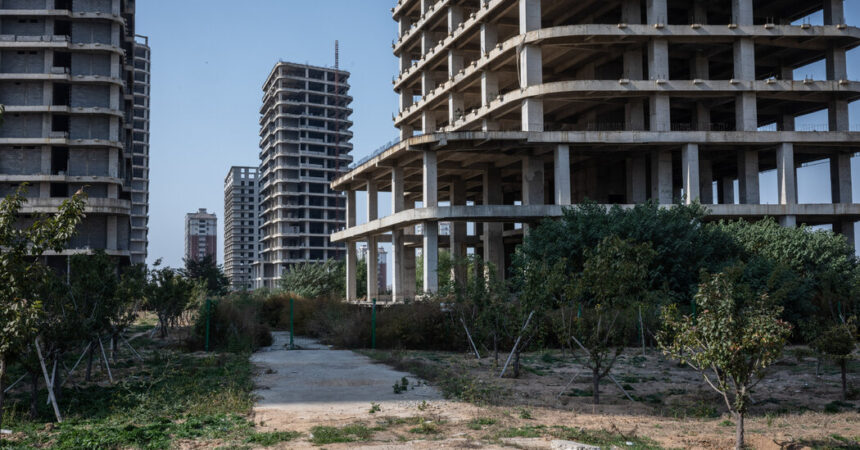
China has a bigger problem lurking behind all those empty apartments: even more homes that developers already sold but have not finished building. By one conservative estimate, that figure is around 10 million apartments.
The scale of China’s real estate boom was breathtaking. The extent of its unrelenting bust, which began nearly four years ago, remains vast and unclear.
China’s leaders were already managing a slowdown after three decades of double-digit growth before the housing crisis created a downturn that is spiraling out of their control. Few experts believe that Beijing can transition to more sustainable growth without confronting all those empty apartments and the developers that overextended to build them. All told, trillions of dollars are owed to builders, painters, real estate agents, small companies and banks around the country.
After decades of promoting the biggest real estate boom the world has ever seen, and allowing it to become nearly one-third of China’s economic growth, Beijing stepped in suddenly in 2020 to cut off the easy money that fueled the expansion, setting off a chain of bankruptcies that shocked a nation of home buyers.
It was the first test of Beijing’s determination to wean China’s economy off its decades-long dependence on building and construction to sustain the economy.
Now the government is confronting another test of its resolve. To stop the excesses of the past, it signaled over the last few years that no real estate company was too big to fail. But as dozens of big developers have gone bust, they have obliterated any confidence that remained in the housing market. Officials have since tried everything to restore optimism among buyers. Nothing has worked.
With few buyers, developers that are still standing are also on the brink of default. And they are intricately connected to local banks and the financial system that underpins the government in every village, town and city. One recent estimate, from the research firm Rhodium Group, put the real estate sector’s entire domestic borrowings, including loans and bonds, at more than $10 trillion, of which only a tiny portion have been recognized.
“Right now, not being able to sell homes looks like a risk, but it isn’t. More developers going bankrupt is,” said Dan Wang, chief economist at Hang Seng Bank. The first big developers to default, like China Evergrande, were problems hiding in plain sight.
Evergrande’s initial default in December 2021 set off fears of China’s own “Lehman moment,” a reference to the 2008 collapse of Lehman Brothers, which set off a global financial meltdown. The fallout, however, was carefully and quietly managed through policy support that let Evergrande finish building many apartments. By the time a judge ordered the company to be liquidated five months ago, Evergrande had effectively ceased being a viable business.
But China has tens of thousands of smaller developers around the country. The only way for officials to stop the free fall in the market, Ms. Wang said, is to bail out some midsize developers in cities where the crisis is more acute.
China’s top leaders are instead refocusing the lens to address the millions of apartments that no one wants to buy, pledging to turn them into social housing at lower rents. They have committed $41.5 billion to help fund loans for state-owned companies to start buying unwanted property — altogether equivalent to eight billion square feet, of which a little more than four billion square feet is unsold apartments, according to the National Bureau of Statistics.
When Beijing’s response was announced last week, shares in developers initially rallied. But some critics said the initiative had come too late. And most speculated that it would take a lot more money. Estimates ranged from $280 billion to $560 billion.
Officials in Beijing began softening their approach last year. They directed banks to funnel loans and other financing to dozens of real estate companies they deemed good enough to be on a government “white list.”
The support was not enough to stop housing prices from crashing.
Policymakers pulled other levers. They made their biggest cut ever to mortgage rates. They tried pilot programs to get residents to trade in old apartments and buy new ones. They even offered cheap loans to some cities to test out the idea of buying unsold apartments.
In all, local authorities tried out more than 300 measures to increase sales and bolster real estate companies, according to Caixin, a Chinese economic news outlet.
Still, the number of unsold homes continued to reach new levels. Prices of new homes kept falling. So at the end of April, Mr. Xi and his 23 top policymakers began to discuss the idea of taking some of those unwanted apartments off the market in a program not unlike the Troubled Asset Relief Program, which the U.S. government set up in the wake of the American housing market crash.
Last week, China’s most senior official in charge of the economy, Vice Premier He Lifeng, convened an online gathering of officials from across the country and delivered the news: It was time to start buying apartments. Not long after, the central bank loosened rules for mortgages and the central bank promised to make billions of dollars available to help state-owned companies buy apartments.
The move underscored just how worried the government had become about the dysfunctions in the housing market.
Yet almost as soon as state media reported Mr. He’s call on local governments to buy unsold apartments, economists started asking questions.
Would local governments be expected to buy all the unsold apartments? What if they, in turn, could not find buyers? And there was the price tag: Economists calculated that such a program should be in the hundreds of billions of dollars, not tens of billions.
More worryingly, to some, the central bank had already quietly started an apartment buyback program for eight hard-hit cities, committing $14 billion in cheap loans, of which only $280 million had been used. Those governments did not appear to be interested in using the loans for the same reason that consumers did not want to buy houses in smaller cities.
One big difference now, said John Lam, the head of China property research at UBS, the Swiss bank, is political will. The country’s most powerful leaders have said they stand behind a buyback plan. That will put political pressure on officials to act.
“The local government can acquire the apartments at a loss,” Mr. Lam said.
Yet in places where the population is shrinking, which are some of the same cities and towns where developers expanded most aggressively, there will be little need for social housing projects.
The optimistic view is that Beijing has more planned.
“Beijing is headed in the right direction with regard to ending the epic housing crisis,” Ting Lu, chief China economist at the Japanese bank Nomura, wrote in an email to clients.
The task, he added, was a daunting one that required “more patience when awaiting more draconian measures.”