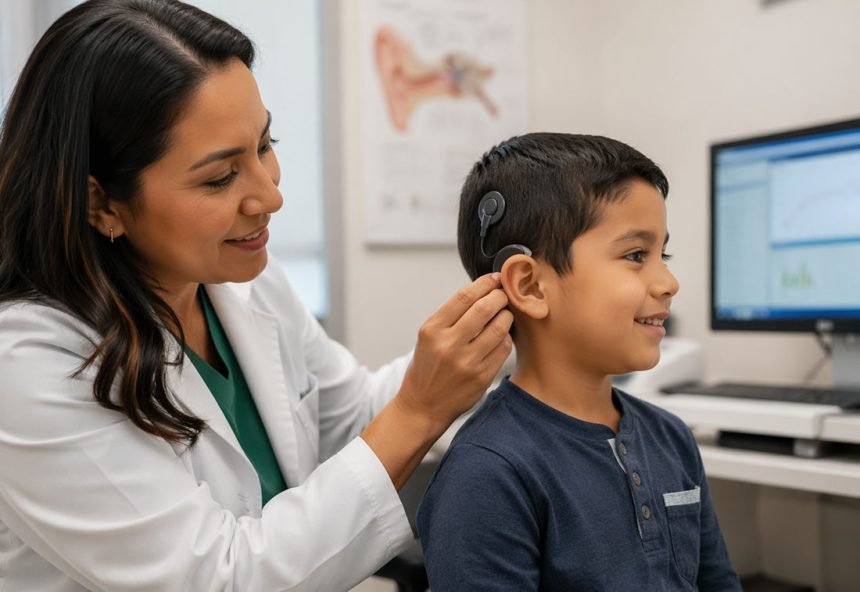
University of Miami Miller School of Medicine audiologists are developing new tools and clinical recommendations in cochlear implant assessments for Spanish-speaking children and adults.
Spanish-speaking children and adults with hearing loss can face an unexpected barrier to cochlear implant care. The tests used to determine eligibility are often designed only for English speakers.
Now two audiologists from the University of Miami Miller School of Medicine are working to tackle this challenge. At the 2026 meeting of the American Cochlear Implant Alliance (ACIA), Chrisanda Marie Sanchez, Au.D., director of the Children’s Hearing Program and associate professor of clinical otolaryngology at the Miller School, and Sandra Velandia, Au.D., an associate professor of audiology at the Miller School, each presented work in progress toward a solution to the assessment gap.
Rethinking Cochlear Implants in Spanish-Speaking Children
To qualify for cochlear implants, patients need to take two tests. One measures hearing levels and another speech understanding. During testing, patients repeat a series of recorded or spoken words. Right now, the word understanding test is only available in English, which limits access for patients who have a different native language.
“In Miami, we serve a very diverse, multicultural population, largely Hispanic, and there have been no clinically available, validated measures in Spanish for children,” said Dr. Sanchez, who specializes in pediatric audiology.
Dr. Sanchez, herself a native Spanish speaker, gave a podium presentation at ACIA about her work to develop a clinical measure for assessment of pediatric Spanish-speaking patients, which was funded by a research pilot program with a cochlear implant manufacturer.

“What ends up happening is that our field says, ‘I couldn’t test them,’ because there was no appropriate test,” she said. “That can potentially squander an opportunity for a child to benefit from this technology, and a health disparity is potentially created or exacerbated.”
Since only 3 percent of audiologists in the United States speak Spanish fluently, Dr. Sanchez points out that an effective assessment tool needs to serve two purposes.
“It has to be able to assess children whose first language is Spanish. But an English-speaking audiologist also needs to be able to give the test, so it can’t be too complex,” she said.
Dr. Sanchez presented on her development of the initial phase of the assessment tool. Next she’ll be developing a means for English-speaking audiologists to administer the test, so that both types of barriers are addressed.
As the leading U.S. conference focused on cochlear implantation, ACIA helps shape best practices and clinical guidelines across the field.
“If indication should change, or if lobbying is needed, the ACIA are the leaders in pushing the field forward. It’s a unique group, because it encompasses surgeons, audiologists, speech therapists, psychologists, educators and other support members that are integral in the cochlear implant journey for patients,” said Dr. Sanchez.
Expanding Clinical Guidance for Spanish-Speaking Adults
While Dr. Sanchez’s work focuses on children, similar challenges exist for Spanish-speaking adults being evaluated for cochlear implants. Dr. Velandia co-chaired a task force at ACIA that aims to address the issues with cochlear implant assessment among Spanish-speaking adults with hearing loss.
“Many patients do not receive appropriate care due to language barriers and limited familiarity with assessment tools for Spanish-speaking populations,” said Dr. Velandia. “Even when bilingual providers are available, they may lack guidance on which tools to use or how to administer them.”
During a panel session, Dr. Velandia and other leaders introduced the Spanish Task Force, which presented the results of a scoping review of studies focusing on Hispanic adults with hearing loss being considered for cochlear implantation.

“Our goal is to provide clinicians and physicians with clear recommendations on test selection, administration and appropriate referral timing,” said Dr. Velandia.
The literature included in the scoping review addressed audiologic assessment, aided speech perception testing and cultural and linguistic considerations. From the findings, the task force identified 10 key themes, which were translated into 10 clinical recommendations for pre-cochlear implant evaluation.
One recommendation suggested use of an already-existing tool that provides a recording of two-syllable Spanish words. One-syllable words, which comprise most of the words on English cochlear implant assessment tests, are more common and recognizable in English than they are in Spanish.
The panel applied the 10 recommendations to guide discussion of a clinical case, which highlighted current gaps in knowledge and practice. Presenters provided guidance on when to refer Spanish-speaking and/or bilingual English and Spanish adult patients for cochlear implant evaluation.
“If patients meet the referring criteria, they should be referred for evaluation for cochlear implantation,” said Dr. Velandia. “Because Spanish differs linguistically from English, some patients may not strictly meet the referring criteria, but still experience significant communication difficulties. These patients should also be considered for evaluation, especially if they report ongoing struggles.”
Together, the efforts presented at ACIA reflect a growing commitment to ensuring that language differences do not become barriers to life-changing hearing care.
More from the Miller School of Medicine
Tags: ACIA 2026, American Cochlear Implant Alliance, audiology, cochlear implants, Department of Otolaryngology, Division of Audiology, Dr. Chrisanda Sanchez, Dr. Ivette Cejas, Dr. Meredith Holcomb, hearing, hearing loss, otolaryngology