
Bill Gates is huge investor in nuclear fusion
Bill Gates said he’s a huge investor in nuclear fusion and fission. He spoke Sunday with Francine Lacqua on the sidelines of the COP28 summit in Dubai.
Bloomberg – Technology
STOUGHTON – Researchers and state lawmakers are hoping to turn Wisconsin into the “Silicon Valley” for nuclear technology research and development, ushering in a new era of clean energy generation for the state.
A group of researchers from the University of Wisconsin-Madison and Realta Fusion, a Madison-based nuclear startup, have developed a fusion device in Stoughton that creates the same kind of reaction that fuels the sun and stars. The process is much different than fission, the nuclear reaction that powers current nuclear reactors and the atomic bomb.
Fusion is a carbon-free process that relies on heated plasma, a gas made up of hot ions and free-moving electrons. The process doesn’t create radioactive waste like current nuclear reactors do, so it eliminates the need to store harmful materials.
Wisconsin lawmakers are hoping to work alongside those researchers as they learn about scaling up fusion reactions and create support for companies interested in researching and investing in the technology.
Three of the 45 companies working on fusion are already located in Wisconsin, and the new bills could encourage more to come here.
Nuclear energy could be one area of compromise for Wisconsin lawmakers, with Gov. Tony Evers including it in his most recent budget proposal, and Republican legislators pushing a package of bills that would lay the groundwork for a new, cleaner type of nuclear energy to meet the rising energy demands statewide.
Rep. David Steffen, R-Howard, is one of the lawmakers who authored a package of three bills supporting nuclear development in Wisconsin and streamlining the process of locating a new fusion energy plant when the technology is ready.
“We are already in a deficit position in terms of energy production and next-generation nuclear provides the greatest opportunity for sustainable, clean, safe energy for the people and businesses of Wisconsin,” he said in an interview.
The package includes two bills and one resolution in support of nuclear energy, authored by Steffen, Rep. Shae Sortwell, R-Two Rivers, and Sen. Julian Bradley, R-New Berlin.
The resolution contends Wisconsin is a desirable location for nuclear development, and how technology discovered in the state can be used to strengthen national security and provide safe, clean energy.
The Senate has approved the resolution, and the Assembly will have its first look at it in an upcoming Committee on Rules meeting
The second of the three bills would create a State of Wisconsin Nuclear Power Summit Board and direct the state to host a summit, drawing knowledge to the state. The bill would also allocate funding for the summit.
The final bill would direct the Public Service Commission to conduct a nuclear power siting study, to find the best location for a new plant to be erected in the Madison area.
The bills have not yet been taken up by committees but could receive hearings as soon as next week.
Steffen said a working power plant likely wouldn’t go online for nearly a decade. It’s important to get the legislative work done now, he said, so that when a company is ready to build a new plant, all of the groundwork has already been laid.
Another driver behind the bills is the newly proposed Microsoft center in Mount Pleasant, which will need a large amount of reliable energy, he said.
“We are going to be in a dramatic energy production deficit very soon,” Steffen said. “The Microsoft data center campus will be drawing more power than the entire city of Madison.”
Evers’ budget also directs the Public Service Commission to conduct a nuclear feasibility study and create an appropriation to fund it, signs that the issue may see some agreement between Republicans and Democrats.
But there could be a catch in getting the other bills passed, because of debate over another set of bills focused on energy.
Republicans are locked in a fierce debate over energy regulation, with one side supporting the so-called “Right of First Refusal” bill and others supporting the “Energy Reform Act.” The second bill would incentivize nuclear energy development in the state, but both largely focus on energy transmission and who gets the first rights to building transmission lines.
But as that debate plays out, the interest in nuclear energy still seems like a focus for Wisconsin, both for lawmakers and researchers.
‘You turn it on, and it just runs’
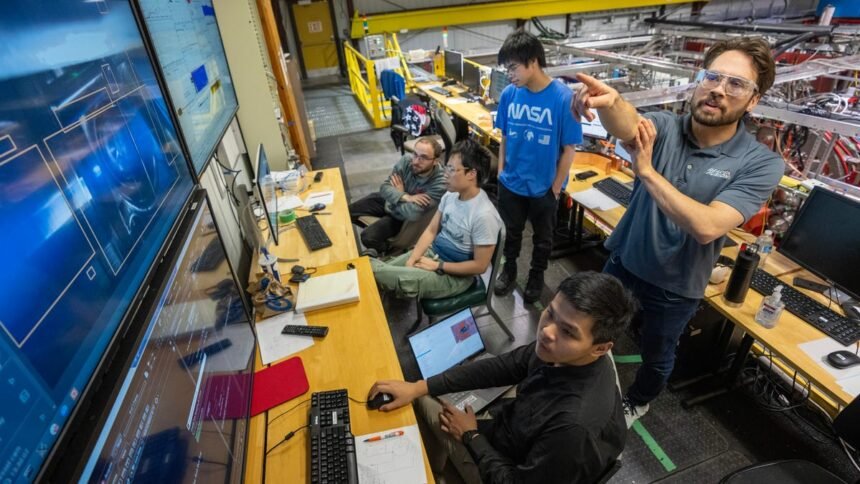
In Stoughton, just a few miles south of Madison, Realta Fusion and researchers and students from UW-Madison have been developing a small fusion reactor that has been generating plasma for the last several months successfully.
The reactor isn’t noisy. Though the reaction isn’t visible inside the machine, periodic clicks measure what’s happening inside. Nearby, a group of researchers studies charts of the energy being produced.
The reactor traps high-energy particles, or plasma, between two magnetic fields and creates fusion reactions. The fusion reaction uses smaller elements, like hydrogen, and fuses them together, instead of breaking larger elements like fission does, said Dominick Bindl, the vice president of technical development for Realta.
The process of fusion is much cleaner than fission, Bindl said, and there aren’t any radioactive waste left behind, making it safer and environmentally friendly.
“After you complete the fusion between two isotopes of hydrogen, you make helium and no long-lived radioactive waste,” he said. “It’s emissions-free. There are no carbon emissions from the formation of this energy.”
And because the fusion reaction creates “dense” energy when a plant is eventually built, it will contain all the fuel needed for 30 years of operation, Bindl said. Once the reactor is turned on, it will run constantly and be able to feed into the energy grid. There won’t be a need to establish a new grid or add in supporting technology.
“You turn it on, and it just runs,” he said.
A plant would require a cooling system, but less so than the current nuclear reactors, which have to be sited near bodies of water and require large amounts.
The companies are currently studying the reactions in Stoughton to figure out how far away from communities fusion reactors would have to be, but there will likely be less space to consider because the reactions are safer. This technology is vastly different than the reactors that melted down in Chernobyl.
Realta is doing work to ensure that people understand the difference between fission and fusion, and will work diligently to educate and assure people if they’re worried or scared.
“There’s no such thing as a fusion runaway reaction,” Bindl said. “That’s where we spend a lot of time engaging with the community on educating the community as to what fusion is, what the risks are, and how we will manage those risks to ensure that when we have fusion technologies available to deploy energy, people want those solutions.”
‘Not your father’s nuclear’
Steffen is well aware that there is hesitancy around nuclear energy from the public.
Recent television shows about the Chernobyl explosion have brought those worries to the forefront again, and environmental groups routinely push back on the state’s current reactors in Kewaunee and at Point Beach near Two Rivers over worries about pollution in Lake Michigan from the nuclear waste storage. But he encourages residents to learn more about fusion, and how much safer it really is.
“The next generation nuclear is not your father’s nuclear,” he said. “The plans that are going to be coming online in the next decade are ones that are safer, cleaner, produce less waste. They’re smaller.”
This is “an incredible opportunity for the future,” he said, and Wisconsin has the chance to be at the forefront of the research and implementation of this new technology. With investors like Bill Gates supporting fusion, it’s sure to grow by leaps and bounds in the coming decade.
If the bills proposed in the Legislature are all passed, Wisconsin will be steps ahead of other states and already know where there’s space to put a plant. Capitalizing on this opportunity now gives the opportunity to cement the state as a place where nuclear research and development is welcome and encouraged, Steffen said.
It’s an opportunity that doesn’t exist for solar or wind energy. While the state can purchase those products, it’s unlikely that Wisconsin will become a leader in those areas.
“Wisconsin already is considered a leader on fusion technology, and we do have arguably the world’s best nuclear engineering program, and we are already a recognized international hub for nuclear technology, especially next-generation nuclear,” Steffen said. “We have the opportunity to capitalize that and make Wisconsin and Dane County in particular the Silicon Valley of next generation.”
Laura Schulte can be reached at leschulte@jrn.com and on X @SchulteLaura.