


- Wing, a drone delivery company, anticipates working with a Walmart store within 30 nautical miles of the Salt Lake City airport early next year.
- Residents within about 6 miles of the store could order on the Walmart or Wing app and have an item lowered into their front yard.
- Before flying, Wing needs local permits for a “nest” that uses about 30 parking spaces, and the company says engaging with the community is “the first priority.”
Salt Lake City shoppers who forget the ground beef may soon get it dropped from the sky.
Wing, an Alphabet-owned drone delivery company, expects to launch service from a Walmart store within 30 nautical miles of Salt Lake City International Airport in early 2027, bringing a service already flying in Texas, Georgia, Florida and North Carolina.
Residents living within 6 miles of a participating Walmart may be able to get a last-minute grocery item in under five minutes.
“We continue to see an expectation and a demand for more delivered items,” said Jessie Poole-Strang, spokesperson for Wing. “People want to save time. They don’t want to be in traffic. And so what we have created is this system that can efficiently get 2-pound packages without a 2-ton vehicle.”
In Atlanta, Poole-Strang said residents who lived 20 minutes from a Walmart store were able to receive a drone delivery in under five minutes. In Dallas, Wing estimates deliveries have saved customers 13 years in drive time.
And the company wants to expand farther west.
How it works

Salt Lake City residents will be able to order deliveries on the Walmart app or on Wing’s app. In the Walmart app, there will be an option for “drone delivery.”
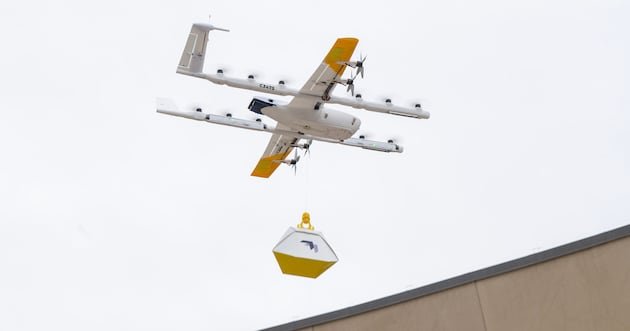
There are two drone models. The first, a drone with 16 small propellers, can carry up to 2.75 pounds and weighs only 11.7 pounds. It’s covered in an expanded polystyrene foam — a Styrofoam-like material, like what’s on the inside of a bike helmet.
The second drone can carry up to 5 pounds and weighs 17.2 pounds. It can cruise at 60 miles per hour for a 12-mile round trip.
“It’s designed to be extremely lightweight and extremely efficient,” said Poole-Strang.
Depending on what item the customer orders, an appropriately sized drone is chosen for the delivery. Pressing “order” sets the process in motion.
Walmart employees gather items as usual, and Wing operators start “route planning.”
Wing holds an FAA Part 135 air carrier certificate and operates beyond-visual-line-of-sight under FAA approvals. Its drones share the same sky as traditional aircraft, as well as recreational drones. Operators plan a route deemed most efficient to reach the customer — a route that Wing says changes each time to avoid continuously flying over the same residential spaces.
“If the aircraft detects that there is a traditional aircraft in its area, we can detect and avoid it. So that’s how we handle traditional aircraft,” said Poole-Strang. “But there’s a whole other component, which is other drone operators. … We have a whole system that commercial drone operators are using to share the air with them as well.”

From there, Walmart employees and Wing operators meet at the “nest.”
Wing operators might set up in the Walmart parking lot — using 30 parking spaces or so. “It’s just simple charge pads,” said Poole-Strang. “We put up a fence, we have a battery generator, and we’re flying.”
She said though the setup is not complex, Wing needs to ensure it’s properly permitted with local authorities. In Bentonville, Arkansas, the town’s planning commission voted 7-0 to approve a Wing “nest” — comprising 27 parking spaces — at a Walmart store.
Walmart employees place the item — which, Poole-Strang says, is most commonly ground beef — into a water-resistant paperboard bag. The bag is clipped to the drone, which then prepares for takeoff. It can fly in rain, snow and some wind.

The drones lift off small charging pads, which are powered by a nearby battery. A Walmart store in Wylie, Texas, reported that running 27 deliveries per hour requires about 14 kilowatts — the equivalent of running the air conditioner, oven, dryer and water heater at once in a home.
The drone autonomously and speedily flies to its destination. The customer decides where the “delivery zone” is — somewhere like the front yard.
“At the delivery, it’s going to gently lower the package to the ground. No help needed,” said Poole-Strang. “Gravity helps detach the hook, and then the tether will be back secured and flying back to where we charge our aircraft.”
Wing says it has programmed the drones to respond to unexpected interactions, like children wanting to play with the tether, a dog in the delivery zone or a broken propeller — all handled without a human pilot.
“We have built from the ground up for residential safe delivery,” said Poole-Strang. “Everything was designed knowing that deliveries to residential homes involves variables that we can’t always control.”
The ‘first priority’

Though innovation is one of Wing’s driving forces, Poole-Strang said engaging with the community is “the first priority.”
“The drone industry is scaling extremely fast, and it’s hard to understand if you’ve never seen the technology before, the differences in different aircraft,” she said. “That’s why we go and demonstrate the technology in the community so people can see it.”
In June 2026, the company surpassed 1 million deliveries — and counting. Wing, in a partnership with Walmart, plans to add 270 “nest” locations nationwide.
“With every new community, we want to make sure everybody understands what the drones look like, what they can expect from our service,” said Poole-Strang. “And then we’ll start conversations with every local municipality about setting up a drone hub or a nest.”
Wing looks at urban and suburban areas and picks stores depending on where the state has the most need. “We do believe that we’re saving people that just don’t want to go to the store, so we’re saving those local miles and time,” she said.