



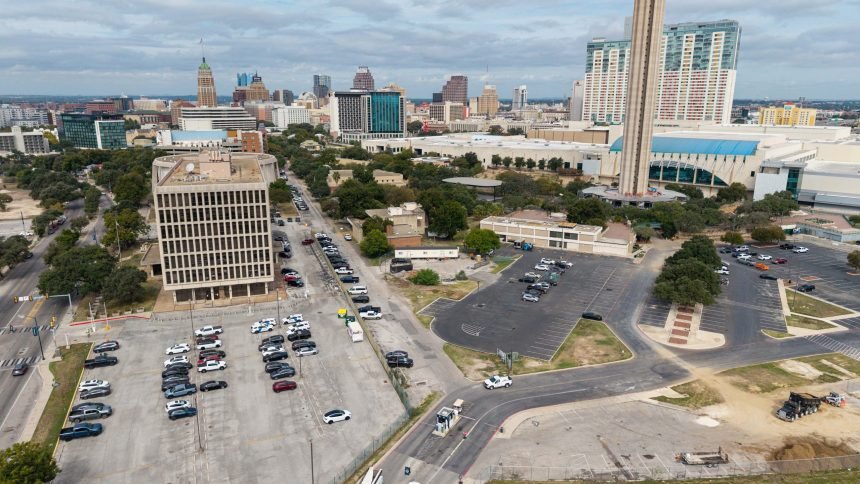
The new downtown arena will come with a parking garage for 1,500 vehicles.
The facility is being designed to hold 17,000 to 18,500 people.
Spurs leaders and city officials say, when combined with other parking and transit options downtown, the sports and entertainment district will have sufficient parking as well as ways to get there — an assessment that also depends on a proposed 2027 bond-funded project to redevelop the roadways in the district.
Early analysis of a study on downtown accessibility and mobility showed there’s plenty of vehicle parking throughout the urban core to support the district even as it expands to include the stadium and new apartments, hotels and a bigger convention center.
Chief Downtown Officer Shanon Miller said the city is studying the overall mobility picture — both parking supply and demand on event days and all the ways that people travel into and out of the city.
An implementation plan will be completed in early 2027, she said. But the study has already revealed that the challenges related to mobility downtown are not caused by a lack of parking supply, Miller said.
“We have enough parking downtown generally, and so as a result, the consultant team is not recommending that we pursue constructing a parking structure,” at the Alamodome, she said.
The question came up often during a summer-long public listening tour. Parking and access was a top concern San Antonio residents expressed, said Bobby Perez, chief legal officer and general counsel of Spurs Sports and Entertainment.
“I want to make sure I have a place that I can get to, it’s accessible, I can park at,” Perez said of their comments. “Or, if you’re a neighbor [to the arena], that it doesn’t undermine what I have today.”
It’s just as critical to the Spurs, he said, as the franchise owners plan for a $1.8 billion arena expected to open in 2030. The organization has conducted multiple parking and mobility studies in the drive to ensure fans and event attendees have a good time.
“If you can’t get there, you can’t park there, you can’t walk through it, you don’t have shade, you won’t have a good experience, so that is front of mind for us,” Perez said.
On game nights, the Frost Bank Center, which holds up to 19,000, uses about 4,000 to 6,000 of the total parking spaces surrounding the county-owned facility.
By contrast, the Alamodome has a capacity of up to 72,000, and between 2,700 and 3,500 on-site parking spaces, plus a VIA Metropolitan Transit park-and-ride station.
San Antonio’s city-owned arena will be built on 6 to 8 acres of the total 25 acres of property the Spurs organization is developing. The arena size is dictated by NBA standards.
The adjacent garage also will be open to the public on non-game or event days with revenue going to the Spurs.
Parking garages add a hefty price tag to any development. A UCLA study released in February estimated the cost to build an above-ground parking garage in Austin, one of 17 cities it included, is about $52,000 per parking space.
The Spurs also will build parking for its other projects in the district, which include a hotel and retail space, as required by code — spaces that will ultimately count toward the overall parking that will be available in the district.
Perez said the Spurs organization is confident in its assessment of the parking need.
“We’ve been operating an arena for almost 30 years, so we know exactly what our fan base uses today and how it works today,” he said, adding, “We’ve got the benefit of watching and learning from no less than every other NBA arena that operates in the downtown.”
The city’s study showed it needs to use technology and take other steps to help drivers more easily find and pay for parking. In addition to numerous private parking options, a parking map shows there are five public parking garages and eight lots in downtown San Antonio.
The study also recommends further investment in public transit and remote parking options, and evaluating rideshare policies.
VIA’s advanced rapid transit lines under construction also add to the equation. The north-south Green Line is expected to be completed in April 2028 and the east-west Silver Line in late 2030.
Through its Park & Ride service, VIA already moves thousands of people in and out of downtown on big event days. The number ranges widely depending on how many park-and-ride service buses are deployed. In 2025, the service provided 23,254 rides for simultaneous Paul McCartney concert and Muertos Fest events with service operating from three facilities.
Port SA President and CEO Jim Perschbach has presented another transit option as achievable. While it may sound fantastical, air bus and vertiport concepts should be considered, he said, and Perez said he supports the idea.
“Everybody wants to build a facility that’s future proof, and that is front of mind on mobility, on communication, on technology, on fan engagement, and on operations,” he said.
The city’s also studying how the East Side connects to other parts of town including the sports district. The federal Reconnecting Communities grant is expected to offer some solutions in spring 2027, but not the funding to make changes.
When it comes to getting in and out of downtown, the city is looking for funding from the Texas Department of Transportation (TxDOT) to redevelop the highway ramps while it works to improve traffic flow in the district by extending Nueva Street and improving Durango Boulevard.
Those projects, plus improving the Interstate 37 interchange, add up to $34.2 million and are on a list of potential 2027 bond items that could be decided by voters in May.
The bond funding would be used as leveraged funds for another $85.2 million from TxDOT which, when added to the city’s portion of $21.3 million in bond dollars, brings the total cost of the project to $106.5 million for I-37 improvements.
That’s why SS&E also wants to see the 2027 bond propositions passed, Perez said, and plans to actively pitch the bond to voters.
“We are really excited about taking the next step with all our local supporters and going out and rallying support for some really good projects throughout the city of San Antonio,” he said.
“We think everybody from City Council will be supportive of the effort,” he added. “We think our neighborhood associations will be supportive of effort, as well as our community.”