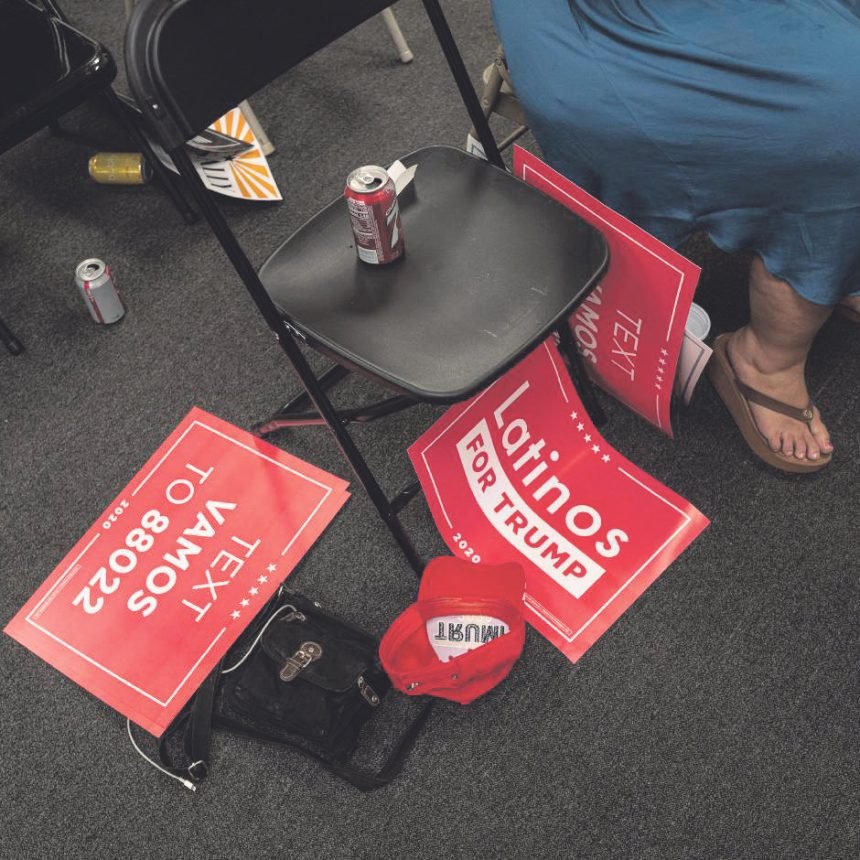
Latino voters shifted sharply toward President Donald Trump in each of the past two presidential elections, a trend that shocked and confounded Democrats.
Many in the party have been asking: Why did this happen, and what can we do about it?
Those questions are even more urgent now for Democrats, with Latino voters set to play a key midterm role in deciding who wins control of Congress. They make up at least 20% of the population in a majority of the most competitive House districts. And Latinos also account for a significant slice of voters in two crucial Senate races — North Carolina and Georgia.
Way to Win, a Democratic-aligned group that focuses on the Sun Belt, including Latino voters, released a new report Wednesday that offers some possible answers for the party.
One conclusion: “The fastest way to lose these communities is to treat their ethnicity as the most interesting thing about them,” the report said.
It’s worth lingering on that statement. Some Democrats have long treated Latino voters as a kind of monolithic group. They’ve focused on Spanish-language advertising, brought mariachi bands to campaign rallies, and sprinkled Spanish into their speeches — all in an effort to attract a growing demographic that is essential to a winning national coalition.
This report suggests that the reality is much more complicated.
‘Hustle culture is dead’
One reason is apathy. Previous research from the group has suggested that Latino voters chose to sit out the 2024 presidential election at higher rates than any other demographic. In the Sun Belt, which includes heavily Latino states such as Texas, Arizona and Nevada, Latino voters were much more likely than other ethnic groups to cast a ballot in 2020, but then skip voting in 2024.
Much of that had to do with a deep-seated frustration that appears to have only gotten worse. Way to Win interviewed 122 Latino voters and found that:
— Almost half did not trust any level of government.
— When asked to pick one word to describe the government, nearly every participant chose a negative one.
— Many believed that “elites” deliberately stoked mistrust and benefited from it.
— Many have stopped believing that anyone in charge takes their responsibility seriously.
While those interviewed are just a slice and may not be fully representative, these attitudes are far more negative compared with similar research done just three years ago. At the time, Way to Win researchers found that most Latinos believed they could “get ahead if they worked hard and played by the rules.” Now, these interviews “reveal a sentiment that hustle culture is dead,” said Tory Gavito, the president of Way to Win.
For decades, research on Latino voters has shown them maintaining a durable optimism, but several polls have shown that this optimism is fading.
“It’s starting to erode and it’s also starting to erode trust,” Gavito said. “People feel like we’re putting in and not getting anything out. They believe there’s a reciprocity the government should be creating.”
At the same time, most Latino voters define themselves by their values, not their race and ethnicity. When participants were asked to describe who they were, they spoke about faith, family, compassion, hard work and resilience.
But there was an important and telling exception — when voters saw persistent threats. Several respondents said the past year had raised intense fears about being detained by immigration agents based on their appearance or accent.
A shifting political moment
So where does that leave Democrats?
They have to simultaneously acknowledge that these voters feel under threat because of their ethnicity, Gavito said, and are desperate to see that their hard work is paying off.
“Don’t come at me with this cultural pandering,” she said. “I want to know how you’re going to fight for me.”
That said, Gavito added, Latino voters do not always bristle if familiar cultural references are used in politics.
In California, Xavier Becerra began embracing the moniker “Tío Xavier” in the final weeks of the primary race for governor. Now, he appears well on his way to becoming the state’s first Latino governor in modern history.
Just a year ago, immigration raids and protests engulfed Southern California. Even now, many residents talk about carrying their passports with them at all times, so that they can prove their citizenship.
“There is an awareness of the racial animus within the Trump administration and the precarity of the moment,” Gavito said.
But even if Democrats manage to win back some Latino voters this fall, there is little reason to think that this would guarantee party fealty. The last several elections have shown that Latinos are arguably the most pivotal swing demographic in the country.
Figuring out how to appeal to these voters is central to both parties’ futures.