Sign up for Chalkbeat Colorado’s free daily newsletter to get the latest reporting from us, plus curated news from other Colorado outlets, delivered to your inbox.
The autism center at Denver’s West High School is twice as big as a typical classroom and more than half as empty. That’s intentional: These specialized centers are meant to have fewer students, more adults, and be a more versatile space.
“The crux of having a center-based program is that we have the flexibility, where we have the staff availability, to give more individualized support,” said teacher Jonathan Baker, who had three teachers aides helping him with seven students during the second week of school.
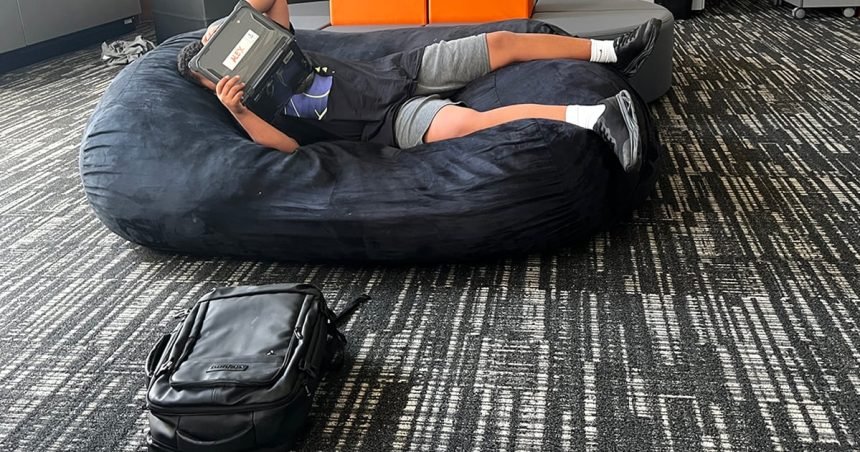
Sometimes the students do whole-class activities, like making blueberry popsicles. Other times, one student might sink into a giant classroom beanbag to work independently on a virtual reading program while another attends a grade-level algebra class with support from an aide.
The classroom is stocked with Play-Doh and fidget toys to help the students self-regulate. Next to the beanbag are soft rocking chairs and a foam-sided pit that one student likes to curl into.
As the number of children identified with autism rises nationwide, more students are needing special education services. Colorado’s largest school district, Denver Public Schools, has opened 28 new autism classrooms in the past two years, including the center at West High. The classrooms, which are officially called multi-intensive autism center-based programs, typically serve 8 to 12 students and are staffed by as many as four adults.
That support comes at a cost of more than $230,000 per classroom, at a time when the district faces mounting financial pressure. While the number of students with disabilities is up, overall enrollment is down. That means Denver and other districts with declining enrollment are getting less per-pupil funding from the state. A proposed tax increase to benefit DPS that will appear on the November ballot would earmark $2 million for special education.
“We want to provide these programs for students with special needs, but it is also something to note in the budget because it is very expensive programming we’re offering,” Chuck Carpenter, the chief financial officer for Denver Public Schools, told the school board this past spring.
Many experts attribute the rise in autism diagnoses to better screening and a widened definition. The number of DPS students with autism who need special education services has increased nearly 75% in the past five years, according to district data. In 2021, there were 1,315 such students. Last year, the number was 2,280. DPS serves about 89,000 students.
Not all students with autism need a dedicated classroom, and not everyone believes in separating students with disabilities. The decision to place a student in a center-based program is up to their special education team, and district officials said they started to see an increase in such placements about three years ago. Changing Medicaid rules also resulted in more children with autism enrolling in public schools rather than full-time therapy, officials said.
Ivy Rodriguez’s daughter Soly is among them. Soly is nonverbal and developmentally delayed. She attended an applied behavior analysis therapy, or ABA, clinic from 9 a.m. to 5 p.m. Monday through Friday until last summer, Rodriguez said.
Shortly after Soly turned 9, Rodriguez said Medicaid stopped covering the cost. Rodriguez enrolled her daughter at a Denver elementary school with a center-based autism classroom. Soly is now 10 and in fifth grade, where she is working on identifying letter sounds.
Soly’s teachers have told Rodriguez that her daughter is making academic progress. Rodriguez is grateful, but she said she misses how the clinic worked with Soly on skills such as following one-step directions and interacting with other children.
“I feel like she needs those life skills and supports,” Rodriguez said.
Pam Bisceglia, the executive director of Advocacy Denver, a nonprofit organization that advocates for students with disabilities, said many of the children that she’s seen transition from full-time therapy to public school have more significant needs, like Soly. But Bisceglia said the goal is not to keep them in separate classrooms forever.
“We’d expect the kids that are going into these center programs, they should provide them with intensive services, and as the child learns different skills, they might transition from that center program to general education with adult support,” Bisceglia said.
In addition to opening more center-based programs, the increasing number of students with disabilities has led DPS to hire more “dedicated adult supports,” paraprofessionals who work one-on-one with students or in small groups.
While the number of teachers in DPS decreased by 2% between 2019 and 2025, the number of paraprofessionals increased by 28%, according to a spring budget presentation.
The district budgeted more than $29.1 million this school year for such paraprofessionals and $44.3 million for center-based programs. Not all of those paraprofessionals work in center-based programs or solely with students with autism. But district officials said students with autism are more likely to qualify for dedicated adult support.
Back at West High, Baker and the paraprofessionals were getting ready to welcome a new ninth grade student the following day, a common occurrence in center-based programs. Elissa Raduazzo, the senior team lead for special education at West High, said adding an autism center program to West’s offerings has been positive.
When Raduazzo first came to West High, the school had two center-based programs: one for students with intellectual disabilities and one for students with emotional disabilities, which can often manifest as challenging behavior.
When the school would enroll a new student with autism, Raduazzo said it could be difficult to decide where to place them. Some students with autism struggle with behavior, and others have intellectual disabilities. But those center-based programs weren’t always the best fit.
“Creating a space that is sensory-based and is rooted in some of those best practices that we know for students with autism — or people with autism, in general — has created another environment where we can best support students who need this space,” Raduazzo said.
Melanie Asmar is the bureau chief for Chalkbeat Colorado. Contact Melanie at masmar@chalkbeat.org.