But the term “digital twin” actually came from a NASA employee named John Vickers, who first used it in 2010 as part of a technology road map report for the space agency. Today, perhaps unsurprisingly, Grieves is head of the Digital Twins Institute, and Vickers is still with NASA, as its principal technologist.
Since those early days, technology has advanced, as it is wont to do. The Internet of Things has proliferated, hooking real-world sensors stuck to physical objects into the ethereal internet. Today, those devices number more than 15 billion, compared with mere millions in 2010. Computing power has continued to increase, and the cloud—more popular and powerful than it was in the previous decade—allows the makers of digital twins to scale their models up or down, or create more clones for experimentation, without investing in obscene amounts of hardware. Now, too, digital twins can incorporate artificial intelligence and machine learning to help make sense of the deluge of data points pouring in every second.
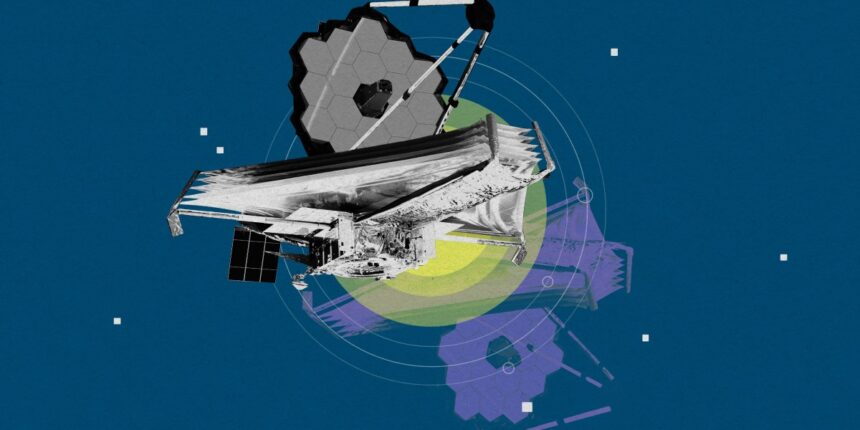
Out of those ingredients, Raytheon decided to build its JWST twin for the same reason it also works on defense twins: there was little room for error. “This was a no-fail mission,” says Casey. The twin tracks 800 million data points about its real-world sibling every day, using all those 0s and 1s to create a real-time video that’s easier for humans to monitor than many columns of numbers.
The JWST team uses the twin to monitor the observatory and also to predict the effects of changes like software updates. When testing these, engineers use an offline copy of the twin, upload hypothetical changes, and then watch what happens next. The group also uses an offline version to train operators and to troubleshoot IRL issues—the nature of which Casey declines to identify. “We call them anomalies,” she says.
Science, defense, and beyond
JWST’s digital twin is not the first space-science instrument to have a simulated sibling. A digital twin of the Curiosity rover helped NASA solve the robot’s heat issues. At CERN, the European particle accelerator, digital twins help with detector development and more mundane tasks like monitoring cranes and ventilation systems. The European Space Agency wants to use Earth observation data to create a digital twin of the planet itself.
At the Gran Telescopio Canarias, the world’s largest single-mirror telescope, the scientific team started building a twin about two years ago—before they’d even heard the term. Back then, Luis Rodríguez, head of engineering, came to Romano Corradi, the observatory’s director. “He said that we should start to interconnect things,” says Corradi. They could snag principles from industry, suggested Rodríguez, where machines regularly communicate with each other and with computers, monitor their own states, and automate responses to those states.
The team started adding sensors that relayed information about the telescope and its environment. Understanding the environmental conditions around an observatory is “fundamental in order to operate a telescope,” says Corradi. Is it going to rain, for instance, and how is temperature affecting the scope’s focus?
After they had the sensors feeding data online, they created a 3D model of the telescope that rendered those facts visually. “The advantage is very clear for the workers,” says Rodríguez, referring to those operating the telescope. “It’s more easy to manage the telescope. The telescope in the past was really, really hard because it’s very complex.”