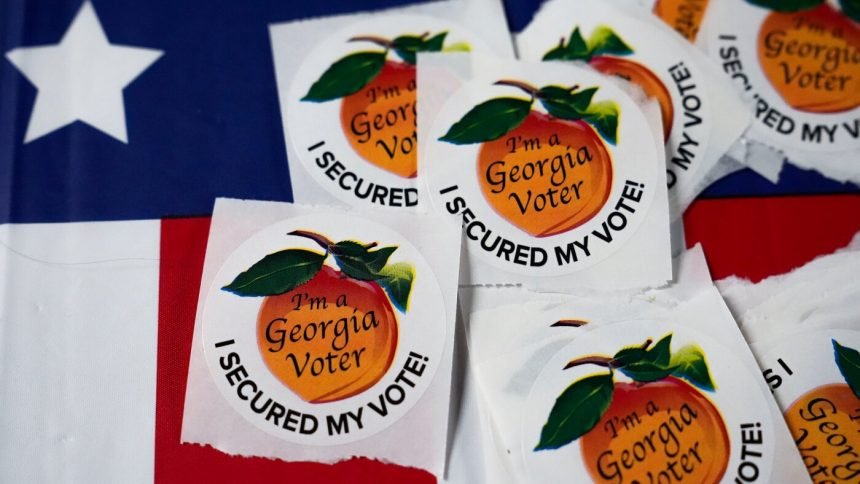
In this file photo, stickers sit on a table inside a polling place on Nov. 5, 2024, in Atlanta.
Brynn Anderson/AP
hide caption
toggle caption
Brynn Anderson/AP
ATLANTA — Tuesday’s primary elections in Georgia have been defined by record-setting fundraising, contentious Republican primaries and turnout driven by enthusiastic Democrats.
Many of the marquee races are likely to head to June 16 runoffs, as Republicans will decide who faces incumbent Democratic Sen. Jon Ossoff and both parties sift through a crowded field of candidates for governor. Republican Gov. Brian Kemp is term-limited. Both the Senate and gubernatorial contests are expected to be among the most competitive in November.
In the wake of last month’s Supreme Court decision weakening part of the Voting Rights Act, there is also increased attention on two nonpartisan Georgia Supreme Court seats on the ballot that Democrats seek to flip.
Like every other state that has held a primary election in 2026, a surge in turnout has been dominated by Democrats. More than a million Georgians cast their ballots before Election Day, with Democrats enjoying a nearly 15% turnout advantage over Republicans.
A consequential Senate matchup
Ossoff is the most vulnerable incumbent Democrat on the ballot this fall, but a divisive Republican primary has eaten up most of the time and attention in the race.

The frontrunner in polls and campaign finance reporting is Rep. Mike Collins, followed by Derek Dooley, son of famous University of Georgia football coach Vince Dooley. Dooley has the backing of Gov. Brian Kemp, who declined to run himself. Rep. Buddy Carter is also in the race.
President Trump hasn’t yet offered an endorsement, likely because the race will head to a runoff.
Self-funding Republicans dominate Georgia governor race
Georgia’s open governor’s race is one of the most competitive in the country this year, and both parties’ primaries have been dominated by arguments over electability.
On the Republican side, Lt. Gov. Burt Jones has Trump’s endorsement and enjoyed a seemingly insurmountable advantage over state Attorney General Chris Carr and Secretary of State Brad Raffensperger for much of the campaign.
But a few months ago, billionaire health care executive Rick Jackson entered the race and has already spent more than $80 million of his own money blanketing the airwaves and filling mailboxes with ads painting himself as the true Trump conservative in the race.
Jones, heir to a gas station and convenience store empire, has also loaned himself nearly $20 million, leading to the most expensive primary in Georgia’s history.
Republican candidates, worried about the party’s unpopularity nationally, argue they are the only ones that can turn out enough Republican base voters and convince moderate voters to keep the party in charge of the state government as Georgia continues to become more politically competitive. The governor’s race is widely seen as a toss-up.

The Republican primary is likely to head to a runoff, as is the Democratic contest. There, former one-term Atlanta mayor Keisha Lance Bottoms, former state Sen. Jason Esteves, former Republican Lt. Gov. Geoff Duncan and several other candidates are on the ballot.
Democrats, too, have emphasized concerns that nominating the wrong candidate could tank an otherwise winnable race, with particular focus on Bottoms’ rocky tenure as governor, decision not to run for reelection and subsequent role with the unpopular Biden administration.
More focus on nonpartisan court races
One thing expected to be decided in Tuesday’s election: a pair of seats on the Georgia Supreme Court. The race is nominally nonpartisan, though the Republican-appointed incumbents Charlie Bethel, a former state Senator, and Sarah Warren, previously the state solicitor general, face challenges from two Democrats.
Former state Sen. Jen Jordan and personal injury attorney Miracle Rankin have been endorsed by everyone from former President Barack Obama to big-name progressive groups and have highlighted recent U.S. Supreme Court rulings like last month’s Voting Rights Act case as reason to focus on state courts.
Attention to the race grew last week when Kemp announced that Georgia lawmakers would return to the statehouse June 17, one day after the primary runoffs, to consider redrawing federal and state maps for the 2028 election cycle.
While other Southern states have rushed to redraw districts that eliminate Democratic representation by dismantling majority-Black districts, Kemp previously said Georgia’s primary was already underway. The current House map includes nine Republican districts and five Democratic districts with no competitive races, even in a wave year for Democrats.
Democratic enthusiasm continues


A recurring trend in elections since Trump returned to the presidency in 2025 is on display in Georgia: overwhelming Democratic enthusiasm and voter turnout.Of the record-setting one million early voters in Georgia’s primary, roughly 56.7% pulled Democratic primary ballots compared to 41.7% Republican primary ballots, a 15% gap. The rest of the voters asked for ballots that only include nonpartisan races.
Georgia Democrats are also looking to build off of November 2025 general election results that saw two challengers flip seats on the state’s Public Service Commission with about 63% of the vote in landslide upsets.
In states that have already held midterm primaries this year, NPR has found that Democrats have seen a surge in turnout compared to the 2022 midterms, including record-setting turnout in Texas, Democrats outpacing Republicans in North Carolina and near parity between the two parties in Ohio.
This matches polling that finds a lot of people don’t like the national Democratic party brand, but will vote for Democrats in large numbers because they’re not happy with Republicans and President Trump’s second term agenda.