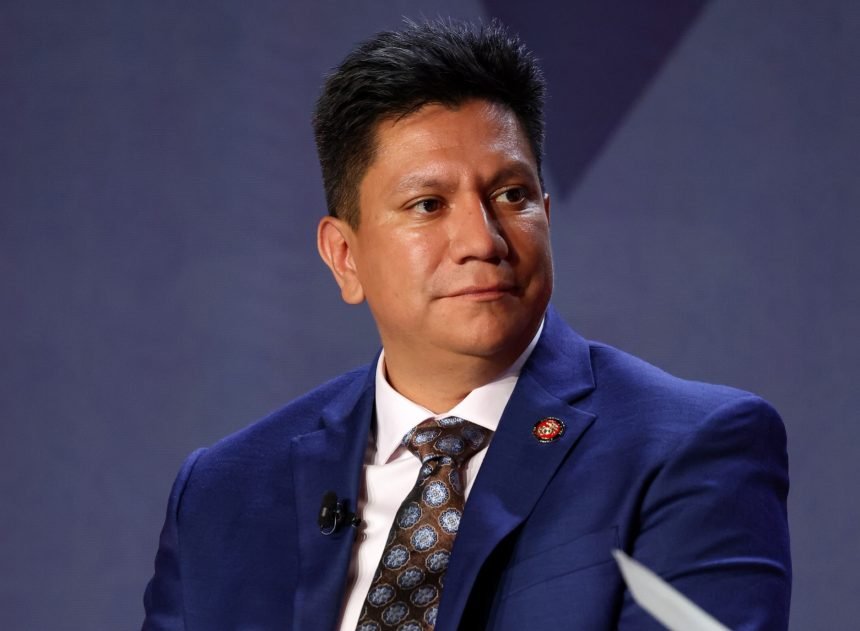
George Carrillo’s personal collection
For George Carrillo, construction is not just another industry, it is the backbone of daily life. “Everything that we do — from the houses that we build to the roads, schools, churches — everything is built on construction,” said Carrillo, CEO of the Hispanic Construction Council (HCC), to The Latin Times. “And the reality is that Latinos are the dominating force when it comes to the labor force.”
That reality has guided the council’s push over the past year to raise the visibility of Latino workers and business owners in a sector where they play a central role but are often absent from policy conversations.
Carrillo said 2025 marked a turning point. The organization released three national studies, expanded its presence in Washington, and was featured in nearly 200 articles. “There has been a lack of representation when it comes to Latinos, especially in the construction industry,” he said. “Now that we’ve stepped into that role, people are directing a lot of their questions toward us.”
Carrillo’s path to construction advocacy was unconventional. Before leading HCC, he worked in government, including as director of social determinants of health, and previously served as a U.S. Marine Corps infantryman and sheriff’s deputy. He traces his entry into the sector to the COVID-19 pandemic, when he began to challenge how essential workers were defined.
“A lot of people thought fire, police, nurses,” he said. “But we need to think about farm workers and construction workers as well, industries that are both populated by Latinos. These were two entities that during COVID did not stop. If they stop, everything stops.” His advocacy eventually led him to fund an organization that looked after Latinos in construction, leading with data and providing much-needed resources.
That perspective now informs how he sees the industry, particularly as it currently faces a mix of labor shortages, policy instability, and immigration enforcement pressures. Carrillo described 2025 as a challenging year in part because of stalled immigration reform efforts. The council supported a proposal focused narrowly on undocumented workers already in the country, pushing for a temporary legal work pathway without immediately tying it to citizenship.
According to Carrillo, both parties hesitated on the proposal for different reasons. Republicans, he said, were receptive but unwilling to move forward while President Donald Trump prioritized enforcement. Democrats, meanwhile, pointed to their lack of power. “Everybody is getting hurt by this” he says. “Both sides need to understand that if we’re solving something for the Latino community, we’re solving things for every single community.”
That argument is central to how he responds to claims from the current administration that stricter immigration enforcement protects American workers, an idea he calls “ridiculous.” In construction, he argues, the issue is not competition but shortage.
“In residential and commercial construction, we’re about 500,000 workers short. In infrastructure, it’s close to a million. If undocumented workers left tomorrow, all of us would be hurting.”
Beyond labor and immigration policies, Carrillo said one of the biggest challenges last year was economic uncertainty tied to tariffs. As he explains, construction projects often span years, requiring companies to estimate material costs far into the future — something that has become increasingly difficult.
“There’s no level of predictability,” he said. “In construction, you need a good foundation.” That uncertainty, he added, is leading developers to slow new investments while finishing projects already underway.
“Just as an example, say there’s a construction company that’s building houses in Chicago,” he illustrates. They’re probably not building the exterior of that house in the middle of winter and with a blizzard. Right now what we’re feeling is like we as an industry are in the middle of a blizzard and we’re working outside.”

George Carrillo’s personal collection
The challenges affect the entire industry but are particularly acute for Latino-owned firms, many of which remain small and undercapitalized. Carrillo said access to financing continues to be a key barrier, limiting their ability to take on larger projects. But he also pointed to a need for stronger business practices, particularly around pricing and long-term planning.
Too often, Carrillo says, small Latino contractors fall into a survival pattern that ultimately limits their growth. In many cases, they underbid projects just to secure immediate work, without factoring in long-term costs, margins or scalability.
He points to an everyday example: a contractor offering to paint a room for a fraction of its actual value. The job gets done well, but at a price that leaves no room to reinvest in the business. “They’re surviving for today,” he said, rather than building something sustainable over time. That dynamic, he argues, doesn’t just affect individual businesses — it drags down pricing standards and slows the industry’s ability to grow in a more structured way.
To address that gap, the HCC is expanding its focus on education through technology. The organization is developing practical tools — including bidding and estimating calculators, prevailing wage guides and real-time material pricing systems — designed to help contractors better understand costs, price projects accurately and operate with a longer-term strategy.
“The goal is for them to think, ‘Because of these tools, I’m more profitable, and it makes sense to continue learning how to run my business,'” Carrillo said.
At the same time, he’s quick to underscore what Latino workers already bring to the industry. “We’re hard workers. That’s something that’s instilled in us,” he says, noting that on job sites across the country, Latino workers are often the first to arrive and the last to leave — a work ethic that has become a defining feature of the construction workforce.
For all the current volatility in the industry and in Washington, Carrillo remains cautiously optimistic. His approach, shaped by years in government, is to prepare for change and act when opportunities arise. “You have to weather the storm,” he said. “And when the right moment comes, you have to be ready to walk through that door.”
For Carrillo, that readiness applies not only to policymakers and businesses, but to the Latino community itself. “We need to show that we matter,” he says.
© 2025 Latin Times. All rights reserved. Do not reproduce without permission.