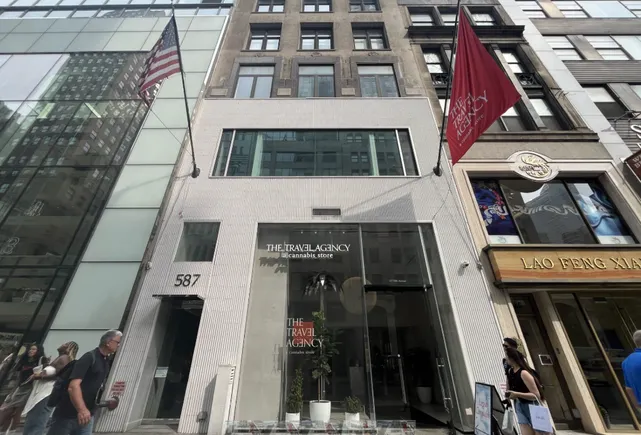


Amid the uncertainty, leaders at The Travel Agency, a luxury-style cannabis dispensary with four locations across Manhattan and Brooklyn, say the brand has emerged as one of the few operators navigating the market successfully. Marketed as a sophisticated, franchise-quality retail experience, The Travel Agency focuses on compliance, branding and strong supplier relationships to stand out in a crowded and complicated landscape. Its stores are designed to appeal to consumers seeking a premium experience in a market still working to distinguish legal operators from unlicensed ones.
In an interview with CFO.com, Roy Cysner, CFO of The Travel Agency, shares how he’s applying lessons from his career in public accounting and fast-growing retail companies like Warby Parker and Camp to the cannabis sector. He discusses Section 280E and technology challenges, the origins of this CFO-built business, supply chain management with local growers and multi-state operators and why building adaptable processes is critical to scaling a legal cannabis business in New York City.
ADAM ZAKI: Cannabis retail faces tough financial constraints — 280E, limited access to banking and technology, as well as regulatory hurdles. How do those realities shape your work as CFO here?
ROY CYSNER: My goal in finance is to create an organization that supports the rest of the business, not slows it down. We need to put processes in place so we can have complete, accurate and reliable data for the rest of the company. Only once we do that can we be comfortable using that data to budget, forecast, analyze and make strategic decisions at the highest level.
280E is a very big topic for us, and for me personally. I’m staying on top of it and updating the leadership team. Broadly, investors are always asking, ‘What’s happening with 280E? How is it affecting us?’
There are a lot of nuances in this business. We’re still in a world where many service providers just don’t want to do business with us because it’s easier for them not to. Sure, there are banks that work with us, and those are our partners. There are point-of-sale solutions, ERP solutions and AP solutions, but 90% of providers won’t touch us.
That’s part of the unique challenge we’re dealing with. We have what we think are the best solutions and processes for our business, but we can’t just pick from the entire market like other companies can. We spend a lot of time taking what’s available and shaping it the best we can to fit our business.
And one thing from my background that carries into cannabis is that there’s no one-size-fits-all solution. I’ve been a CFO in multiple roles, and you walk in and someone says, ‘What solutions did you use at your previous company? We should do that.’ But it’s not that easy. Even if the business looks similar, the right answer is often different internally. We do our best with what we have to figure it out. If it doesn’t work, I’ll dismantle it and rebuild it, and keep doing that as we scale and grow, to make sure finance can support the business in the best way.
How do technology and system choices affect your costs, given the limited solutions available to cannabis companies?
On average, our tech costs are actually lower because my approach has generally been to keep it simple. We’re operating in the New York retail cannabis market. In the scheme of businesses, we’re still fairly small.
In my previous roles, we spent a lot more money because we could. We could use large ERP providers such as NetSuite and other more advanced solutions. That made sense there. We can’t do that now. Right now, we’re on QuickBooks, and I plan to stay on QuickBooks because I’m not going to force our systems into a solution that isn’t the best fit. I don’t know if the right answer would be NetSuite or something else, but our options are limited.
When we look for solutions, it’s usually [just] three options. Payroll is a perfect example. Nobody thinks about payroll — everyone just assumes people get paid and it’s simple. But we have a payroll person who spends a lot of time making sure people are paid correctly, especially with hourly workers.
Most payroll companies will not do business with us. We’re using a current solution that isn’t a seamless fit, but we don’t know where else to go. That’s the reality of our technology outlook; our market of available technology is much smaller, so we stick to simple, reliable tools and adapt them as best we can.
I saw that the company’s CEO is a former CFO. How does that shape your working relationship and the way you run finance?
I actually came into this job pretty randomly. I was working at Warby Parker when I got a call: “We have a role in a cannabis company.” It seemed unusual, but it was a new and interesting industry. I connected with [CEO Paul Yau], and we got along very well. We talked about his background as a CFO. We also have another founder, Adam Semler, who is a former CFO as well.
I see it as a good thing. My background includes working with founder CEOs, all brilliant in their own ways, but often very creative and emotional types. That can be challenging from a financial perspective. Many times, those leaders, as brilliant as they are, don’t want to hear what the numbers are saying, what’s working and what’s not. They see the business visually, and they don’t want to compromise the vision. There’s always a balance there.
In this case, I have someone who speaks my language. The nice part about Paul is that his background is more banking. I’ve had exposure to that later in my career, though it wasn’t my starting point in finance. It creates a good balance. Paul trusts me and gives me the freedom to run finance independently. He also understands what’s going on without needing a lot of charts or schedules for me to show what’s working and what’s not. And that makes the relationship work very well.
How do you manage your supply chain and grower relationships in New York’s unique market, and what’s your outlook on how multi-state operators will factor into that over time?
New York is a unique market right now. Dispensaries operate independently, but we’re not vertically integrated, and all of our growers are in-state. That’s the landscape we’re working in.
We are probably one of the biggest—if not the biggest—purchasers of cannabis in New York state, and we maintain very close relationships with all of our growers. Some of our partners are multi-state operators that now have grow houses in New York. They don’t have retail space to sell, and we interact with them the same way we would with any other one of our brands.
We also take pride in promoting the smaller growers. To the extent that there are women-owned growers and growers owned by people of color, that will always be important to us. We’ve talked about that from the start. But as larger MSOs enter the market—Curaleaf and others—they will have a lot of supply that we need.
In many cases, the smaller growers run out of product, and we’re selling through a ton of inventory. Those larger players are, and will continue to be, an important part of our growth. In this region, we’ll rely on them as key partners to keep our stores stocked and support our expansion.
How do New York’s strict cannabis advertising rules impact your growth?
Advertising restrictions are one of the biggest ongoing challenges in New York’s cannabis rollout, and we’re experiencing them again with our Soho store.
You can’t buy a billboard. No public transportation. No outdoor advertising anywhere that someone under 21 could see, which is almost everywhere.
These rules significantly limit our ability to market and run campaigns in a normal way, and they really affect our growth. After we open a store, the pace of growth isn’t great because awareness is hard to build. We have to spend far more than a typical retail business would just to get people in the door. Finding a normal, effective way to get a solid return on ad spend through the limited available channels is extremely difficult.