Scottsdale Avenue, on the southwest edge of the city near Burbank, looks like an average Chicago neighborhood — brick houses, two-flats with tiny well-kept yards and kids in the grass soaking up the last days of summer. But on the weekend, crowds assemble along the sidewalk to buy fresh pastries from one of the city’s many home-based bakers.
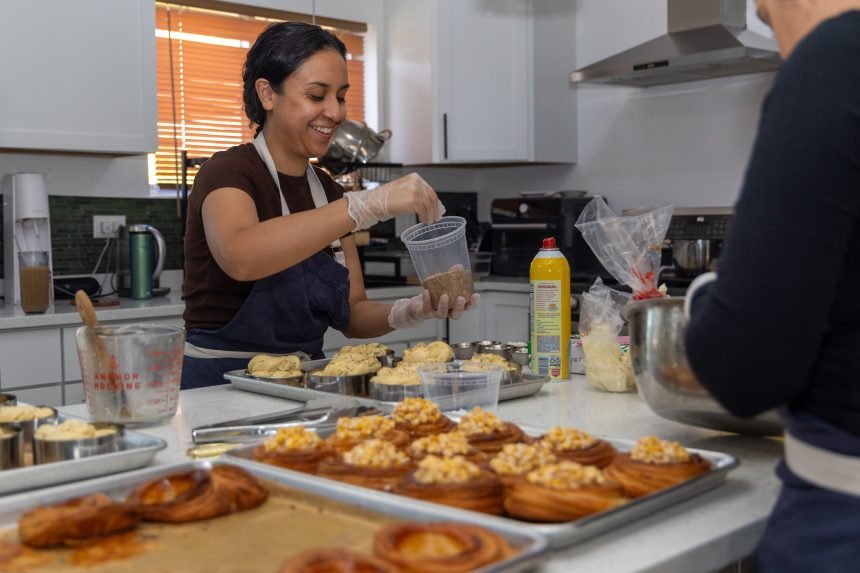
On a recent Thursday, Samaria Pérez, wrapped tightly in a blue apron, was getting started on the base of her croissant dough. It’s one of many baked goods that have recently been selling out within hours of Pérez sharing an online link for digital orders. Come Saturday, she’ll have about 500 pastries boxed up and tagged with a “Samaria’s Kitchen” sticker, ready for pickup.
The kitchen of her licensed micro-bakery could easily be mistaken for a brick-and-mortar, if it wasn’t for her living room a few yards away.
The 30-year-old Pérez has two commercial ovens and one of those massive 40-quart mixers that require an equally massive whisk or paddle attachment. A separate, meticulously organized room holds an extra fridge, freezer drawers, rolling racks, bins of flour and sugar, stacks of sheet pans and parchment paper, and a wide assortment of baking tools and gadgets.
Outside in the backyard, there’s a coop with four chickens.
“I try to use my own chickens’ eggs in as many recipes as I can, especially curds,” Pérez said. “It can change the flavor and even my customers keep telling me, ‘I don’t know what you put in this pastry, but it’s so different.’ I know it; it’s the eggs.”
Pérez is a bit obsessive about quality ingredients. She only uses Kerrygold Irish Butter and buys raw honey from local beekeepers. Even when she’s buying milk from Target, she picks the one certified by the USDA as organic, so there are no added growth hormones or prohibited pesticides.
“I have spent so much time in kitchens, and something that I always remember is how my grandma ran her kitchen and her food businesses in Mexico,” Pérez said, smiling. “She cared so much about quality, cleanliness and details. The ingredients she cooked with.”
When Pérez started her home-based business a few months ago, those fundamentals were the driving force. Now, it all culminates in a much-anticipated weekly bake sale, proving that long lines for food in Chicago aren’t reserved only for the big Michelin-starred places — there’s also a quieter but similarly dedicated devotion to these small-business owners.
On Thursday, while Pérez focused on croissants, her business partner and sister, Arely Pérez, 29, dropped golf-ball-size cookie dough onto sheet pans. The cookies and cream-flavored dough balls were carefully wrapped and put in the freezer to be baked off fresh on Saturday, just before the 10 a.m. to 1 p.m. pickup window.
As a growing number of local entrepreneurs are avoiding expensive brick-and-mortar costs in favor of smaller-scale operations, Pérez is hoping the noticeable difference in her pastries will help sustain her popularity.
“I first thought, there has to be a way that people keep coming back to me,” Pérez said, admitting that she’s a reluctant social media user. “But I know the only way to (draw more people in) is to keep showing through social media what ingredients that I use … maybe we can change the whole system slowly.”
Pérez has been making cakes and pastries for family and friends for years. In June, before Samaria’s Kitchen was open for business, she would hold little bake sale pop-ups outside her house, with pastries that one neighbor said “rivaled ones from places like Del Sur and other popular bakeries.”
Juanita Cano, a pastry aficionado who lives a couple of doors down from Pérez, said her neighbor’s baked goods are harder to land these days, thanks mostly to word-of-mouth and a loyal following.
“The first thing I tried was an olive oil sliced cake with a hint of orange and a mascarpone frosting … I’ve never had anything like that before; it was delicious,” Cano said. “Then she did another (bake sale) maybe two weeks after, and then I went at the same time, 9:30 in the morning, and she was almost sold out. I was like, how … what is happening?’”

Line culture isn’t new to big cities like Chicago, but Cano noted how customers will flock for good food, whether it’s outside big bakery names in the city or outside Pérez’s home.
One Saturday morning several weeks ago, Cano said customers were lined up three houses down in the pouring rain to buy pastries.
“That day I told my mom to go for me because my kids were sleeping and my mom lives in the area — I think that day the bake sale started at 9, but I told (my mom) just get there at 8:30,” Cano said with a laugh. “When my mom came over with the pastries, she said, ‘These people are crazy … this stuff can’t be that good.’ But then we had coffee, opened the box of pastries and she immediately was like, ‘OK, wow … worth it.’”
As of three weeks ago, Pérez shifted her sales model to an online ordering system, so now she only produces what she already sold.
While 3,000 Instagram followers might seem modest in an era of massive social media counts, Pérez built her audience organically, with dedicated regulars who have become her biggest advocates, enthusiastically spreading the word about her micro-bakery. One customer — a digital creator who posts about Chicago food spots — shared a video of people standing in the rain at Pérez’s bake sale that amassed 274,000 views. Those kinds of things directly boost sales, Pérez said, but have also sparked some debate.
The caption on that video refers to Pérez’s pastries as “Mexican bread,” and the comment section was quick to say it wasn’t.
“There was some controversy because a lot of people said, ‘That’s not even Mexican bread,’ which they are right. I am a Mexican baker, but I’m not making traditional Mexican bread,” Pérez said. “I try to add Mexican flavors to my pastries, but typical panaderías don’t usually sell croissants.”
Sourdough bread is another one of her bestsellers, but Pérez only has the capacity to make about 16 loaves each week.
Pérez plans on offering traditional Mexican sweet bread during pan de muerto season, but her usual lineup doesn’t stick to any one category. The croissant flavors in a recent drop included pistachio, pecan, chocolate, almond, burnt honey, and a salted honey-and-orange croissant knot. A rajas con queso croissant knot was part of the savory selections, with a creamy filling and a topping of cotija cheese and fried tortilla chips. Plus cinnamon rolls, espresso Nutella buns, churro cajeta cruffins, strawberry cheesecake danish, banana bread tea cake and chocolate chip cookies. Pastries usually range from $3 to $8 each.
“I think one of the differences with our croissants is that I use a manual machine to roll out the dough, so I have more control over the process,” Pérez said.
She’s also meticulous about the texture of her butter before it’s added to the croissant dough. To mimic high-quality European butter, Pérez starts by lightly beating the Kerrygold butter with a little bit of flour, which helps soften it so she can flatten it while maintaining the ideal plasticity needed for folding. Once chilled, the cold rectangular brick of pliable butter is ready to meet the dough, she explained.
“And that’s just the first day of our croissant prep — I’m making about 20 books of butter at once, and then the next day we are making the dough with all organic flour,” Pérez said. “And then it’s all about folding and laminating the dough. That’s how you get the flaky, beautiful layers.”
Pérez and her sister will then discuss flavors before mapping out how many of each pastry they need to make.
Pérez is noticeably unflustered, likely because she isn’t new to any of this. The only thing she’s new to is being her own boss and working out of her own home, she laughed.
Pérez has more than 13 years of experience working in professional kitchens and bakeries.
Her family moved from Nuevo Laredo, near the U.S.-Mexico border, to Chicago when she was 17, to resettle with her stepfather. At first, she struggled with the culture shock and desperately missed home.
“I had to do my senior year of high school again, so that year I was learning just enough English to go to school,” she said. “I always had good grades, amazing grades, but coming here suddenly I wasn’t doing as well, and it was entirely because of the language.”
After high school, Pérez pivoted from her initial plan of attending law school to study culinary arts at the now-defunct Robert Morris College — a natural step having started cooking in her grandmother’s kitchen at just 5 years old.
After obtaining an associate’s degree and a ServSafe certification, she worked for years as a savory chef before transitioning to full-time baking as a pastry chef. At home, she kept experimenting with flavor combinations and intricate techniques to achieve a perfect crumb or the ideal flakiness.
It soon became clear to her that a small-batch bakery out of her home was the most economically feasible and creatively freeing way to continue down this road.
In fact, business management experts point to a rise in solo ventures, citing the accessibility of technological innovations like digital storefronts and payment processors.
“Especially when compared to the standard brick-and-mortar, these advancements have allowed micro-businesses to have a much lower initial cost to getting up and running and a lower cost of failing, so you see more of them trying it out and seeing if they succeed,” said Sean Higgins, professor of finance at Northwestern University’s Kellogg School. “And all of the things that used to be necessary in order to be able to find your customers and have them come in and buy something and to process payments is much cheaper and easier online.”
The Front Porch, an extensive online directory of home makers and bakers, lists 27 microbakeries in Chicago, but notes that the number is growing.
There is a paradox of choice, Higgins noted, with the proliferation of micro-businesses, like bakeries.
“From the consumer’s perspective, it could be both good and bad,” he said. “There may be an oversaturation, but each of them may be targeting some particular niche as well, which could benefit the consumer by making the exact thing they want available.”
For Pérez, the target audience is people looking for high-quality pastries featuring high-quality ingredients, made at a hyperlocal scale. She’s found her customers, but she does worry whether or not she’ll be able to accommodate a higher demand if word continues to spread.
Pérez said she spent around $20,000 to equip her home bakery with commercial kitchen appliances.
Those shiny silver ovens and her giant mixer are usually in view when she posts videos to Instagram — typically a sneak peek of laminated dough or a quick chat about which flavors customers can expect. The videos are mostly in Spanish, with an English translation. And she’s extremely transparent about which ingredients and brands she uses.
“I think people love honesty when it comes to food, and I know a lot of people don’t trust, for some reason, a home-based business,” she said. “But I think people need to start opening their minds about how beautiful it is for a small business to cater for you, and also the intention that goes into every item. It’s not like we’re doing 70 dishes in a row — every time you place an order, we are making it just for you.”
One ingredient she was using on Thursday was a brown cane sugar popular in Mexico called piloncillo or panela, known for its deep caramel and molasses flavor. Another item was a brick of Mexican chocolate, sharper in flavor, to fold into her chocolate chip cookie dough that uses three distinct flours.
Each week, she drops a link to her Hotplate storefront and customers can peruse the menu and purchase directly from the website. Because it’s a limited quantity, it’s common for Pérez to sell out within hours. On Saturday mornings, while her 4-year-old son zooms around the house, her husband helps box up the orders.
“I feel like I’m at a point where I’m actually enjoying every aspect of my life,” she said. “Whenever I was working somewhere else, I would lose myself in schedules and bad bosses and routine. I work for myself now and I get to decide what I make and what I use.”