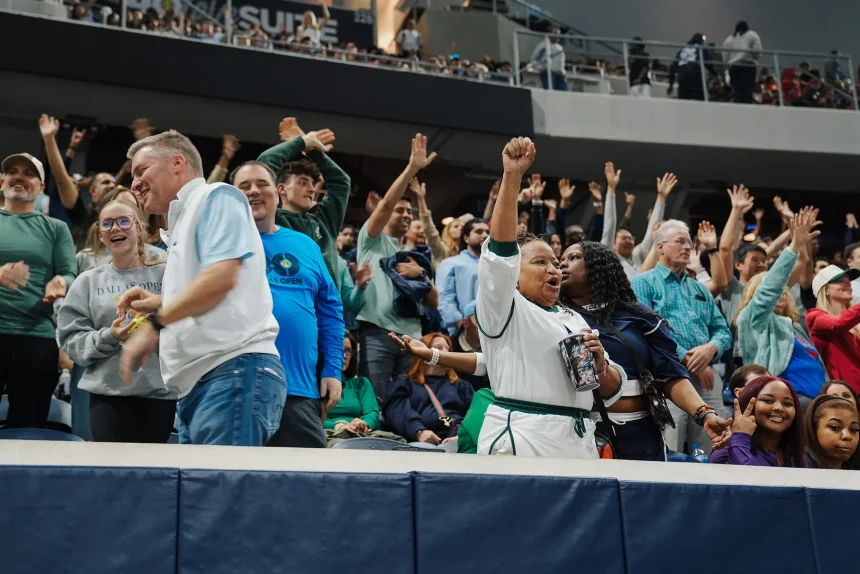
The year was 2020. Along with the pandemic shutting New York down, that year turned into the final playing of the New York Open, a low-level indoor tennis tournament organized by the ATP. John Isner, an icon in the sport who had recently moved to Dallas, thought the tournament could have legs in North Texas. So, he called tournament director Peter Lebedevs. “I know the crowd support will be great,” Isner told him. “Dallas is a huge market, and they love tennis.”
A native of Australia, Lebedevs grew up playing tennis and became an ATP tournament director in 2009. He had known Isner for a while, having met on the tournament circuit. At the time, Lebedevs and his team were looking at Minneapolis, Las Vegas, and Austin as potential new homes for the tournament. DFW wasn’t top of mind—after all, the region hadn’t hosted a pro tennis tournament since 1989. But Isner, alongside SMU men’s tennis coach Grant Chen, invited Lebedevs to Dallas for an official pitch.
“It was a big risk to take a chance on Dallas—a city that hadn’t had professional tennis in a long time,” says Isner, who famously won the longest match in tennis history—an 11-hour marathon stretched over three days. “There were a lot of question marks.”
The Dallas Open marked its inaugural playing in 2022, hosted at SMU’s indoor tennis complex, a venue Isner never imagined as a long-term home for the tournament. After all, the 2,500-seat facility was one of the smallest on the circuit. But the venue made for an intimate setting. During a men’s doubles quarterfinal, a ball flew from the court during play and into a spectator’s beer. Rather than being a disruption, the moment became part of the appeal. “We sold our venue out before we hit the first ball on our last few sessions because of the intimacy,” Lebedevs says.
The tournament stayed at SMU for the next few years, with Reilly Opelka, Yibing Wu, and Tommy Paul snagging the 2022, 2023, and 2024 titles, respectively. Attendance and momentum followed. But a deal came together that would significantly expand the tournament’s scale.
On a late October evening in 2024, the walkway outside Charlotte Jones’ Highland Park home had been transformed into a Dallas Cowboys-themed tennis court. In the backyard, set for a private party, guests enjoyed tennis-themed cocktails. Easily spotted in the crowd was Mavs legend Dirk Nowitzki, a talented junior tennis player during his upbringing in Germany, alongside tournament ambassador Isner, who retired from play a year earlier. Jones threw the soiree to mark the Dallas Open’s move from SMU to The Star in Frisco and its elevation from an ATP 250 affair to an ATP 500 (see sidebar).
“As soon as we started our second year of the event, the opportunity came to upgrade to a 500 event,” Lebedevs says. “As a team, we said, ‘Well, hang on, what can we do?’” Shawn Tilger—president of GF Sports and Entertainment, the Open’s owner and operator—had an answer. “As the story goes, one day when we were supposed to have a meeting, [Sean] was not there—he was out courting the Cowboys about a partnership,” Lebedevs says. “They liked the idea and thought tennis would round out the events at The Star.”
By November 2023, the deal was sealed: Beginning in 2025, the tournament would move from SMU to the Ford Center at The Star, a venue that can accommodate roughly 6,000 fans for tennis. “SMU really launched it in an incredible way,” says Charlotte Jones, the Cowboys chief brand officer. “But when we saw the city had an appetite for it, that allowed us to step up and make it bigger and better.”
For the Jones family, the business proposition was straightforward: tennis is a global sport. And the Dallas Open, even as a 250-level tournament, drew viewers from 120 countries. “We are pretty proud of our ratings with the Cowboys, but we are not global like that,” Jones says.
Media intrigue may have sparked the conversation, but the Star’s infrastructure closed the deal. An Omni hotel, a cluster of restaurants, and space to expand practice courts made the Dallas Open a natural candidate for an ATP 500 event. Of the 17 lower-level tournaments the ATP evaluated for elevation, only three were selected—and Dallas was among them. “We had a lot of support from the players,” Lebedevs says, “but when you partner with the Cowboys, that automatically gives us a helpful identity with the players, fans, and sponsors.”
The prize money increased significantly, from a $756,020 purse to $2.76 million. As a result, the 2025 and 2026 tournaments have attracted a deeper, high-profile field, including World No. 34 Frances Tiafoe, No. 20 Tommy Paul, No. 13 Casper Ruud, No. 9 Taylor Fritz, and No. 7 Ben Shelton. Canandian Denis Shapovalov secured the 2025 singles title. And in 2026, Shelton and Fritz battled it out in the final, with Shelton securing the ultimate victory.
$51.9 million: That’s the economic impact that the 2025 Dallas Open generated for North Texas, according to a study. “The Cowboys are a marketing monster,” Isner says. As the tournament and word of its success spreads, prospective sponsors have increasingly begun to reach out. The 2025 event included partnerships with Alto, Choctaw Casinos & Resorts, and Boss. All of this—including profitability—occurred without a title sponsor. “That’s a pretty big deal,” Isner adds. “There are a lot of tournaments on tour that are not profitable. I think it has turned into exactly what the Cowboys thought it could be.”
The 2026 edition became the first Dallas Open with a title sponsor. In January, tournament officials inked a three-year agreement with crypto wealth platform Nexo, with an option to extend. Official financial terms were not disclosed, but 2026 sponsorship revenue came in at approximately $5 million.
For Lebedevs, the title sponsor was just one item on a growing to-do list. He wants to bring on additional partners. He wants to continue expanding the local tennis fan base. He wants to create a 365-day buzz around the tournament through year-round programming. He also hopes to eventually integrate women’s tennis into the event.
Isner’s focus is on attracting more European players, the sport’s deepest talent pool. But the tournament runs the same week as The Rotterdam Open, a fellow ATP 500 tournament in the Netherlands that has run for 54 years. “They have great history and tradition,” Isner says. “So, we want to create that history and tradition here in Frisco, where each and every year in early February, everybody knows it’s tennis week.”