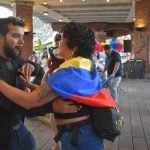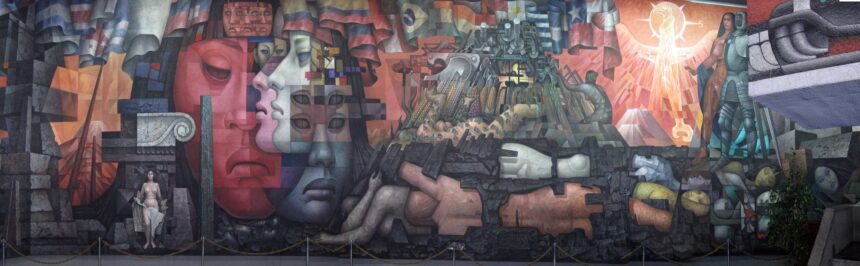
I grew up in Queens, a borough of New York City perhaps best known as the home of Peter Parker.
More than being home to Spider-man, Queens is also one of the most ethnically diverse places on earth. Even though New York is hours from Latin America by plane, it has become a cultural center for many dimensions of the Latino community, with thinkers such as José Martí and Julia de Burgos making their home in the city for years. A simple look at an arrival board at John F. Kennedy Airport in Queens, with its tons of flights from Latin America, makes apparent the incredible Latino presence in the city.
In Queens, “Latino” doesn’t have a clear definition. There are poor Latinos and rich Latinos. There are Black, brown, and white Latinos. There are Latinos who just arrived in New York and ones who have always lived there. The Latino community is a big, welcoming tent.
That’s why I was shocked when I was called a fake Latino during my first week at Harvard. I was in Annenberg, and I thought it would be a bonding experience to tell another student that I was also Latino. Instead, I was met with a repulsed look and a comment that I could not be a ‘real’ Latino because I didn’t grow up in Honduras. I stuttered that I really am Honduran. I began mentioning my family ties and multiple visits. That, too, was met with snark.
It never dawned on me that someone could have a checklist for what a ‘real’ Latino is. How many years do you have to live in Latin America to be considered ‘real’? Is there a minimum number of hours before you earn your status? A maximum number of vacation hours outside of Latino countries before exposure to other cultures makes you less Latino?
These are rhetorical questions. I know I’m Latino. I have Indigenous blood that comes from Central America, and I’ve always felt in tune with my Honduran roots. This interaction didn’t make me question my identity; it made me think about the needless divisions that exist in the Latino community and how they hold us back.
The sort of identity gatekeeping I heard that day reminds me of the rhetoric I’ve heard some people use to justify why Latinos aren’t ‘real’ Americans. Maybe they haven’t lived long enough in the United States, or they have an accent, or their visits to Latin America prove they aren’t invested in U.S. culture. It’s intriguing that people with this kind of prejudice rarely seem to know or care what a ‘real’ Latino is. Why must we make such distinctions amongst ourselves?
This identity gatekeeping also does a disservice to the complex and legitimate reasons why people leave Latin America. For many, especially in poorer countries like Honduras, the choice is not about trying to maintain cultural authenticity — it is about escaping violence and persecution, or trying to find upward mobility in another place.
This kind of division pits Latinos against each other based on geography rather than recognizing our shared dignity. This especially hurts the many Latino families that span borders. While I have relatives in Honduras, many live in other Latin American countries, in the United States, and in Europe.
Unfortunately, Latino divides don’t stop there. Colorism is prevalent in the Latino community, and Black and Indigenous Latinos too often face the brunt of discrimination in the U.S. and Latin America. For instance, in Brazil, former president Jair Bolsonaro decimated a government agency designed to protect Indigenous rights, and his administration stopped recognizing traditional Indigenous lands. In pop culture, Black Latinos are too infrequently cast in top telenovelas, while Latinos who appear to have European features are often elevated as the beauty standard.
We are living at a time when human rights are in jeopardy for Latinos across the world. For example, hate crimes against Latinos in the United States have risen since the pandemic, and at universities in the United States, Latinos are drastically underrepresented among faculty.
When our community needlessly divides itself, it undermines our collective power to tackle these challenges. Globally, Latin Americans number in the hundreds of millions. In the U.S., we are also the largest and one of the fastest growing minority groups. We have the ability to fight for our rights and win, but that requires unity.
There are bound to be differences within a community of more than 600 million people — and, yes, between Latinos who grew up inside and outside of Latin America. Growing up in New York City undoubtedly gave me privileges and opportunities I would not have had growing up in Honduras. My cultural influences, too, would have been different outside of the United States. We can acknowledge these differences without looking down on others and dismissing them as not ‘real.’ We can also find ways to unite and come together despite these differences.
Instead of creating arbitrary rules for what constitutes a ‘real,’ as opposed to a ‘fake,’ Latino, we should find ways to come together, both at Harvard and across the world. Our numbers are our strength, and can help us uplift one another. We can’t expect non-Latinos to afford us the respect we deserve if we spend our energy alienating each other.
Roberto C. Quesada ’27, a Crimson Arts comper, lives in Hollis Hall.