Alejandra Palma lives in perpetual fear of the next storm.
“We are constantly checking the weather,” said Palma, who co-owns Root Hill Cafe in Brooklyn’s low-lying Gowanus neighborhood. “If we see that there’s a hurricane in Florida, it’s like, oh my God, please let it not come here.”
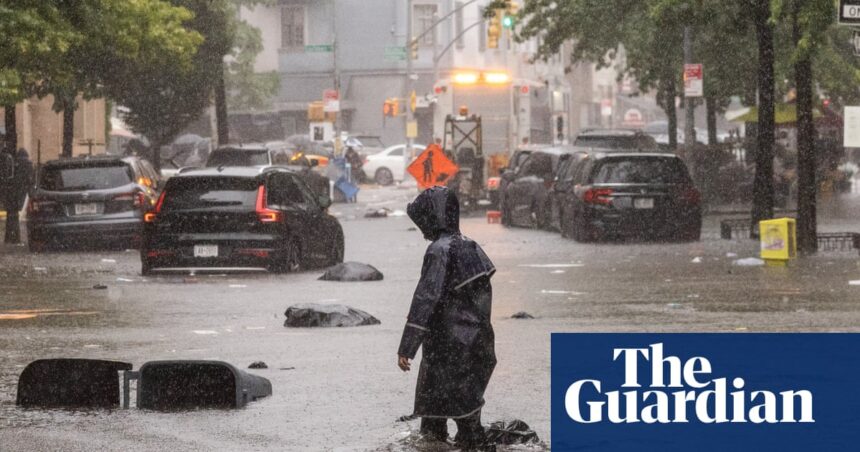
Last September, when record rain hit New York, it flooded her small businesses, damaging walls and floors already weakened from previous flooding and causing gasoline from a nearby construction site to leak into her basement. It took almost two days to clean up and reopen the shop.
Last year wasn’t entirely a fluke: Palma said that each year she loses about five business days to flooding and estimates that each day Root Hill is closed, it costs her business about $3,500 in lost sales and employee pay.
Those losses, coupled with lingering hardship and debt from Covid and what she says are prohibitively expensive flood insurance rates have her questioning whether the business will survive.
“We as small business owners have to realize at [some] point where we’re going to cut our losses,” Palma said.
As the climate crisis causes heavier and more frequent floods across the US the costs associated with flooding – among them insurance, infrastructure upgrades, flood prevention measures, damages, and lost revenue – are straining businesses like Root Hill.
According to the US Chamber of Commerce, one in four (27%) of small businesses say they are one disaster away from shutting down.
“In the past two years, businesses experienced disaster damages and closures not only in higher-risk states like Florida and California but also in Vermont, Iowa, Minnesota, Kentucky, Colorado – the list goes on,” said Benjamin Collier, a professor at Temple University’s business school. “These events have been devastating.”
That carries major economic implications. Small businesses employ nearly half of US workers and represent 43.5% of America’s GDP.
In New York, the September flooding event led to $100m in total economic losses across the New York metro region, according to a report by the city comptroller.
“Many retail and restaurant establishments occupy both ground floor and basement spaces, making them highly susceptible to flooding and sewer backup damage,” said a SBS spokesperson who asked not to be named. They said most NYC small businesses lack plans to mitigate, respond to and recover from unexpected events like floods.
Small businesses across the US face similar threats.
In January, rains blanketed southern California, affecting more than 100 businesses, many of which were in a low-income, formerly redlined section of San Diego.
“Financially, it is devastating. It has wiped out savings accounts,” said Donna DeBerry, CEO of the county of San Diego Black chamber of commerce. “People are trying to get loans, but because they’re a small, underserved, underrepresented business, they may not be credit-qualified.”
In Vermont, some businesses devastated by last summer’s severe floods still haven’t gotten back on their feet, while others have decided to close their doors permanently. Reports estimate $300m in economic damage with businesses losing an average of nearly $200,000 in equipment and inventory. (In July 2024, the state suffered major flooding again when passing remnants of Hurricane Beryl dumped 6in of rain in certain areas.)
First Street, a climate risk data non-profit, projects the US commercial sector stands to lose $16.9bn in damages over the next 30 years due to flooding. Experts say small businesses struggle to afford insurance that might help them weather future storms – especially as rates increase and insurers exit the market in certain states due to climate risk.
“Small businesses are often less likely to have other resources that are available to larger clients,” said Collier. “They are dealing with cashflow constraints, which means they’re not buying the same insurance or the same amount of insurance.”
According to the Federal Emergency Management Agency (Fema), as of April, only a fraction of the country’s small businesses – about 120,000 – carried insurance through Fema’s National Flood Insurance Program (NFIP), the country’s largest insurance provider for small businesses.
Experts, advocates and business owners said local governments can help small businesses by investing in infrastructure upgrades for things like sewage, drainage and water catchment systems; funding flood prevention and resilience programs; and requiring greater transparency on flood history.
“You should be able to find out about the flood history of a property before your purchase or rent,” said Chloe Demrovsky, a risk and resilience expert who teaches at New York University. “A public-private partnership with real estate websites could be helpful here.”
She said expediting federal aid could also provide a lifeline. “It might be two years for you to wait for your Fema recovery grant and by then, the businesses have often run out of cash,” she said.
Mark Caserta, vice-president of small business support at the Brooklyn chamber of commerce, said cities should also improve emergency alert systems, which he said don’t always reach small business owners. “I think there needs to be more targeted alerts for businesses and more methods of alerting,” he said.
Joshua L DeVincenzo, a lecturer at Columbia University’s Climate School said: “If there’s incentives for small businesses to actually start thinking about business continuity, management, disaster recovery and preparedness, and the financial resources to do so, I think that’s kind of a missing gap.”
As the first anniversary of the flood approaches, Palma is unsure whether she will renew Root Hill’s lease. Investing more money to fix the flood-worn floors and porous walls would cost thousands. Plus, after 10 years of fighting floods and other small business owner battles, Palma doesn’t want to sacrifice her mental health any more.
“I think our peace of mind is more valuable than whatever little money we make as a small business owner,” she said.