ST. PAUL, Minn. – James Rodríguez knows what you think about him. He knows that his club career began with so much promise, only to be whittled down to a series of what-ifs and abrupt departures. He is without a doubt among the most polarizing stars in world football.
Since signing with Real Madrid in 2014, Rodríguez has worn seven club shirts in seven countries. During that time, he maintained his status as one of South America’s premier players.
Rodríguez is admired for his technical skill and his penchant for big moments. He’s also lambasted for being the poster boy for unmet potential. There are still many around the world who claim that his spectacular display for Colombia at the 2014 World Cup was a fluke, that his Puskas-winning goal in the quarterfinal against Uruguay, a cinematic volley from distance, was the only reason Real Madrid acquired him at 23 years of age.
Of course, what happened after that is a mixed bag of world-class performances in Europe’s top leagues and failed comeback attempts across several continents.
In a candid interview with The Athletic, minutes after he was introduced as Minnesota United’s newest signing, Rodríguez spoke openly about the missteps that have bolstered his critics. But he isn’t asking for anyone’s sympathy.
With a smile on his face, but in a defiant tone, the 34-year-old Colombian addressed the blemishes on his résumé, the celebrity status that still surrounds him, and the secrets behind his unrelenting drive as Colombia’s talismanic leader. Now in his 15th year as a Colombia international, and on the cusp of his third World Cup, Rodríguez is at peace with all the noise.
“I think that obviously there have been more good things in my career than bad,” he said. “If one were perfect, life wouldn’t have any magic, right? That’s the magic of life: being able to make mistakes.”
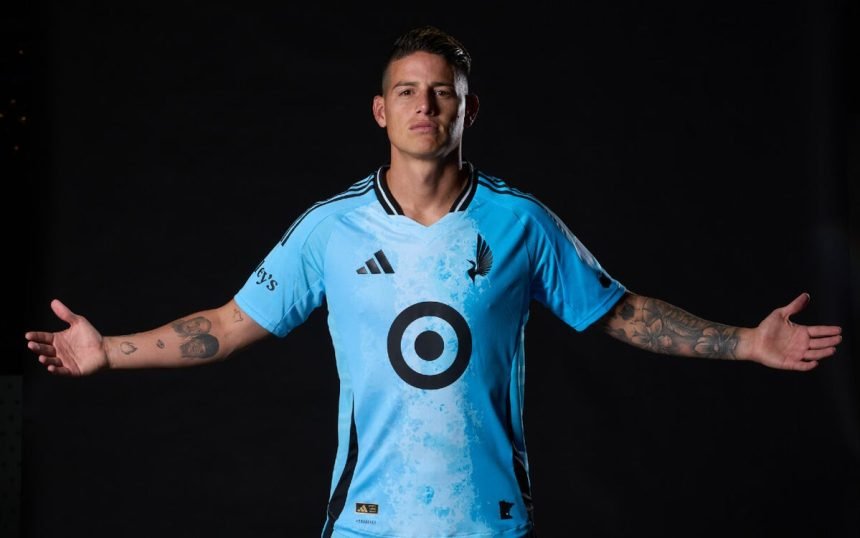
James Rodríguez and Minnesota United chief soccer officer and sporting director Khaled El-Ahmad at the Colombian’s introduction. (Courtesy of Minnesota United)
Over a decade ago, he was given the No. 10 shirt at Real Madrid. He was eventually phased out after a flying start in the Spanish capital. “Thirty-seven goals, 42 assists,” he said in reference to the footprint he left at Madrid. Bayern Munich supporters may remember him fondly after his two-season spell in the Bundesliga.
He was a clinical playmaker for the German giants, and in many ways, it was the last best version of the Colombian at a truly elite level of club football. What followed were spells at Everton (England), Al-Rayyan (Qatar), Olympiacos (Greece), São Paulo (Brazil), Rayo Vallecano (Spain) and Club León (Mexico).
“Not all of them, but I’ve gone to clubs that weren’t the right path for me, but it was what my heart was telling me to do,” Rodríguez confessed. “You learn from all those things, and as you get a bit older, you realize where you went wrong and where you failed. Then you try to not take that same path again.”
He has traversed the world and now finds himself in the unlikeliest of MLS markets. Minnesota United is entering its 10th year as an MLS club. It’s not a team that is accustomed to signing international stars. When staffers were notified early last week of Rodríguez’s signing, a surreal sense of excitement spread throughout the club’s main headquarters.
Yet, one MLS sporting director, who spoke on condition of anonymity to preserve relationships, said that Rodríguez was shopped throughout MLS, and there were few takers, due to a combination of factors, namely Rodríguez’s wage demands and reservations about his tactical fit in a fast and physical league.
“The same thing happened with Thomas Müller,” the sporting director said, referencing the German legend’s high-profile signing with the Vancouver Whitecaps last season. The sporting director added that Rodríguez’s deal with Minnesota United more closely resembles Gareth Bale’s stint with LAFC.
The former Welsh international played just 13 games with LAFC in 2022 before he captained Wales at the World Cup in Qatar. Rodríguez said that in January, while pundits and fans in Colombia debated whether he would make Colombia’s 2026 World Cup squad without a club, he focused on his preseason workouts with a personal trainer.
“I was more like, ‘Relax, it’s all going to work out,’” he said. “I’ve never been one to respond to all those things, because I’ve always thought that you do your talking on the pitch. If I were to be asked to play a game right now, I’d be ready.”
Rodríguez signed a non-designated player deal through the 2026 World Cup with a club option to extend until December. Public reaction to Rodríguez’s MLS arrival has focused on his short-term contract with Minnesota — there are 15 games between now and the World Cup — and his perceived disdain for cold-weather cities. His reaction to the frigid winters in Munich went viral after a podcast interview in 2020. What was meant to be innocent banter about the cold instead became fodder for his critics.
“There were days when I would go to work at 9 in the morning, start my car, and look at the temperature: -28 (Celsius),” he told Daniel Habif six years ago. “I would ask myself, ‘What am I doing here in this cold?’” Habif and Rodríguez laughed it off and continued onto other topics. But the headlines about thin skin and a lack of mental fortitude have chased him ever since.
“I said it more as a joke. A gag,” Rodríguez told The Athletic. “But (the press) twisted it around and said that I left because of the cold. Nothing could be further from the truth. I didn’t leave because of the cold. I’ve lived in Munich. For me, cold or heat — being here (in Minnesota) or being in (the heat of) Barranquilla are the same, because all I think about is playing.”
Rodríguez harbors a distrust for the press, particularly in Colombia. During his press conference on Friday, a Colombian journalist asked him to clarify reports that linked him to Millonarios. Rodríguez referred to those reports as “gossip.” He then said that Colombian football has to “grow in many aspects” after watching league matches in January from his home in Medellín.
“Just watch,” he said. “They’ll distort what I just said about Colombian football. They’ll write a different headline. In Colombia, I’d say one thing and (the press) would publish something entirely different. They’re going to spin all of that and create media speculation. It’s always been that way. I really respect the work (journalists) do, but there are some in the media who slightly change everything just to get clicks and more views. I think it’s always been like that.”
Rodríguez then made a point to put the cold-weather jokes to rest once and for all.
“As for the Munich thing, in Colombia they changed all that just to stir up gossip,” he said. “They think I left because of the cold. But I left for a different reason: because I essentially had a done deal with Atlético (Madrid). I wanted to live in Madrid. My daughter was there. But that’s in the past now. It’s true that what I said about Munich was just that — it was a joke — but in Colombia, they took it the wrong way. They always take what I say the wrong way.”

James Rodriguez kisses the Colombia crest during a 2026 World Cup qualifier. (Luis Acosta / AFP / Getty Images)
Yet Rodríguez is beloved in Colombia and around the world. His more than 50 million social media followers are testament to that. He also has a long list of detractors who have questioned his professionalism at club level and his outsized influence on his national team. Meanwhile, he is considered among Colombia’s most successful internationals, alongside Radamel Falcao, Carlos Valderrama, Faustino Asprilla, and today, Bayern Munich’s Luis Díaz.
The flack that has followed Rodríguez since 2016, when his dream of becoming a Real Madrid legend quickly faded, ranges from his profile as a luxury No. 10 to his purported issues with several of his former head coaches, including Zinedine Zidane, Rafael Benítez, Niko Kovač, Carlos Queiroz, and Reinaldo Rueda.
The latter replaced Queiroz as Colombia attempted to qualify for Qatar 2022, and Rodríguez was promptly left off the squad for two crucial World Cup qualifiers. Colombia failed to reach that World Cup, but Queiroz and Rueda had support from a sector of the Colombian fanbase. Perhaps it was time to find the next great Colombian No. 10.
“Many players have come and gone during my time (with the national team),” Rodríguez said. “People say, ‘the new (Faustino) Asprilla,’ ‘the new (Radamel) Falcao,’ ‘the new James.’ They arrive, play a couple of matches, and then maybe the pressure — or all those kinds of things — they just don’t handle it well. So, being with the national team, representing a country for so long, it’s not easy. It’s the pressure that you carry.”
There is also a massive contingent of loyal fans who see Rodríguez as Colombia’s heart and soul. They accept his flaws and his rollercoaster past. The emotions that he inspired during the 2014 World Cup, and most recently during the 2024 Copa América, are simply too powerful for them to forget. And when the door seems to be closing on his international career, Rodríguez manages to silence his critics. He helped lead Colombia to that Copa América final and was named the tournament’s top player.

James Rodríguez was named best player of the 2024 Copa América after leading Colombia to the final. (Chandan Khanna / AFP / Getty Images)
“My detractors probably say — they probably think — that (their criticism) will hurt me or affect me,” Rodríguez said. “It’s the opposite. They are the gasoline that fuels me to do the things I want to do and to achieve what I’ve set my mind to.
“Those who doubt me,” he continued, “are the ones who give me that spark to go out on the pitch and do things right; they light that flame. What they don’t realize is that they’re actually doing me a favor.”
Since his senior international debut in 2011, Rodríguez has prioritized his national team responsibilities. One can admire the commitment, especially today when opting out of international duty in favor of club football has become more common. To hear Rodríguez explain why his national team is so important to him is to understand football’s truest form of duty over glory.
“When you play for your country, it is just a different feeling, it’s something else entirely,” he said. “You go to the stadium and see all the yellow jerseys, you acknowledge the people who want to see you play … you see that it’s not just there, but in their homes, in the small towns. In Colombia, people will literally run to a television just to watch Colombia play.”
Rodríguez was guarded and a bit reluctant to talk more about his past. He has felt attacked by the press during his career. But when the conversation shifted to his ability to consistently show up for his national team (no matter his club situation), Rodríguez sat up in his chair and spoke with a genuine confidence about a subject matter in which he is considered an expert.
“They shut down the schools, they shut down everything when Colombia plays,” he said. “You have to play for them. You’re representing your ancestors, your roots, where you come from, where you were born. You have to give your life for your country. That’s that ‘extra something’ you have to give when you’re with the national team. And that’s why I’ve lasted so long — because in the national team, it’s not just about running. It’s not just about playing well; you have to give something more. You have to feel it from deep, deep within.”
His short-term contract with Minnesota United will become another data point in his whirlwind football career. It’s viewed universally not quite like a last dance, but rather a last resort to stay match fit before this summer’s World Cup. That alone has fueled his critics — which should, in turn, fuel Rodríguez. He’s not bothered by it. Instead, he’s ready to write the next chapter of his career.
“History is yet to be made,” he said. “I’d like that. To be continued.”