It wasn’t the hope of securing tickets to the biggest sporting event on the planet this year that convinced Leo Sa to travel more than 4,000 miles to Miami to spend a weekend but the love for a sport he once played as a child while growing up in his native Brazil.
“Tickets were never part of the equation,” said Sa, clutching a miniature Brazilian flag. “The matches at Hard Rock Stadium will be thrilling, I’m certain. But what you see here—the variety of people, the many things to do, and the promise that youth represents—is an atmosphere that just can’t be duplicated by the actual games.”
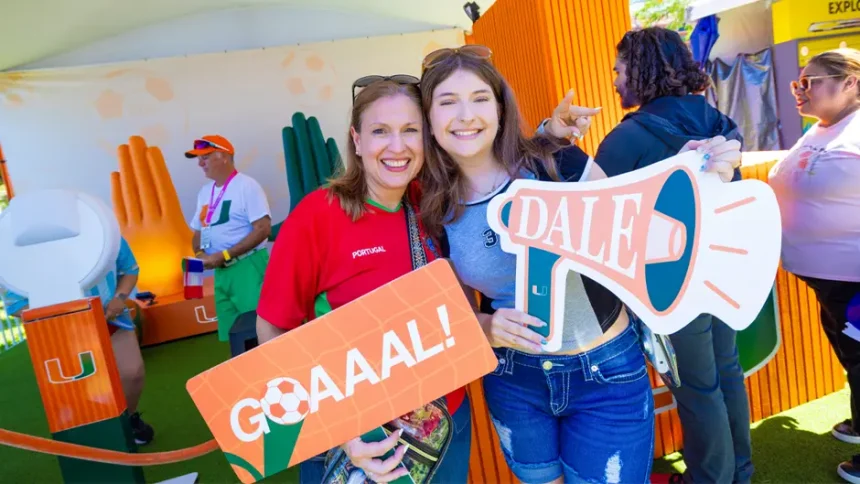
Sa, his wife, and mother were among the more than 30,000 people at Miami’s Bayfront Park on Saturday for a daylong celebration of all things soccer, as FIFA Fan Festival in Miami kicked off its 23-day schedule of live match broadcasts, entertainment, cultural performances, food, and interactive experiences all themed around of the largest and most ambitious World Cup in the tournament’s history.
The University of Miami is one of the official host committee supporters of the festival, featuring an interactive booth with other events planned throughout the more than three week festival schedule. In addition to support of the festival, the University’s strategic relationship includes a community legacy investment aligned with ONE GAME ONE FUTURE, the FIFA World Cup 2026 Miami Host Committee overarching legacy initiative.
The 39-day tournament features an expanded field of 48 teams, three host countries (the United States, Mexico, and Canada), and 16 stadiums staging a record 104 matches.
Miami is a featured site, with matches set to begin June 15 at Hard Rock Stadium.
At Bayfront Park on Saturday, Fan Festival organizers spared no effort to impress. “Electrifying” is how Patricia Contreras described the event. Fans posed for pictures and took selfies in front of a multitude of displays throughout the 32-acre park in downtown Miami.
 On a miniature soccer field, some fans performed feats of dexterity and athleticism that would probably impress Argentine superstar Lionel Messi himself. Yunier Gonzalez, who was born in Cuba, executed gymnastics-style flares with a soccer ball sandwiched between his legs. His girlfriend, Veronia Loyola, did a 30-second handstand, a soccer ball wedged into the crease directly behind her bent knee. “This is more like breakdancing than soccer,” Loyola said. “But we do love the game.”
 At the University of Miami interactive booth, fans lined up to pose for pictures behind a giant set of green and orange hands positioned in the ubiquitous split U. Laura Zamora and her two children, 11-year-old Alejandro and 14-year-old Daniela, were among the first to visit the booth.
“We just had to stop here. We love the Miami Hurricanes,” said Zamora, noting that Daniela hopes to attend the University one day.
 Children ages 7 to 16, recruited from local schools, participated in a soccer clinic taught by Johnny “Irish” Hynes, head coach of the Miami FC Academy. “This is an investment in kids, their future,” he said, noting that as many as 60 kids from the academy have gone on to attend college on soccer scholarships.
Many fans wore replica soccer jerseys representing their favorite teams. But in a community home to every major sport, can events like the World Cup and FIFA Fan Festival help soccer gain a greater foothold in the area?
 “The possibilities are endless,” said Jennifer Roche, director of community and legacy for the FIFA World Cup 2026 Miami Host Committee, who is a graduate of the University of Miami’s Sport Administration program and has played a major role in organizing World Cup-related events.
After the 2026 World Cup, we’ll see tremendous growth in the sport.” Roche continued. “Miami was already on that trajectory with Inter Miami’s success and with many of the confederations and governing bodies of soccer now based here. So, in terms of grassroots development, we’ll see many more people playing the sport. Soccer is here to stay.