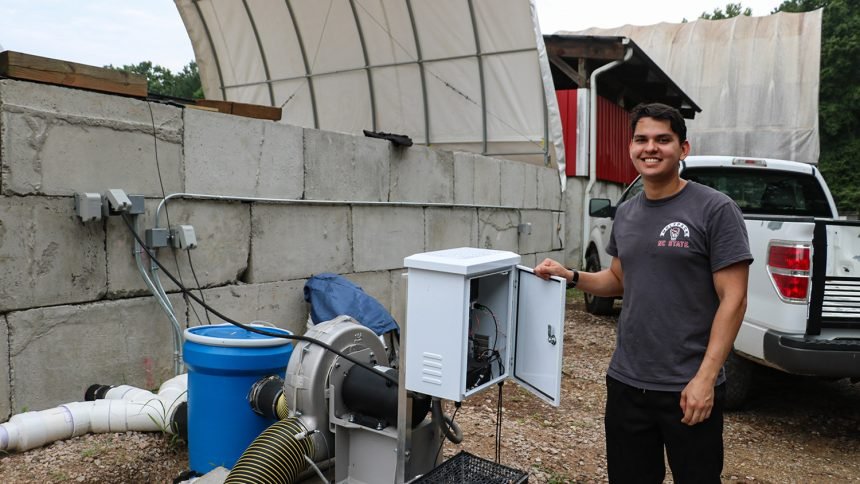
Tucked away off Lake Wheeler Road in Raleigh, North Carolina, sits NC State University’s Compost Facility and Research Cooperative, where Pablo Ortiz Paciello, a graduate student in the Department of Biological and Agricultural Engineering’s Biocarbon Utilization and Sequestration (BUS) Lab, demonstrates a patent-pending technology to capture carbon emissions directly at the compost pile.
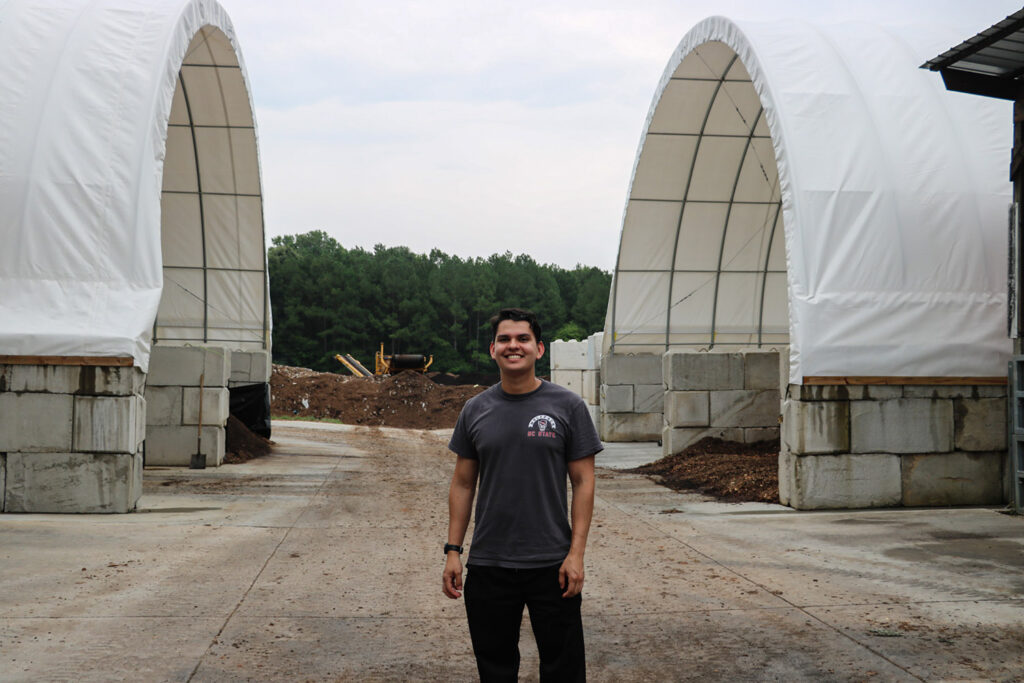
The facility is ripe with possibilities — it’s where the campus’s organic waste is carefully composted with product quality in mind, processing up to 1,200 tons of material annually.
Backed by funding from the U.S. Department of Agriculture (USDA) and Cotton Incorporated, Ortiz’s research and related technology aims to collect carbon dioxide before it can enter the atmosphere — and trap it inside a value-added product.
Biomass carbon removal solutions prevent organic waste emissions from returning to the atmosphere by capturing the carbon and locking it into durable products or permanent storage.
“If we can take biogenic carbon, convert it to a stable form, including a carbonate mineral, we can prevent carbon from returning to the atmosphere,” says Joe Sagues, an associate professor of biological and agricultural engineering who is supporting Ortiz’s work.
Scaling Up Sustainability
It’s no secret that food is one of the most common organic materials sent to decompose slowly in landfills over time. The absence of oxygen caused by materials packed tightly into landfills slows the process of decomposition and releases methane, a potent greenhouse gas, into the atmosphere.
Compost facilities prioritize sustainable uses of waste by mixing the organic material until it is high-quality compost that can be added to crop fields and landscapes as a nutrient-rich soil amendment.
While sending organic waste to compost facilities can cut emissions significantly, the process is not completely carbon-neutral. As organic matter breaks down inside compost piles, carbon dioxide is still released.
To close this gap, Ortiz is working with Sagues, who leads the BUS Lab, to scale up the carbon capture technology from lab scale to industrial scale, using both food waste and cotton textile materials as feedstocks.
NC State is the first university to demonstrate the potential of integrating carbon capture mechanisms with composting processes. First at the lab scale, and now with Ortiz’s system.
This process was previously demonstrated in the lab by Ethan Woods, a BUS lab alumnus who recently earned his Ph.D. in biological engineering and now works on carbon removal projects as a researcher at ETH Zürich.
“My project is to take what Ethan did and prove that we can replicate it at a larger scale,” Ortiz says.
Building Potential
At the facility, Ortiz’s engineered system uses negative aeration, a method that pulls air down through the pile instead of blowing it out into the atmosphere.
After the system is successfully tested, a local mining company is interested in using the captured biogenic carbon dioxide to neutralize alkaline wastewater and the compost for a topsoil product.
“Once the system’s sensors detect the right amount of carbon is being produced, we can use that concentration to test it for treatment of alkaline wastewater,” Ortiz says.
Demonstrating that carbon dioxide can be captured reliably from industrial compost facilities could create an economic incentive to scale up organic waste management practices.
“Many other industrial bioprocess systems have conducted commercial trials of carbon capture, but not industrial composting,” Sagues says. “I think it was just a matter of time, and I’m glad NC State was the one to be able to showcase that.”