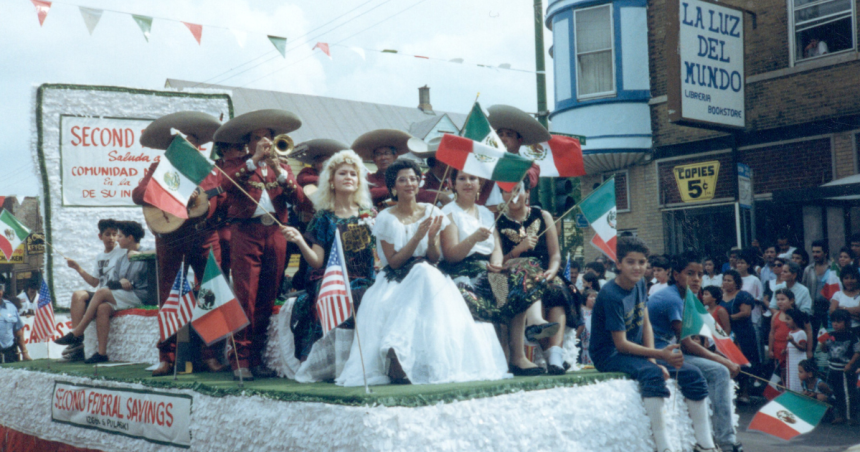
Photo from the R. Vargas Family (Courtesy of Nuestro Chicago Archives)
CHICAGO — Nuestro Chicago Archives is working to preserve a fuller picture of the city’s Latino communities by collecting family photographs and personal histories that capture everyday life, memory, and identity.
The project, founded in 2024 by Thais Beltran, recently hosted a photo-scanning event at the Little Village Branch of the Chicago Public Library, where residents brought historic family photos to be digitized and preserved.
At that event, The Latino Newsletter spoke with Beltran about the project.
“I think creating a dialogue between generations when you’re looking at family photos is really special, and hopefully it brings back good memories. Honestly, I wouldn’t have known at the time when I made the archive how intense everything would get with the state of the world,” Beltran said.
Beltran’s family settled in Chicago when they first moved to the U.S. She has long been passionate about Chicago history and photography — interests she’s held since childhood.
“Being Latino, you’re constantly part of different spaces. It’s kind of like this big umbrella that touches so many things. We have our mom-and-pop shops, our restaurants, barbershops, hairdressers, the DJs from back then, sports teams, and recreational activities. There are just so many elements that it feels endless when I think about what to highlight in future posts and open calls for the archive,” she noted.
Pre-Digital Vibes
The project focuses on pre-2008 images before the shift from physical to digital photography. It reflects an era when families were still printing photos at places like Walgreens or Jewel, marking a distinct moment in how memories were documented.
“I remember those days as a kid when you had a digital camera, and you would plug it into your computer, and the photos were just there,” Beltran said. “We had online photo albums on MySpace or Facebook, and now we’re at a point with social media like Instagram and cloud storage for different phone setups. But I think a lot of those early memories are kind of lost.“

Photo from Gaspar/Vargas Family (Courtesy of Nuestro Chicago Archives)
Beltran appreciates when people take the time to physically search for photos in response to open calls, valuing both the process and the memories it brings back. She is especially drawn to the tangible nature of film photography, noting that holding a photo can spark reflection and meaningful conversations with family and friends.
Documenting Latino Experiences
When Beltran first considered starting an archive, there were questions about whether it would represent all Chicago communities, but she saw value in culturally specific projects and said she would welcome archives highlighting other groups. Ultimately, she chose to focus specifically on documenting the city’s Latino experiences.
“I love Chicago history and exploring where the Latino community has been, where they started, whether they’re still in those areas, or if they were pushed out due to gentrification and displacement,” she explained.

Photo from the Romero family (Courtesy of Nuestro Chicago Archives)
Through neighborhood-specific open calls and despite coming from different parts of the city, many communities share similar stories. The archives serve as a reminder that these stories go beyond the headlines people often see in the news.
“My friend Iris brought in a photo of her brother, who had passed away, and she holds an annual event in his honor. He was a breakdancer, so she shared a photo of them as kids and talked a bit about him to commemorate his memory,” Beltran said.
She believes immigrants are too often reduced to stories of hardship or hard work, and wants people to recognize the more human experiences and contributions within these communities.

Photo from the C. Vargas family (Courtesy of Nuestro Chicago Archives)
“We’re more than just what we contribute to society. A lot of things aren’t in our favor, especially if you come from an immigrant family or are first- or second-generation. But even with those challenges, we’re still finding joy no matter the obstacles in front of us or what our parents experienced. It’s about finding joy in whatever climate the world is in and not seeing us only for what we contribute to this country, but simply as people at the end of the day,” Beltran said.
About the Author
Hector Cervantes is a freelance writer based in Chicago who enjoys covering stories related to Latin culture, entertainment, and community.
Give to The Latino Newsletter
The Latino Newsletter is a 501(c)(3) nonprofit organization. Help us reach our $100,000 goal to fund our podcast’s third season and to offer more opportunities for journalists to file their stories without paywalls or paid subscriptions.
What We’re Reading
About Nebraska: From Jonathan Cardona out of Nebraska, a sobering opinion piece about what he believes is something dangerous happening in his state.
“The national media constantly ignores the Midwest, but the working-class Raza out here are on the frontlines,” Cardona wrote in an email to The Latino Newsletter.
Rosa on Unbearable Whiteness: New opinion from Rosa Clemente: “Turn on any major Latino media outlet, scan any telenovela casting, walk into any meeting held under the banner of ‘Latino unity,’ and usually, proximity to whiteness dominates, as well as the politics of Black liberation is silenced. Black Latinx people are missing, reduced to a symbol, or pressured into believing that bringing up race is disloyalty to a community that was structured to keep them at the margins. Adding ‘Afro’ or ‘Black’ in front of latinidad does not fix the foundation; it reinforces it.”
Consider donating to The Latino Newsletter. Any contribution, no matter how small, helps keep this newsletter free and accessible to all. ¡Gracias mil!