



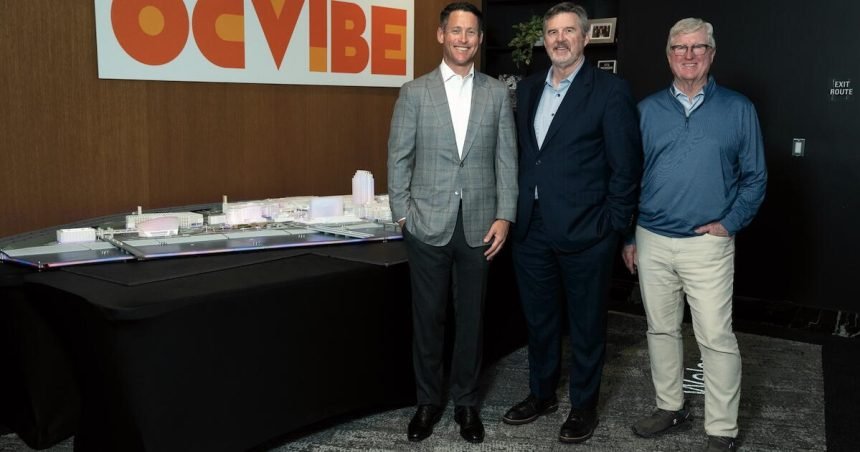
Set to Deliver a Transformational Sports and Entertainment District to Anaheim, OCVIBE’s Phase 1 Open Attracts Businesses, Leadership and the Public
Orange County’s newest cultural, entertainment and culinary destination is rising from the parking lots surrounding the Honda Center, with the first phase of development set to open early next year.
The $5 billion, 100-acre mixed-use project is one of the largest active construction projects in Southern California. Individual elements of the project would be major additions to the Southern California landscape alone, but the Samueli family envisioned a district that combines music venues, hotels, an office building, food hall, restaurants and 2,000 residences in a cohesive buildout anchored by the Honda Center. It is also connected to the Anaheim Regional Transportation Intermodal Center hub (ARTIC) which is managed by OC Sports and Entertainment, the company that oversees the Samuelis ownership of the Anaheim Ducks and manages the facility.
“Each building, each place tells a different story. Henry and Susan (Samueli) gave us the freedom to design all of these creative pieces and put them together in a walkable environment that is open to all,” said Dan Young, executive director of development for OCVIBE. “The finishes are coming in, the walls are becoming real and the story is literally coming to life.”
The district will open in phases, with the initial elements that include the 5,000-person concert venue set to open in March 2027. The first phase also includes free parking for nearly 8,000 vehicles, enough to handle the fans and guests attending events at the Honda Center, concert venue and 35 dining options. Additionally, there is an urban park with a 4,500-square-foot screen that will host community gatherings and broadcast major events.
The development process was launched years ago by the Samuelis, who slowly acquired parcels surrounding the Honda Center with a long-term vision to build a district that would serve the surrounding population by providing unique amenities to the area while concurrently making it a global destination that attracts top music groups and sporting events, all in addition to serving as home to the Anaheim Ducks NHL hockey team.
Honda Center is also hosting the 2028 Olympics, where it will serve as the venue for indoor volleyball. Ownership committed $1 billion to upgrades throughout the arena including a new entrance, overhauls of suites and premium hospitality areas, a new high-end club and parking for season-ticket holders with direct access to the arena.
OCVibe’s plans started to move forward in 2020, although supply chain issues slowed development for about a year because certain materials weren’t available. Data center construction was cited as a reason that certain components – like wiring for the concert venue – were unavailable. Since then, tariffs, rising interest rates and construction labor have all been challenges that could have impacted the project, but it has proceeded on time and on budget.
“Our core vision is to be the gathering place for all of Orange County. The architecture, the uniqueness of the food and the music and entertainment will bring people here to celebrate the 33 different cultures that are spread out across Orange County. There can’t be any place in the country that’s more diverse than this little patch of ground,” said Bill Foltz, chief executive of OCVIBE.
Now, with the first phase nearly completed, a new development could generate additional interest as a new neighbor “moves in.” Stan Kroenke, who owns sports teams in the major professional leagues in the United States as well as European soccer, agreed to purchase the Anaheim Angels and the 150-acres of land where the stadium and parking sits adjacent to OCVIBE. There is potential to add housing, retail and more hospitality that could connect with the Honda Center development – albeit bisected by a freeway – but connected with an underpass. It’s led to optimism that the 820-acre “Platinum Triangle” area of Anaheim will achieve its full development potential.
“Sports venues can no longer just be three hour, game day destinations. Mixed use sports and entertainment districts create 365 day destinations that drive new revenue, increase consumer spending and build community. The leadership at OCVIBE and the Anaheim Ducks has done a spectacular job thinking through how all of these pieces integrate,” said Jeff Marks, chief executive of Innovative Partnerships Group, a Los Angeles-based sponsorship and naming rights agency.

A Fresh Take on a Music Hall
In this region of Orange County, a huge missing component was a mid-sized concert venue. A 5,000-person music hall could generate significant attendance that complements the much larger Honda Center and could be utilized more frequently. The developers studied the Orange County market and determined that this type of venue would generate significant interest from events similar to YouTube Theater in Inglewood and Peacock Theater in downtown Los Angeles. Many concert tours skipped Orange County because it lacked a modern venue of this size.
The concert hall will operate as an open venue, meaning that it can partner with multiple concert and tour operators. Orange County’s largest music draw caters to Latin music audiences, but there are also strong demographics to support country music, rock and pop. Honda Center has even hosted sold-out K-pop concerts.
Additionally, it complements surrounding venues such as the nearby 1,700-person capacity Grove of Anaheim, the neighboring baseball stadium that can host mega events and the Honda Center with capacity of approximately 18,000. In addition, an intimate 350-person music and comedy venue dubbed the Golden Bear will open in Phase 2 of the development. The name hearkens back to Orange County’s historic nightclub in Huntington Beach that shuttered in 1986.
Seats have been installed and finishing touches are underway as it prepares for its debut in March. The amenities for the talent and crew are first class. There are multiple private dressing rooms attached to the theater as well as areas for the crew to gather. Moreover, the loading docks have been revamped for the concert venue and Honda Center. Trucks used to have to descend to the loading docks in reverse, but the new design allows three trucks to access the venue simultaneously with simpler access.
The music venue has one of several pieces of the district’s public art on the exterior. The district commissioned multiple artistic elements for the facades that add striking features to the modern designs. For example, the concert hall has a design that is representative of musical notes. Public art is an important part of the vision for the district, which is led by Smith-Clementi, the master architecture firm leading the overall design.
Dining Out
Patrons who attend concerts and the Anaheim Ducks hockey games will have plenty of food options. Katella Commons is a 50,000-square-foot, two-level market hall with 21 chef-driven concepts plus six bars and lounges. The food hall sits at the base of the six-story Weave office tower.
There are 35 dining destinations spread throughout the development. Local chefs have committed to opening in the district. OCVIBE handled most of the infrastructure buildouts, which made it attractive for chefs to open in the space due to the low cost of kitchen design and shared common space for seating within Katella Commons.
Recent announcements include plans from Osen Hospitality Group, led by Chef Damon Cho, to open two new dining concepts focused on a Japanese dining experience. Osen Urban Table restaurant will open in the district’s Urban Park and Osen Handroll will open in Katella Commons.
Fine dining and quick-service offerings provide options for business lunches, amenities for onsite and nearby residents, dinner prior to sporting events and concerts plus late-night eats, the district has a private kitchen and banquet space with capacity to handle events of up to 1,000 people on an outdoor patio. It’s a unique event space in Orange County where there are challenges finding hotel ballrooms with that capacity, especially in the Anaheim area outside of the convention center.
That event space is a key amenity for businesses and organizations that may want to host private events, especially for tenants at the Weave, a 168,000-square-foot mass timber office building that is the first of its kind in Southern California. Mass timber structures are made from large, engineered wood products that can replace concrete and steel in mid-rise buildings. The design is unique and the open floor plans are attractive to businesses that seek high-end office space surrounded by amenities. Plus, each floor has balconies that give tenants access to outdoor space without leaving the tower.

Anthony Olheiser, Nick Pacific, Dan Young and Scott Frick in the underconstruction Weave office building
(Varon Panganiban)
These types of projects have had the strongest leasing velocity in Orange County as companies attempt to attract and retain top talent in technology, professional services and life sciences. The first tenant at the building, which is set to open in late 2027, is Kiln, a hospitality-focused coworking operator that offers smaller offices and memberships.
The office component is an important, but smaller element of the district compared with others across the country. It’s one of the few office projects underway in Orange County, where there is contraction in the market as older buildings are converted to warehouses and apartments. The building gets its name because it is designed to look like the weave of a basket that the Indigenous people of the region made.
Outside of the office space, companies have signed on as founding partners where they can leverage the district’s platform to connect with the community. Founding partners include UCI Health, Rady Children’s Health, Arthur J. Gallagher, Yaamava’ Resort & Casino, Cox and Concordia University Irvine.
The Future
The hotel is ready to break ground next to the Honda Center. A second hotel and park space is planned closer to the regional transit center, which is currently a parking lot. It will be supported by a new parking structure that is nearing completion across Douglass Road that connects via a pedestrian bridge to ARTIC, which is managed by OC Sports and Entertainment. Combined, these two projects will add more than 500 hotel rooms.
There is also a residential neighborhood and park with 2,000 new homes spread across eight residential buildings planned for a later phase. That development includes low-income housing. It wasn’t mandated, but it was an important element and could provide housing for people who work onsite. Housing is a critical element. The city of Anaheim’s master plan calls for more housing in the area that includes the district.
Residents and the public will have access to 20 acres of open-air parks spread across the development connected by a three-mile pedestrian loop spanning the district. The development is adjacent to the Santa Ana River with its bike path that traverses the region. One of the most unique elements of the project is being planned with help from local and federal agencies to bring water into the Santa Ana River with potential for water activities.
“The placemaking is exceptional with the park areas. One of the biggest land use mistakes is over densifying an area. Open space creates the opportunity for engagement and activations that don’t already exist,” said Sean McNamara, managing director of The Mixx, JLL’s property management group that will oversee operations, management, and maintenance of OCVIBE’s expansive commercial and common areas.
OC Sports and Entertainment will continue to manage the Honda Center and will manage the future entertainment venues at OCVIBE. One key to the development is the technology that supports communication directly with fans and patrons through apps as well as more than 100 video boards across the district. Those are managed from a central location within the district and support communication between various stakeholders, an element that is key to success, according to McNamara.
Technology is especially important given the background of the district’s ownership. Billionaire Henry Samueli co-founded of Broadcom Corp., a developer, manufacturer and global supplier of a wide range of semiconductor and infrastructure software products for data centers, networking, broadband and wireless communications. He purchased the Anaheim Ducks in 2005 from Walt Disney Co.
Sports-anchored venues tend to have better financial success among mixed-used districts across the country with various types of anchors. McNamara has experience working with districts across the country and noted that those with substantial open space can command premiums for retail, office, hospitality and events. “They all benefit in some way from the parks and the placemaking spaces,” said McNamara.