The first time Steve Jobs held a public demo of the Apple Macintosh, in early 1984, scripted jokes were part of the rollout. First, Jobs pulled the machine out of a bag. Then, using speech technology from Samsung, the Macintosh made a quip about rival IBM’s mainframes: “Never trust a computer you can’t lift.”
There’s a reason Jobs was doing that. For the first few decades that computing became part of cultural life, starting in the 1950s, computers seemed unfriendly, grim, and liable to work against human interests. Take the 1968 film “2001: A Space Odyssey,” in which the onboard computer, HAL, turns against the expedition’s astronauts. It’s a famous cultural touchstone. Jobs, in selling the idea of a personal computer, was using humor to ease concerns about the machines.
“Against the sense of computing as cold and numbers-driven, the fact that this computer was using voice technology to deliver jokes made it seem less forbidding, less evil,” says MIT scholar Benjamin Mangrum.
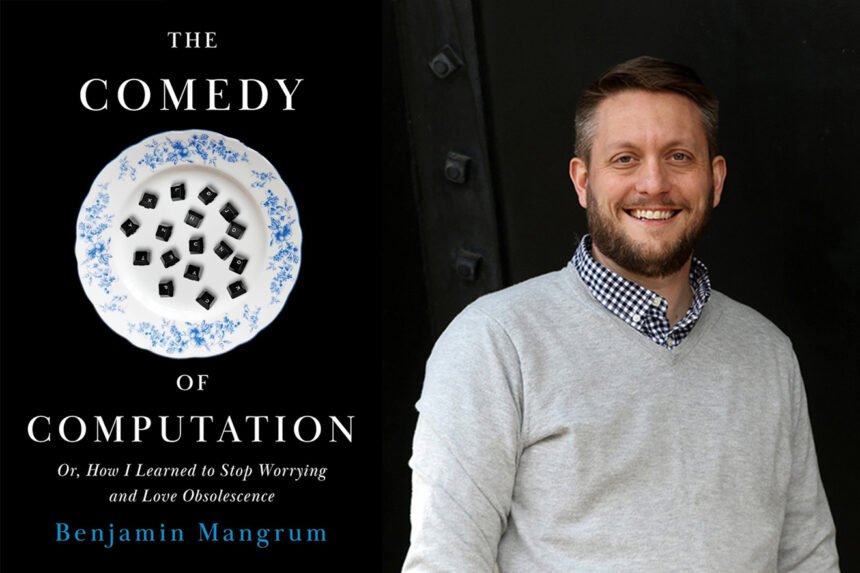
In fact, this dynamic turns up throughout modern culture, in movies, television, fiction, and the theater. We often deal with our doubts and fears about computing through humor, whether reconciling ourselves to machines or critiquing them. Now, Mangrum analyzes this phenomenon in a new book, “The Comedy of Computation: Or, How I Learned to Stop Worrying and Love Obsolescence,” published this month by Stanford University Press.
“Comedy has been a form for making this technology seem ordinary,” says Mangrum, an associate professor in MIT’s literature program. “Where in other circumstances computing might seem inhuman or impersonal, comedy allows us to incorporate it into our lives in a way that makes it make sense.”
Reversals of fortune
Mangrum’s interest in the subject was sparked partly by William Marchant’s 1955 play, “The Desk Set” — a romantic comedy later turned into a film starring Katharine Hepburn and Spencer Tracy — which queries, among other things, how office workers will co-exist alongside computers.
Perhaps against expectations, romantic comedies have turned out to be one of the most prominent contemporary forms of culture that grapple with technology and its effects on us. Mangrum, in the book, explains why: Their plot structure often involves reversals, which sometimes are extended to technology, too. Computing might seem forbidding, but it might also pull people together.
“One of the common tropes about romantic comedies is that there are characters or factors in the drama that obstruct the happy union of two people,” Mangrum observes. “And often across the arc of the drama, the obstruction or obstructive character is transformed into a partner, or collaborator, and assimilated within the happy couple’s union. That provides a template for how some cultural producers want to present the experience of computing. It begins as an obstruction and ends as a partner.”
That plot structure, Mangrum notes, dates to antiquity and was common in Shakespeare’s day. Still, as he writes in the book, there is “no timeless reality called Comedy,” as the vehicles and forms of it change over time. Beyond that, specific jokes about computing can quickly become outmoded. Steve Jobs made fun of mainframes, and the 1998 Nora Ephron comedy “You’ve Got Mail” got laughs out of dial-up modems, but those jokes might leave most people puzzled today.
“Comedy is not a fixed resource,” Mangrum says. “It’s an ever-changing toolbox.”
Continuing this evolution into the 21st century, Mangrum observes that a lot of computational comedy centers on an entire category of commentary he calls “the Great Tech-Industrial Joke.” This focuses on the gap between noble-sounding declared aspirations of technology and the sometimes-dismal outcomes it creates.
Social media, for instance, promised new worlds of connectivity and social exploration, and has benefits people enjoy — but it has also generated polarization, misinformation, and toxicity. Technology’s social effects are complex. Whole televisions shows, such as “Silicon Valley,” have dug into this terrain.
“The tech industry announces that some of its products have revolutionary or utopian aims, but the achievements of many of them fall far short of that,” Mangrum says. “It’s a funny setup for a joke. People have been claiming we’re saving the world, when actually we’re just processing emails faster. But it’s a mode of criticism aimed at big tech, since its products are more complicated.”
A complicated, messy picture
“The Comedy of Computation” digs into several other facets of modern culture and technology. The notion of personal authenticity, as Mangrum observes, is a fairly recent and modern construct in society — and it’s another sphere of life that collides with computing, since social media is full of charges of inauthenticity.
“That ethics of authenticity connects to comedy, as we make jokes about people not being authentic,” Mangrum says.
“The Comedy of Computation” has received praise from other scholars. Mark Goble, a professor of English at the University of California at Berkeley, has called it “essential for understanding the technological world in its complexity, absurdity, and vibrancy.”
For his part, Mangrum emphasizes that his book is an exploration of the full complexity of technology, culture, and society.
“There’s this really complicated, messy picture,” Mangrum says. “And comedy sometimes finds a way of experiencing and finding pleasure in that messiness, and other times it neatly wraps it up in a lesson that can make things neater than they actually are.”
Mangrum adds that the book focuses on “the combination of the threat and pleasure that’s involved across the history of the computer, in the ways it’s been assimilated and shaped society, with real advances and benefits, along with real threats, for instance to employment. I’m interested in the duality, the simultaneous and seemingly conflicting features of that experience.”