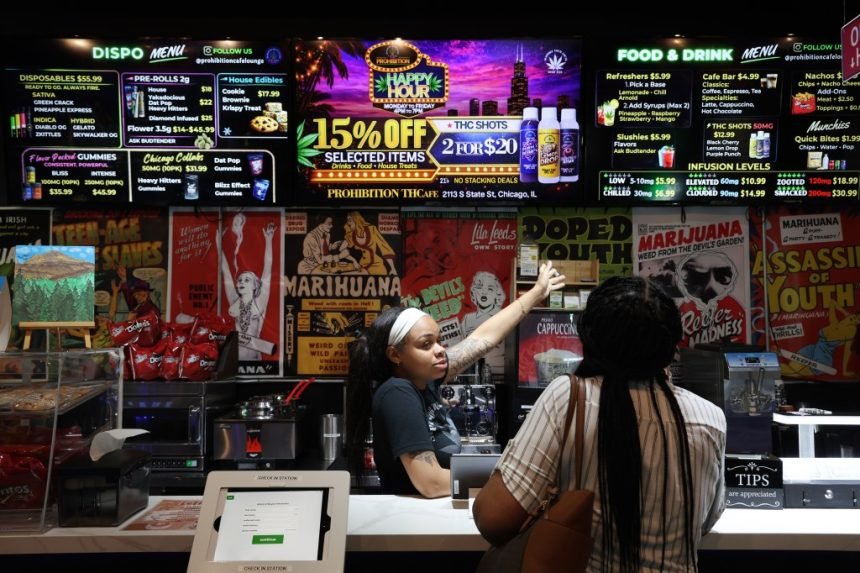
After federal law legalized hemp in 2018, Samuel Wilson co-founded Prohibition THCafe, which sells hemp-derived THC-infused edibles and beverages on the Near South Side. For the informal 420 cannabis holiday on April 20, the cafe partnered with Harold’s Chicken to sell infused wings, with customers lining up down the block.
But Wilson’s cafe may be put out of business by both a new federal law banning sales of intoxicating hemp and a proposed Illinois measure, approved by lawmakers, that would ban hemp sales other than by state-licensed dispensaries. The bill, which would have to be signed by Gov. JB Pritzker to take effect, is meant to get rid of unscrupulous shops that sell untested, unlimited amounts of hemp to minors. It also would close businesses like that of Wilson, who says he sells only tested, high-quality products to those 21 and over.
“I was that innovator who chased the American Dream,” Wilson said. “To see that now in jeopardy after all the sacrifice and hard work I’ve done … it’s a hijacking of small operators and handing it over to corporate cannabis.”
The bill marks a win for licensed cannabis businesses who say unregulated hemp shops are undercutting their sales while facing none of the same security restrictions, such as testing and labeling the content of their products.
Cannabis operators lobbied for the sweeping legislation as a long overdue correction, and the most significant improvement to the industry since recreational cannabis sales were allowed in Illinois beginning in 2020.
The state ban on intoxicating hemp would be similar to, but much broader than, a federal law that would ban hemp sales of more than 0.4 milligrams of total tetrahydrocannabinols, the chemical component that gets users high. Both measures are scheduled to take effect in November.
Wilson holds out hope that federal lawmakers will amend their law to allow hemp sales to continue, though any such change faces an uphill battle. The Illinois law would end unlicensed hemp sales in either case.
Small hemp startups have grown to become a noticeable presence in Illinois commerce. More than 1,000 hemp retailers in Illinois generated some $870 million in sales in 2025, plus more than 500 wholesalers and processors, employing some 13,000 workers overall, a Whitney Economics survey found.
On the licensed cannabis side of the industry, dominated by multistate corporations, the Illinois “omnibus” bill would make a wide range for changes.
Perhaps the biggest change would be a doubling of the amount of licensed cannabis or THC that consumers may possess.
For Illinois residents, the bill increased the limits to 60 grams, or about 2 ounces, of flower used for smoking, 1,000 milligrams in infused products like edibles, and 10 grams of cannabis concentrate. Out-of-state residents may possess half that much.
Dispensaries would be allowed to stay open until 2 a.m., rather than the current 10 p.m. closing time, unless local communities set other hours.
Most importantly for medical cannabis users, the bill would allow any licensed dispensary to sell what’s designated as medical cannabis, which is not subject to the same high retail taxes as recreational weed. Previously, only certain dispensaries sold such tax-exempt products, forcing purchases in some cases to drive long distances.
The ability to sell medical cannabis would also be an advantage for recent start-up dispensaries, who aren’t able to do so now. It would also potentially allow them to take standard business tax deductions on federal income taxes, following the federal government’s recent rescheduling to ease restrictions on the medical use of marijuana.
For the first time, the bill also would allow drive-thru service. And licensed cannabis would be permitted to be accessible in a car as long as it’s in the original sealed packaging.
Tiffany Ingram, executive director of the Cannabis Business Association of Illinois, which represents most licensed growers and sellers, welcomed the legislation.
“For years, the industry has been asking policymakers to do two things: modernize regulations that no longer make sense and address the growth of intoxicating hemp products being sold outside the licensed marketplace,” Ingram told the Tribune. “(Senate bill) 3222 accomplishes both, making it one of the most consequential cannabis bills since legalization.”
As for hemp businesses, Ingram noted that their owners may apply for up to 145 new licenses that would allow them to infuse and sell products like beverages and edibles with THC.
State Sen. Kimberly Lightford, a Democrat from Maywood, had fought for such hemp restrictions for several years.
“Together, these changes formalize the hemp market, modernize cannabis operations and lower barriers for both patients and smaller operators,” Lightford said.
If the governor signs the bill into law, it would immediately ban any sales of intoxicating hemp to those under 21, and would ban marketing that’s deceptive or aimed at children, said state Rep. Will Guzzardi, a Chicago Democrat and co-sponsor of the bill. It would also eliminate the costly dispensary requirement to hire a security contractor, allowing in-house security.
Since federal agencies lack the manpower to impose the hemp ban at thousands of stores nationwide, enforcement likely would rely largely on state regulators and local police, which could be a challenge.