Using the repurposed equipment, a team including Imperial College London researchers have measured parts of the Martian atmosphere that were previously impossible to probe. This includes areas that can block radio signals if not properly accounted for—crucial for future Mars habitation missions.
The results of the first 83 measurements, analyzed by Imperial researchers and European Space Agency (ESA) colleagues across Europe, are published today in the journal Radio Science.
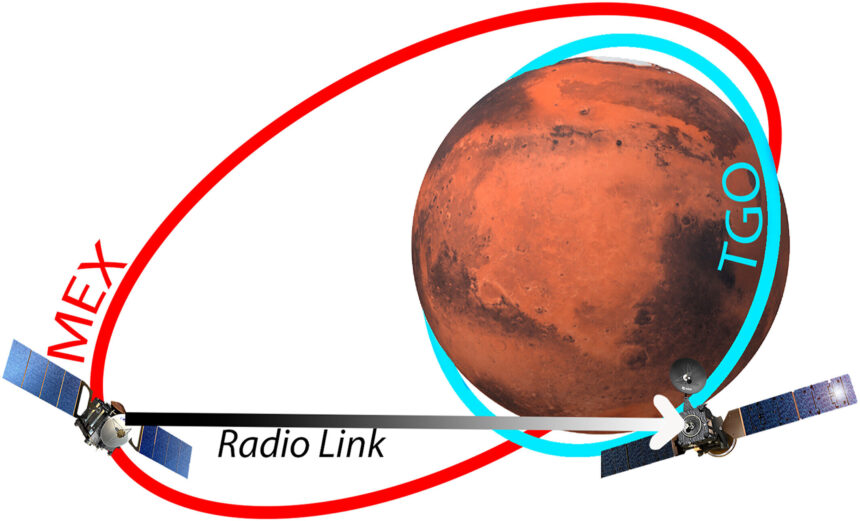
To achieve this, ExoMars’ Trace Gas Orbiter (TGO) teamed up with another ESA spacecraft orbiting the red planet: Mars Express (MEX). The two craft maintain a radio link, so that as one passes behind the planet, radio waves cut through the deeper layers of the Martian atmosphere.
Changes in the atmosphere’s refractivity—how it bends the radio waves—cause tiny but detectable shifts in the radio frequencies received by the spacecraft. By analyzing this shift, scientists can determine the density of the lower atmosphere and the electron density in the ionosphere—a charged upper layer of the atmosphere. The technique is called mutual radio occultation.
Lead author of the study Jacob Parrott, a Ph.D. student from the Department of Physics at Imperial, said, “The systems on MEX and TGO were not initially designed to do this—the radio antennas we used were made for communication between orbiters and rovers on the planet’s surface. We had to reprogram them while inflight to carry out this new science.
“This innovative technique is likely to be a game-changer for future missions, proving that mutual radio occultation between two orbiting spacecraft is an economical way to extract more scientific value from existing equipment.”
Dream teamwork
Previously, radio occultation was conducted using the radio link from a Mars orbiter to large ground stations on Earth. The radio signal from the orbiter would be monitored as the spacecraft “set” (was occulted) behind Mars, meaning the signal passed through the layers of the planet’s atmosphere.
Using two orbiting craft to take this measurement is already a common way to investigate the Earth’s atmosphere: thousands of such measurements occur between global navigation satellites, where the data they provide are used for atmospheric monitoring and weather prediction.
However, this method had only been used on Mars three times before; by NASA in 2007 as a hardware demonstration. The new use by the two ESA spacecraft marks the first time this technique has been routinely applied to another planet.
Now its viability has been proven, the scientists and engineers behind the work are looking into how to expand the use of this technique in future Mars missions.
Study co-author Dr. Colin Wilson, Project Scientist for the ExoMars Trace Gas Orbiter and Mars Express at ESA, said, “ESA has now demonstrated the viability of this technique, which could be transformational for Mars science in the future.
“There are currently seven spacecraft orbiting Mars; as the number of spacecraft increases, as it will in coming decades, the number of radio occultation opportunities increases rapidly. Therefore, this technique will be an increasingly important tool for studying Mars.”
More measurements, more insights
Spacecraft-to-spacecraft occultation allows more measurements to be taken and allows new regions of the atmosphere to be probed.
Because conventional radio occultation measurements on Mars involve a radio link to a ground station on Earth, the measurement location is fixed relative to Earth’s slow movement. This makes it hard to capture global changes on Mars, as researchers are often looking at the same spots.
Additionally, this method can only sample near sunset and sunrise because of Earth’s proximity to the sun, limiting our view of Mars’ atmosphere.
Moreover, traditional radio occultation suffers from “occultation seasons,” where measurements are only possible for a few months each year due to the spacecraft’s orbit. For example, Mars Express could only perform radio occultation for two months in 2022.
Mutual radio occultation overcomes these problems, allowing researchers for the first time to explore the entire depth of Mars’ ionosphere around noon and midnight.
More information:
Jacob Parrott et al, First Results of Mars Express—ExoMars Trace Gas Orbiter Mutual Radio Occultation, Radio Science (2024). DOI: 10.1029/2023RS007873
Provided by
Imperial College London
Citation:
Repurposed technology used to probe new regions of Mars’ atmosphere (2024, July 5)
retrieved 6 July 2024
from https://phys.org/news/2024-07-repurposed-technology-probe-regions-mars.html
This document is subject to copyright. Apart from any fair dealing for the purpose of private study or research, no
part may be reproduced without the written permission. The content is provided for information purposes only.