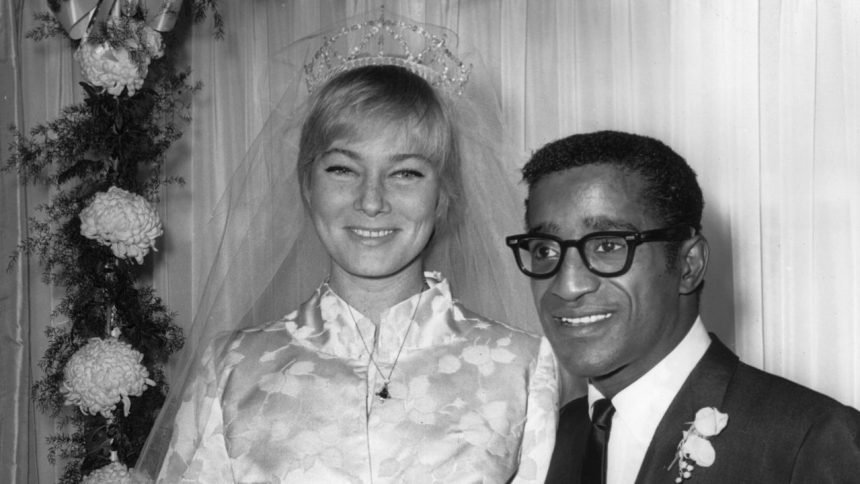
Sammy Davis Jr., otherwise known as “Mister Show Business,” was one of Hollywood’s brightest (and most versatile) stars during the 1950s and ’60s. Born in 1925 in Harlem, New York, Davis began performing as a child in his family’s dance troupe before rising to fame on Broadway in the musical Mr. Wonderful. From there, he went on to headline in Las Vegas, host the variety program The Sammy Davis Jr. Show, release chart-topping music like the hit single “The Candy Man,” and appear in a string of memorable films, including Ocean’s Eleven, starring alongside fellow Rat Pack members Frank Sinatra and Dean Martin.
Ever the showman, Davis also considered his true home to be the entertainment industry. “My home has always been show business,” he wrote in his 1989 autobiography, Why Me?: The Sammy Davis, Jr. Story. “That’s where I’ve lived since the age of three. I’ve slept in hotels and rooming houses, in cars, on trains and buses, in our dressing rooms … But home was where the lights were, the people out front, the laughter and applause, the acts I watched from the wings all day long.”
Still, his offstage residences across Hollywood and Beverly Hills were just as dazzling as his career. Below, we’ve rounded up 7 photos that offer a glimpse at Davis’s domestic life.
A star on the rise
In this 1955 photo, Davis is shown during the filming of the CBS interview special Person to Person. At the time, he was still in the early days of his Hollywood career—so early, in fact, that when the CBS crew was scheduled to arrive at his home in the Hollywood Hills to prepare for the interview, the space, which he shared with his grandmother, was barely furnished. In his 1965 autobiography, Yes, I Can: The Story of Sammy Davis, Jr., Davis recalled the frantic scene. “I couldn’t afford to pass up the importance of that kind of exposure, so almost overnight I had to get the house furnished,” he wrote. “Crews of workmen were swarming around the place, hammering down carpet, putting up curtains and draperies, bringing in chairs, lamps, pictures, and parts of beds, working with hectic efficiency—like they were putting together a movie set.”
Here comes the bride