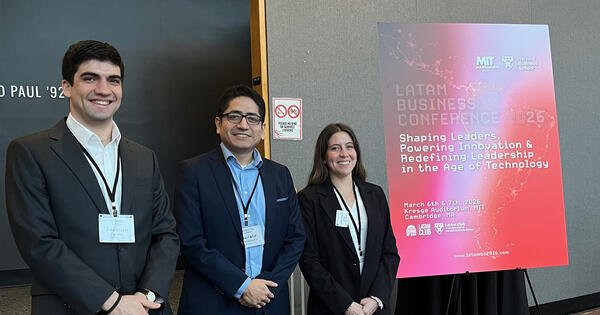
As a second-year MBA student at Yale SOM, I’ve spent the past year navigating recruiting, refining my career direction, and building a sharper view of how technology reshapes industries. But some of the most clarifying moments happen outside Evans Hall. That was the case at the MIT Sloan and Harvard Business School Latin American Business Conference 2026, which I attended alongside Joaquín Sardón ’26 as a Yale SOM representative, sponsored by the Office of Community Engagement and Dialogue’s External Partnership and Travel Initiative. Our classmate Andrea Gonzalez ’26, a student in the Master of Advanced Management program, came to the conference as well.
Held in March at MIT, the conference convened over 100 attendees from programs including MIT Sloan, Harvard Business School, NYU Stern, Babson College, and Boston University, along with a roster of speakers from companies like Goldman Sachs, PepsiCo, Microsoft, Amazon Web Services, and Warner Music. Under the theme “Shaping Leaders, Powering Innovation, Redefining Leadership in the Age of Technology,” the two-day program included 11 panels covering fintech, mining, AI, venture capital, entertainment, infrastructure, diplomacy, and women in business. What drew me to this particular conference was its breadth: rather than focusing on a single country or industry, it explored opportunities across Latin America through the connecting thread of technology and innovation.
One of the sessions that stood out most was “Tech & Tomorrow: Latin America Tech Future,” featuring Andrés Hernández, a general manager and partner at Xbox. He acknowledged the enormous Latin American gamer base as an opportunity to create content by Latino creators and for Latino audiences. What I found particularly striking was his vision for AI in gaming, which moved beyond the usual narrative of smarter non-player characters or more personalized experiences. He described a future where AI stochastic models optimize computing resources at the graphics rendering level, fundamentally changing how games are built and displayed. For someone like me targeting product management in the tech industry, this was a concrete example of how AI is not just a feature layer but a shift in the underlying infrastructure of digital products.
Another session that stayed with me was “From Local Stories to Global Stages: The Rise of Entertainment in Latin America,” in which Gabriela Tafur, CEO of Idilo TV, broke down the complexity of producing micro-series in a vertical format. She explained that the entire production process, from camera work to direction, requires a completely different mindset than traditional filmmaking. It is not simply a matter of cropping a horizontal frame; rather, this new medium demands rethinking storytelling from the ground up. Her point illustrated how Latin American talent is actively engaging with new formats that are currently led primarily by Asian content creators. It was a reminder that innovation in Latin America extends well beyond fintech and software.
Beyond the panels, what made this conference memorable was the quality of the conversations in between. I had the opportunity to meet Peru’s ambassador to the United States, Alfredo Ferrero; Carolina Hernández, a principal product manager at Microsoft; and other professionals from different countries. During a brief conversation with Andrés Hernández after his session, we discussed experiments pitting AI models against each other and the future of AI-driven players capable of mimicking near-human behavior. These informal exchanges reinforced a conviction that I have been developing throughout my time at SOM: in a period of uncertainty, people value leaders with the courage to propose next steps and move through ambiguity.
Roque Benavides, chairman of Compañia de Minas Buenaventura, delivered an inspiring keynote that gave us a snapshot of the mining landscape in Latin America and Peru. He highlighted the increasing importance of copper as an enabler for new technologies, from semiconductor chips to electric vehicles, and emphasized the central role of sustainable business practices to operate in harmony with all stakeholders. His words carried weight for those of us with Peruvian roots in the audience.
After the conference, I returned to New Haven and SOM with a sharper perspective on the intersection of technology and leadership in Latin America, and with new connections I intend to build on. For any first-year student considering this conference next year, I would say: attend. The topics are diverse, the access to speakers is genuine, and you will discover possibilities you were not looking for.