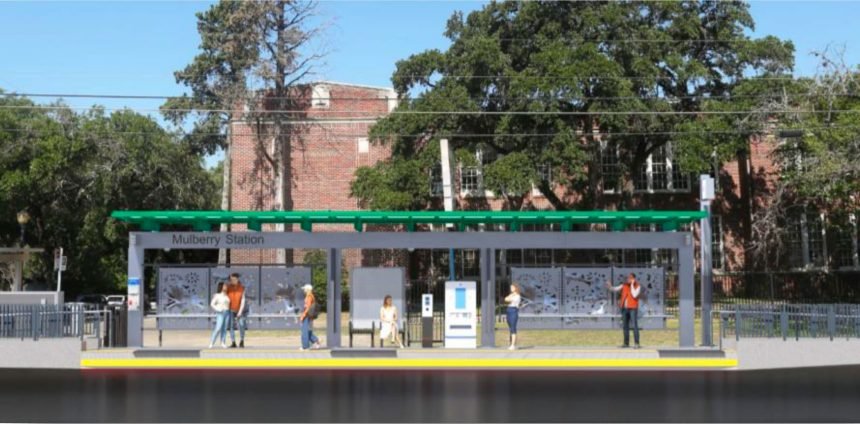
Details around VIA Metropolitan Transit’s new east-west line are coming into focus as designs and locations for the future bus stations in the city’s historic districts are expected to go before a panel for review.
Documents submitted to the city’s Office of Historic Preservation list the bus stops that VIA has planned for the Silver Line, an advanced rapid transit system with a route through downtown San Antonio.
The city’s Historic and Design Review Commission is scheduled to consider the plans Aug. 5 and make a recommendation for eight of a total 18 stations.
The commission’s review is required by ordinance because some of the stations are located in the river improvement overlay (RIO) district and others in four historic districts — Cattleman Square, Main and Military Plaza, St. Paul Square and Dignowity Hill.
Four of the eight under review are brand-new locations for a bus stop, including eastbound stops in the St. Paul Square and Dignowity Hill districts, and an eastbound and westbound stop in Dignowity Hill at Houston and Olive streets.
The other four locations already have bus stops which will be upgraded for this project.
The 7.3-mile-long Silver Line will operate along West Commerce, Buena Vista and East Houston streets in the heart of downtown, spanning from North General McMullen Drive on the West Side to the Frost Bank Center on the East Side.
The nearly $300 million transit system is still in design, with about 70% of that phase of the project completed, according to the documents.
The Silver Line will serve as the corresponding route to VIA’s north-south Green Line, a $481 million project already under construction. The Green Line’s 10.3-mile route will have 25 new bus stations.
As with the Green Line, the Silver Line comes with renewed bus shelters and also infrastructure improvements along the corridor, including new and repaired sidewalks, intersection and sign upgrades, new or replaced stormwater drains and new pedestrian crossings with signals.
The Silver Line will mostly use bus stop locations already in use. Construction is expected to start next year with the line open for ridership by early 2031.
New stations are proposed as three different types — center lane, curbside and curbside-narrow — depending on the size of the right-of-way. Most shelters match the basic, “next gen” design used in existing VIA local service.
Station costs through the corridor vary based on station type and amenities included. Current estimates range from $150,000 to $900,000 per station and are based on the project’s 40% design phase. These estimates may change through the design process.

Two planned stations are located in RIO Districts, including the St. Mary’s/Navarro stop and the City Hall/Santa Rosa stop. The others are located in four districts designated as historic.
The commission is being asked to review the plans for a certificate of appropriateness.
So far property owners in the historic districts have signaled their support of the plans they’ve been shown, according to VIA’s documents.
In meetings with business owners and residents going back to 2024, VIA solicited input on the locations and designs and, in most cases, modified its plans in response to concerns.
In St. Paul Square, for example, business owners asked VIA to revise the planned bus station in the east-bound lane due to its proximity to a commercial business and existing shade elements.
In response, VIA refined the design to eliminate the shelter structure, redesign the bench to complement the district’s streetscape and move the farebox.
VIA plans more public meetings related to the Silver Line starting in August.