In summer in Mount Vernon, Latino students go back to class for five weeks to learn, play and thrive in an environment that encourages them to embrace their cultural heritage and their futures.
For a decade now, the Foundation for Academic Endeavors’ Summer Academy, based at Skagit Valley College, has shepherded low-income Latino youth from pre-K to high school toward a path of college credentials and career readiness.
This summer, 200 students from Mount Vernon, Burlington-Edison and Sedro-Woolley school districts are spending their days in July on the college’s campus, practicing their reading, learning about STEM topics, going on field trips, and receiving free meals and transportation to and from the program.
Executive Director Dania Jaramillo said the nonprofit was founded out of a community need for a space in the summer that was intergenerational and multicultural.
Most Skagit school districts run summer schools, but the programs are often targeted to specific ages and populations. With budget challenges, district capacity to run those programs continues to shrink.
A survey from After School Alliance found there are nearly 275,000 children in Washington state whose parents want them to be in a summer program but aren’t, largely due to affordability challenges. Families of children enrolled in Summer Academy contribute what they can on a sliding scale, said Jaramillo.
With Latino students making up 60% of the Mount Vernon School District, 50% of Burlington-Edison and 25% of Sedro-Woolley, that’s thousands of students, Jaramillo said. They can’t meet the demand with limited funding sources.

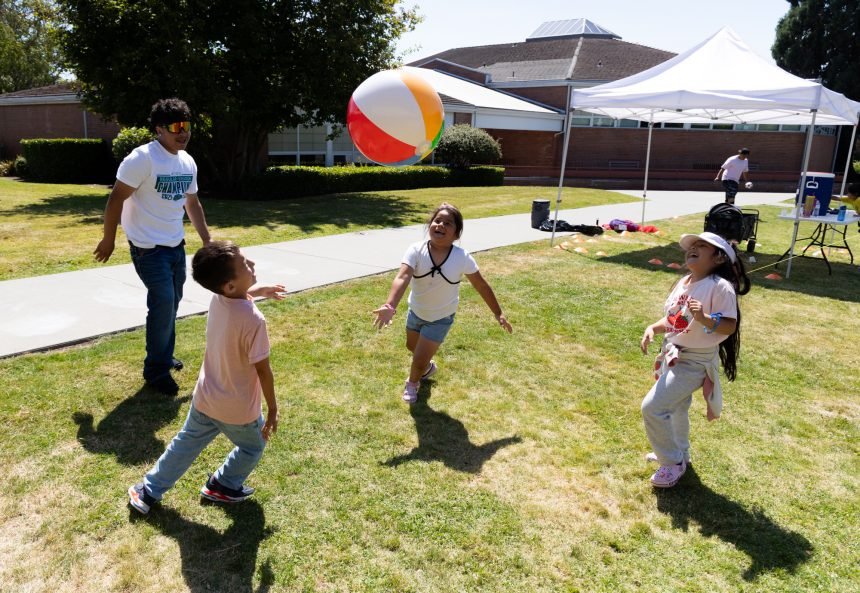
Outside on Skagit Valley College’s Mount Vernon campus on Tuesday, a group of younger students played volleyball with a big beach ball and passed tiny soccer balls back and forth.
Inside a classroom in Lewis Hall, a sixth- and seventh-grade class discussed water scarcity and quality challenges, colonialism and how the topics are connected.
At the beginning, the program was largely focused on preventing summer learning loss. That remains a goal, Jaramillo said. But the greatest impact, she thinks, is “strengthening the cultural identities and language of our students.”
That comes through a staff that is now 90% Latino — a racial and linguistic “reflection of who we’re serving,” Jaramillo said. That’s not something that is seen in the local school districts, although she noted that they have committed to diversifying their teaching workforce.


It also looks like reading in English and Spanish, and books that have characters who look like them.
Marlene Kurtz-Rios helped get the Summer Academy off the ground. A parent of three children who have gone through the program and then came back as high school interns and college fellows, she said it planted the “seed” for her oldest that he could go to college. Her younger two are now following that same path.
“The choice is not whether I go to college,” Jaramillo said. “It’s what college, what career.”
Beyond the Summer Academy for pre-K through eighth grade, the program has high school internships and a college fellowship for Latino students interested in studying to be educators.

Jaramillo describes the program as having “cascading mentorship” opportunities: high school interns mentor the students, college fellows mentor the interns and certificated teachers mentor the fellows.
One of those fellows this summer is Christian Cabrera, a Skagit Valley College student who was a student at Summer Academy and then a high school intern.
He credited the program for getting him more interested in school and sparking his interest in pursuing teaching. A teacher at Summer Academy helped him apply for college and scholarships.
“It put the idea through my head that I could do it — that it’s a possibility, attainable,” he said.

The Foundation works to boost parent knowledge, too. They host hybrid bilingual workshops on how to apply for financial aid, kindergarten readiness and mental health. Jaramillo said they want to grow families’ networks in the community to expand the number of spaces they feel comfortable entering and asking questions.
Jaramillo said Summer Academy can serve as an example of what they think public schools should look like: inclusive, multilingual and diverse.
“This is our end goal, statewide.”
Charlotte Alden is CDN’s general assignment/enterprise reporter; reach her at charlottealden@cascadiadaily.com; 360-922-3090 ext. 123.