Hispanic Business TVHispanic Business TV
  • Featured
  • Popular Cities
    • Atlanta
    • Boston
    • Chicago
    • Dallas
    • Denver
    • Houston
    • Las Vegas
    • Los Angeles
    • Miami
    • New York
    • Phoenix
    • Salt Lake City
    • San Antonio
  • Business
    • HBTV Toolbox
      • Social Media Management
  • Politics
  • HBTV Sports
    • MLB
    • MMA
    • NCAAF
    • NBA
    • NCAAM
    • NFL
    • NHL
  • Entertainment
  • Living
    • Culture
    • Latino Lifestyle
    • Education
    • Cannabis
Reading: South African researchers test use of nuclear technology to curb rhino poaching
Share
Sign In
Notification Show More
Font ResizerAa
Font ResizerAa
Hispanic Business TVHispanic Business TV
Search
  • Featured
  • Popular Cities
    • Atlanta
    • Boston
    • Chicago
    • Dallas
    • Denver
    • Houston
    • Las Vegas
    • Los Angeles
    • Miami
    • New York
    • Phoenix
    • Salt Lake City
    • San Antonio
  • Business
    • HBTV Toolbox
  • Politics
  • HBTV Sports
    • MLB
    • MMA
    • NCAAF
    • NBA
    • NCAAM
    • NFL
    • NHL
  • Entertainment
  • Living
    • Culture
    • Latino Lifestyle
    • Education
    • Cannabis
Have an existing account? Sign In
Follow US
© 2024 hispanicbusinesstv All Rights Reserved.
Hispanic Business TV > Business > Tech > South African researchers test use of nuclear technology to curb rhino poaching
Tech

South African researchers test use of nuclear technology to curb rhino poaching

HBTV
Last updated: June 30, 2024 7:37 am
HBTV
Share
7 Min Read
South African Research.jpg
SHARE
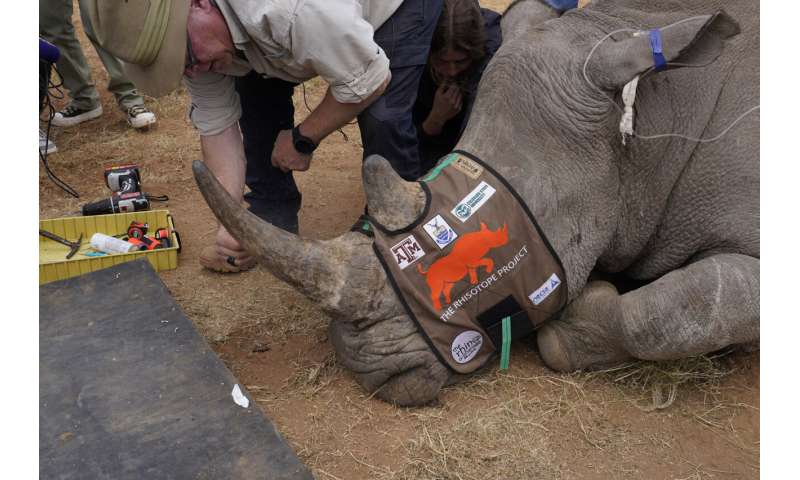
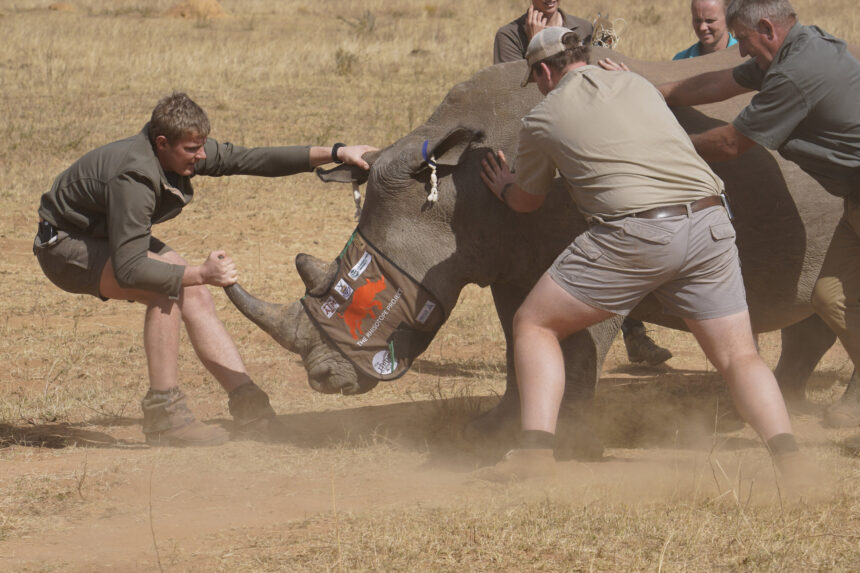
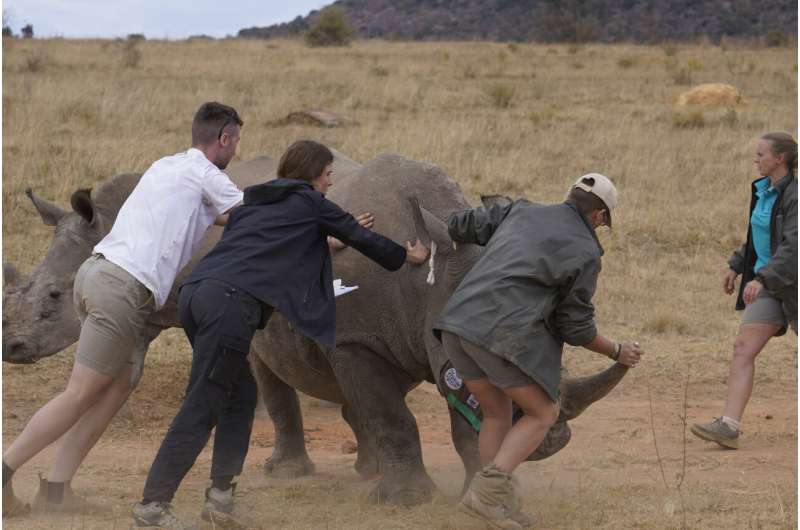
A sedated rhino is prepared to be tranquilized, before a hole is drilled into its horn and isotopes carefully inserted, at a rhino orphanage in the country’s northern province of Limpopo, Tuesday, June 25, 2024. Researchers have started the final phase of a research project aimed at reducing rhino poaching by inserting radioisotopes into rhino horns to devalue one of the most highly trafficked wildlife commodities. Credit: AP Photo/Denis Farrell

Researchers in South Africa have injected radioactive material into the horns of 20 rhinos as part of a research project aimed at reducing poaching.

The idea is that radiation detectors already in place at national borders would detect the horns and help authorities arrest poachers and traffickers.

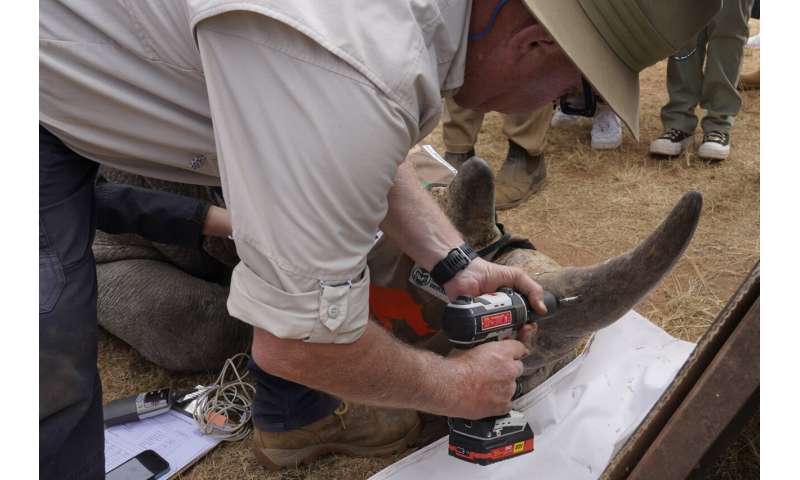
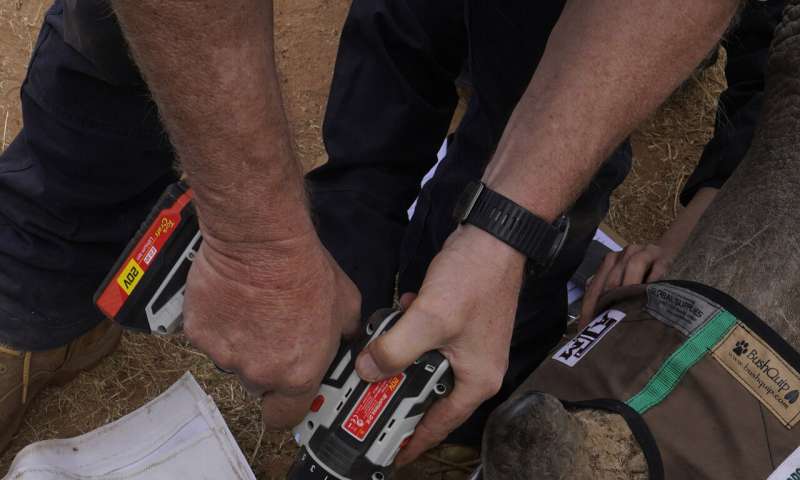
The research, which has included the participation of veterinarians and nuclear experts, begins with the animal being tranquilized before a hole is drilled into its horn and the nuclear material carefully inserted. This week, researchers at the University of the Witwatersrand ‘s Radiation and Health Physics Unit in South Africa injected 20 live rhinos with these isotopes. They hope the process can be replicated to save other wild species vulnerable to poaching—like elephants and pangolins.

“We are doing this because it makes it significantly easier to intercept these horns as they are being trafficked over international borders, because there is a global network of radiation monitors that have been designed to prevent nuclear terrorism,” said Professor James Larkin, who heads the project. “And we’re piggybacking on the back of that.”

According to figures by the International Union for Conservation of Nature, an international conservation body, the global rhino population stood at around 500,000 at the beginning of the 20th century. It now stands at around 27,000 due to continued demand for rhino horns on the black market.
South African researchers test use of nuclear technology to curb rhino poaching
A sedated rhino is prepared to be tranquilized, before a hole is drilled into its horn and isotopes carefully inserted, at a rhino orphanage in the country’s northern province of Limpopo, Tuesday, June 25, 2024. Researchers have started the final phase of a research project aimed at reducing rhino poaching by inserting radioisotopes into rhino horns to devalue one of the most highly trafficked wildlife commodities. Credit: AP Photo/Denis Farrell

South Africa has the largest population of rhinos with an estimated 16,000, making it a hotspot with over 500 rhinos killed yearly.

The country experienced a significant decline in rhino poaching around 2020 at the height of the COVID-19 pandemic, but the numbers increased when virus lockdown restrictions were eased.

“We’ve got to do something new and something different to reduce poaching. You know, you’ll see the figures they’ve already started going up,” said Larkin. “During COVID, they all went down but post COVID we are now starting to see those numbers go up again.”

While the idea has received support from some in the industry, the researchers have had to jump many ethical hurdles posed by critics of their methodology.

Pelham Jones, chairperson of the Private Rhino Owners Association, is among the critics of the proposed method and doubts that it would effectively deter poachers and traffickers.

  • South African researchers test use of nuclear technology to curb rhino poaching
    Professor James Larkin drills a hole into a rhinos horn to insert isotopes at a rhino orphanage in the country’s northern province of Limpopo, Tuesday, June 25, 2024. Researchers have started the final phase of a research project aimed at reducing rhino poaching by inserting radioisotopes into rhino horns to devalue one of the most highly trafficked wildlife commodities. Credit: AP Photo/Denis Farrell
  • South African researchers test use of nuclear technology to curb rhino poaching
    Professor James Larkin drills a hole into a rhinos horn to insert isotopes at a rhino orphanage in the country’s northern province of Limpopo, Tuesday, June 25, 2024. Researchers have started the final phase of a research project aimed at reducing rhino poaching by inserting radioisotopes into rhino horns to devalue one of the most highly trafficked wildlife commodities. Credit: AP Photo/Denis Farrell
  • South African researchers test use of nuclear technology to curb rhino poaching
    Professor James Larkin performs a procedure where isotopes are placed into a rhino’s at a rhino orphanage in the country’s northern province of Limpopo, Tuesday, June 25, 2024. Researchers have started the final phase of a research project aimed at reducing rhino poaching by inserting radioisotopes into rhino horns to devalue one of the most highly trafficked wildlife commodities. Credit: AP Photo/Denis Farrell

“(Poachers) have worked out other ways of moving rhino horn out of the country, out of the continent or off the continent, not through traditional border crossings,” he said. “They bypass the border crossings because they know that is the area of the highest risk of confiscation or interception.”

Professor Nithaya Chetty, dean of the science faculty at Witwatersrand, said the dosage of the radioactivity is very low and its potential negative impact on the animal was tested extensively.

© 2024 The Associated Press. All rights reserved. This material may not be published, broadcast, rewritten or redistributed without permission.

Citation:
South African researchers test use of nuclear technology to curb rhino poaching (2024, June 29)
retrieved 30 June 2024
from https://phys.org/news/2024-06-south-african-nuclear-technology-curb.html

This document is subject to copyright. Apart from any fair dealing for the purpose of private study or research, no
part may be reproduced without the written permission. The content is provided for information purposes only.


Sign Up For Daily Newsletter

Be keep up! Get the latest breaking news delivered straight to your inbox.

By signing up, you agree to our Terms of Use and acknowledge the data practices in our Privacy Policy. You may unsubscribe at any time.
Share This Article
Facebook Copy Link Print
Share
Previous Article Snapshot 2024 06 29t081611.817.jpg CIA Robotics Academy inspires Atlanta students in week-long STEM extravaganza
Next Article Urlhttp3a2f2fnpr Brightspot.s3.amazonaws.com2fa82f082f1a81ece04d24a6915409f73da3b52fkentucky Cannabis Company Hemp.png Medical cannabis application period for Kentucky businesses begins Monday
Leave a Comment Leave a Comment

Leave a Reply Cancel reply

Your email address will not be published. Required fields are marked *

Stay Connected

FacebookLike
XFollow
InstagramFollow
- Advertisement -
Ad imageAd image

Latest News

Instinct and preparation: Behind Atlanta’s momentum-shifting steals
Atlanta
May 23, 2026
Inside Hesty’s Pregnancy Journey – Denver Zoo Conservation Alliance
Denver
May 23, 2026
Los Angeles Sparks vs. Las Vegas Aces: Defending champs look to extend four-game winning streak
Los Angeles
May 23, 2026
Montgomery College will remain a Hispanic-Serving Institution regardless of federal funding cuts
Education
May 22, 2026

Advertise

  • Advertise With Us
  • Terms and Conditions
  • Privacy Policy
  • About Us
  • Contact

HispanicBusinessTV is your go-to source for the latest in Latino lifestyle, culture, and business news. Stay informed and inspired with our comprehensive coverage and in-depth stories.

Quick links

  • Advertise With Us
  • Terms and Conditions
  • Privacy Policy
  • About Us
  • Contact

Top Categories

  • Business
  • HBTV Sports
  • Entertainment
  • Culture

Sign Up for Our Newsletter

Subscribe to our newsletter to get our newest articles instantly!

© 2025 HispanicBusinessTV.com All Rights Reserved. A WooWho Network Digital Property.
Join Us!
Subscribe to our newsletter and never miss our latest news, podcasts etc..

Zero spam, Unsubscribe at any time.
Welcome Back!

Sign in to your account

Username or Email Address
Password

Lost your password?